
Entering the Chinese market requires decisive action, but moving too fast on your foundational corporate structure can lead to million-dollar mistakes. When establishing a Wholly Foreign-Owned Enterprise (WFOE), one of the very first decisions you must make is determining the ultimate WFOE shareholder: will it be you as an individual, or a corporate holding company?
With the strict enforcement of the newly revised PRC Company Law in 2026, the legal and financial liabilities tied to your shareholder choice have never been higher. The days of treating a WFOE as a simple, low-risk shell are over. Today, choosing the wrong entity type can result in excessive tax burdens, blocked profit repatriation, and severe personal asset exposure. Let us compare the two structural pathways in depth so you can secure your assets, maintain compliance, and maximize your operational agility in the modern Chinese commercial landscape.
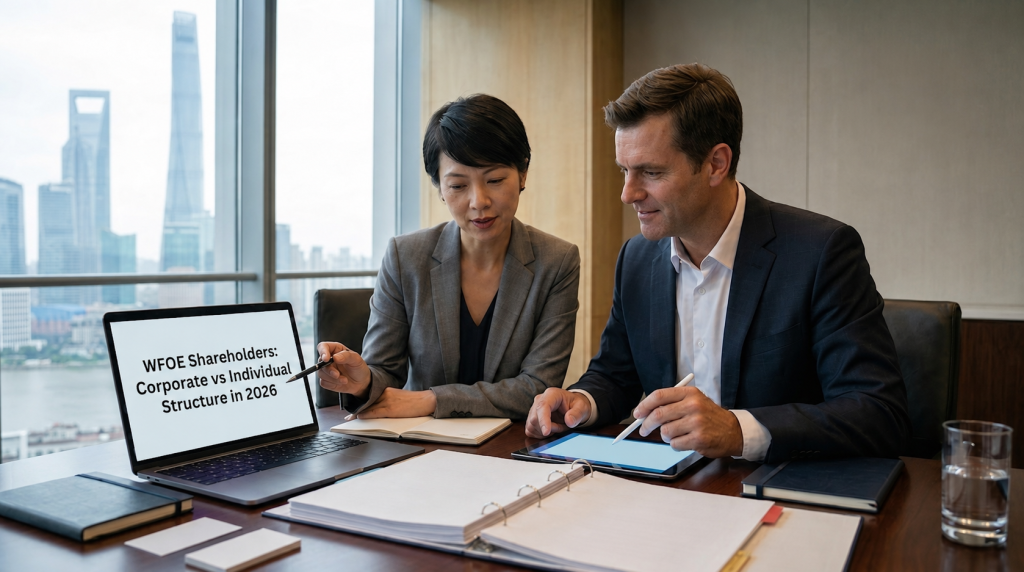
Core Comparison: Individual vs. Corporate Shareholder
| Feature | Individual Shareholder | Corporate Shareholder (Holding Co.) |
| Setup Speed | Slightly faster; requires less initial offshore paperwork. | Takes longer if a new offshore entity must be created first. |
| Dividend Tax | Usually subject to a standard 20% withholding tax. | Can be reduced to 5% or 10% utilizing Double Tax Treaties. |
| Risk Isolation | Poor. Business debts can trigger accelerated capital calls against personal assets. | Excellent. The corporate veil protects the ultimate individual owners. |
| Financing & Scaling | Difficult to issue equity to new investors without triggering China local taxes. | Highly flexible. Issue new shares at the holding company level offshore. |
| Exit Strategy | Highly complex equity transfer in China, subject to high local taxes and audits. | Simple. Sell the offshore holding company shares without Chinese bureaucratic hurdles. |
The 2026 Capital Injection Reality
Before diving into the specific shareholder types, we must address the elephant in the room: the 2026 PRC Company Law updates. The most critical change is the strict mandate that registered capital must be fully injected into the WFOE within five years of its establishment.
In the past, foreign investors could declare a massive registered capital amount and delay the actual cash transfer indefinitely. Now, the capital commitment is a hard legal liability. Furthermore, if the WFOE is unable to pay its due debts, creditors have the legal right to demand the accelerated injection of your subscribed capital. This new reality drastically changes the risk profile of who—or what—should officially own your Chinese company.
The Trap of the Individual Shareholder
On the surface, registering yourself as the direct individual shareholder of a WFOE seems appealing. It is straightforward, requires fewer documents to be translated and notarized at the Chinese embassy, and avoids the immediate cost of setting up an offshore company. However, for serious B2B operations and multinational expansions, it is widely considered a strategic trap.
The primary disadvantage is the severe tax inefficiency. When your WFOE generates a profit and you wish to repatriate those dividends back to your home country, individual shareholders are almost always hit with a flat 20% Withholding Income Tax (WHT) by the State Taxation Administration.
More importantly, combining the individual shareholder structure with the 2026 capital rules creates a dangerous scenario. If the WFOE encounters a debt crisis before your 5-year capital is fully paid, creditors can legally force you to accelerate your capital injection, pulling funds directly out of your private bank account. Additionally, transferring shares as an individual triggers an arduous bureaucratic process within mainland China, requiring you to navigate local tax bureaus, banks, and the State Administration for Market Regulation (SAMR), often stalling urgent M&A decisions for months.
The Strategic Advantage of a Corporate Shareholder (SPV)
The gold standard for multinational corporations, tech firms, and savvy entrepreneurs is to establish a Special Purpose Vehicle (SPV)—often a holding company in Hong Kong, Singapore, or another favorable jurisdiction—to act as the direct, 100% shareholder of the Shanghai WFOE.
This multi-layered WFOE Shareholder Structure offers unparalleled financial defense and operational flexibility.
1. Maximizing Profit Repatriation:
If your holding company is in a jurisdiction with a favorable Double Tax Treaty with China (such as Hong Kong), the dividend withholding tax can be legally slashed from 20% down to 5%, provided the holding company meets the “beneficial owner” criteria. For a WFOE generating millions in RMB, this single structural decision translates to massive, immediate capital savings.
2. Absolute Risk Isolation:
A corporate shareholder provides a crucial liability firewall. If the WFOE faces unexpected debts or liquidation challenges under the 2026 laws, the liability stops at the holding company. Your personal assets remain completely insulated from the operational risks of the mainland entity.
3. Frictionless Mergers & Acquisitions (The Exit Multiplier):
Consider a scenario where a larger competitor wants to acquire your Chinese operations. If you are an individual shareholder, the buyer must purchase the shares directly in China. This triggers heavy local taxes, extensive financial audits, and weeks of bureaucratic approvals.
However, with a corporate shareholder, you do not need to alter the WFOE’s registration in mainland China at all. You simply sell the shares of your Hong Kong or Singapore holding company to the buyer. The WFOE continues operating without disruption, the local staff remain unaffected, and the transaction happens entirely under a fast, business-friendly offshore tax jurisdiction.
Build a Resilient Corporate Architecture
The optimized 2026 regulatory environment rewards companies that prioritize strategic foresight. While setting up a corporate shareholder requires slightly more initial investment and planning, it is the only viable path for businesses aiming to secure B2B contracts, scale rapidly, and eventually exit with maximum profit.
At FDI China, our legal and financial experts do more than process standard registrations; we architect secure pathways for your capital. Whether you need to establish a new overseas holding company from scratch, restructure your existing assets, or register your new WFOE under a complex corporate structure, our professional consultants handle the end-to-end bureaucracy. Contact our expert team today to design a 2026 market entry strategy that protects your profits and positions you for long-term corporate success.