
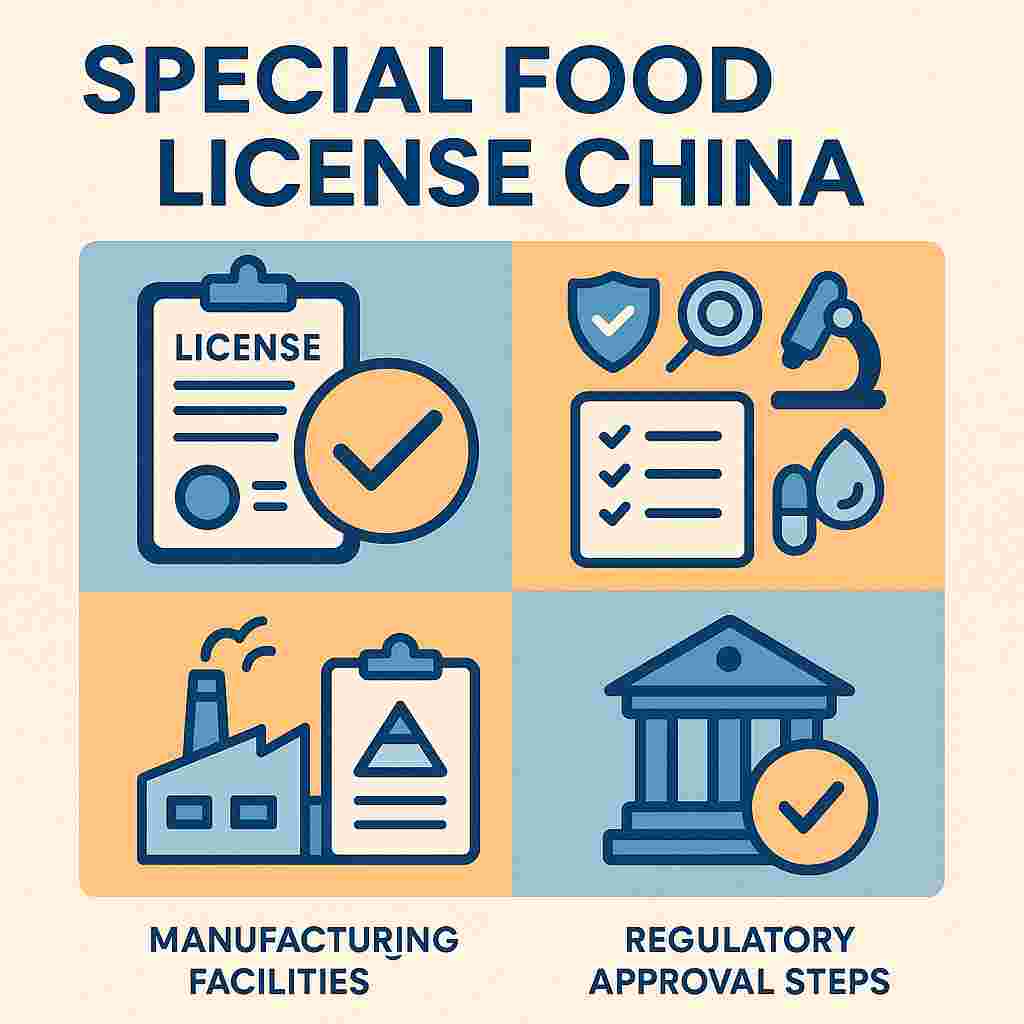
Special food license China is a mandatory regulatory approval required for companies selling “special foods” in the Chinese market. Special foods include health foods, infant formula, foods for special medical purposes (FSMP), and nutrient supplements. Because these foods directly affect public health, China enforces one of the world’s most comprehensive and strict regulatory systems. Companies must therefore understand all special food license China requirements, registration procedures, documentation rules, and long-term compliance obligations to avoid penalties, delays, or failed market entry.
To guide foreign manufacturers and importers, this article explains the complete approval pathway—from product testing and dossier preparation to regulatory submissions, inspections, renewals, and post-market compliance. With proper planning, companies can secure the special food license China successfully and maintain long-term distribution rights.
- Regulatory definition of special foods in China
- Special food license China requirements
- Health food registration and filing procedures
- Infant formula registration requirements
- FSMP license approval and testing
- Labeling, claims, and advertising compliance
- Post-market surveillance and reporting obligations
- Foreign manufacturer responsibilities
- Common pitfalls and inspection risks
- Best practices for successful market entry
Understanding China’s Special Food Regulatory System
China divides food products into “general foods” and “special foods.” Special foods include health foods, infant formula products, and FSMP. The State Administration for Market Regulation (SAMR) oversees licensing, while the National Medical Products Administration (NMPA) supervises testing and product claims. Because special foods are often consumed by vulnerable groups, China’s regulatory system is much stricter than many international frameworks. Companies entering China usually consult global references from institutions such as the International Organization for Standardization and public-health guidelines issued by the World Health Organization, although China-specific approvals remain mandatory.
Special Food License China Requirements
Special food license China requirements include product technical dossier preparation, stability testing, safety evaluation, functional claim verification, ingredient compliance, and production-site inspections. Manufacturers must also prove that their factories meet Good Manufacturing Practice (GMP) standards. For imported products, the overseas factory must be registered with Chinese regulators, and all raw materials must comply with China’s positive lists and food-safety standards.
Documentation inconsistencies are one of the most common causes of rejection. Companies must maintain consistency across product labels, formulations, testing reports, and imported batch records. Additionally, labels must comply with China’s mandatory standards and must not contain misleading claims.
Long-Tail Keyword: Special Food License China Requirements
Depending on the product type, special food license China requirements may also include product-specific clinical data, nutrition evaluations, functionality evidence, allergen identification, and contamination testing reports. Foreign companies must ensure these documents match Chinese regulatory templates to avoid rework or delays.
Health Food Registration and Filing Procedures
Health foods in China require either “registration” or “filing.” Imported health foods must undergo registration, meaning the government conducts a full technical evaluation. The process includes product testing, toxicology review, ingredient compliance validation, and claim verification. Because health-food claims are tightly regulated, authorities often request additional data to confirm safety and functional evidence. Manufacturers importing vitamins or supplements must check China’s health-food catalog and permitted claims list before filing.

Long-Tail Keyword: China Special Food Import Compliance
Companies performing China special food import compliance must also implement traceability systems covering batch numbers, supplier data, expiration dates, storage conditions, and logistics temperature records. Regulators verify these systems during on-site inspections.
Infant Formula Registration Requirements
Infant formula (0–36 months) is the most strictly regulated category. All formulas—whether domestic or imported—must undergo SAMR registration. Companies must provide product formulation, R&D records, production processes, pesticide reports, heavy-metal tests, protein and nutrient specifications, and packaging materials documentation. Additionally, the production site must pass an on-site audit performed by Chinese inspectors. International comparison reviews are sometimes referenced through organizations such as the EU Food Safety Authority, but China-specific review remains the legal requirement.
FSMP License Approval Procedures
Foods for special medical purposes (FSMP) require stringent testing, clinical-use evidence, medical-nutrition data, and stability assessments. Companies must submit detailed documentation on formulation design, production controls, contamination prevention, and nutrient effectiveness. FSMP includes formulas for people with metabolic or digestive disorders, so authorities demand extensive safety evidence.
Long-Tail Keyword: China FSMP Licensing Procedure
The China FSMP licensing procedure includes clinical-support documents, factory inspection, nutrient stability reports, microbiological testing, and packaging-safety verification. Renewal cycles also require updated labels and compliance declarations.
Labeling, Claims, and Advertising Compliance
China prohibits misleading claims, unverified medical benefits, and unauthorized functional descriptions. Special foods must follow stringent labeling rules, including nutrient tables, usage instructions, target demographic statements, allergen notices, and mandatory Chinese labeling. Claims must be scientifically supported and consistent with regulatory guidance.
Foreign Manufacturer Responsibilities
Foreign manufacturers must ensure GMP certification, batch integrity, raw-material traceability, and accurate production-site documentation. Exporters must also maintain compliance with customs procedures for imported special foods. Many companies rely on guidance such as FDI China’s China Market Entry Guide when planning long-term operations and compliance management.
Post-Market Surveillance, Reporting, and Renewals
After receiving the special food license China, companies must participate in post-market surveillance programs. They must report adverse events, perform annual reviews, update documentation when formulations change, and renew licenses as required. Authorities may conduct unannounced inspections to verify claim accuracy, storage safety, and shelf-life integrity. Products must always match the specifications originally approved.
Long-Tail Keyword: China Special Food Registration Update
If a manufacturer modifies formulations, packaging, or production processes, a China special food registration update must be filed. Unreported changes can result in license revocation.
Common Pitfalls and How to Avoid Them
Frequent reasons for rejection include inconsistent documentation, incomplete testing reports, unverified claims, incorrect labels, or lack of traceability. Businesses must therefore perform internal compliance audits, verify ingredient lists, validate claims, and keep updated technical dossiers to avoid interruptions during the special food license China review.
Conclusion
The special food license China system protects consumers by enforcing rigorous standards for safety, accuracy, and scientific validity. Companies that prepare complete documentation, validate claims, maintain transparent traceability systems, and comply with China-specific regulations can successfully register special foods and expand into China’s fast-growing health-nutrition market.