
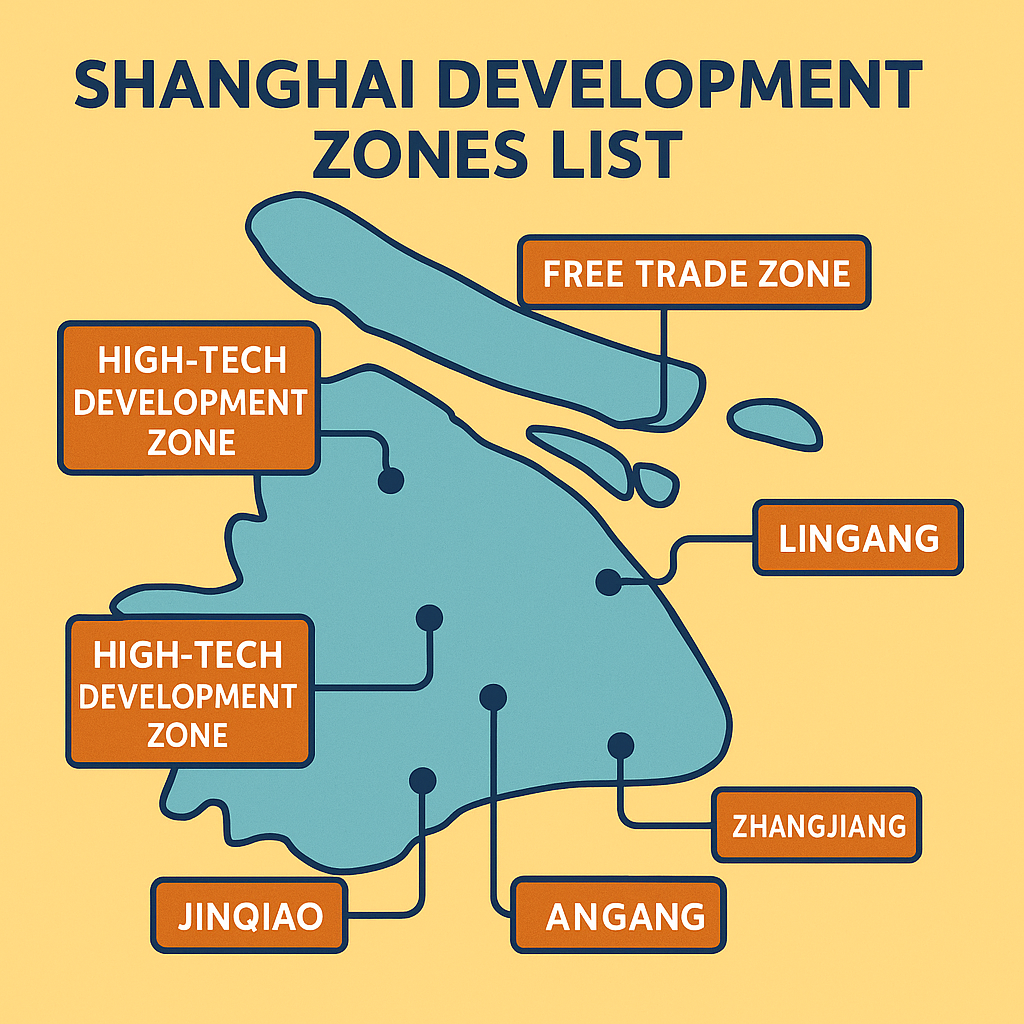
Shanghai Development Zones List provides a strategic blueprint for foreign investors evaluating where to establish operations, expand production, build R&D capabilities, or launch headquarters in China’s most internationalized commercial hub. With world-class infrastructure, liberalized trade rules, and high-tech industrial clusters, Shanghai’s development zones play a central role in attracting FDI and accelerating China’s advanced manufacturing and service-sector transformation.
- Overview of the Shanghai Development Zones List and zone classifications
- Shanghai FTZ and Lingang New Area advantages
- Zhangjiang Hi-Tech Park and biomedicine cluster strengths
- Jinqiao Development Zone for advanced manufacturing
- Hongqiao International Open Hub opportunities
- Waigaoqiao Free Trade Logistics Zone
- Pudong Airport Comprehensive Bonded Zone
- Preferential policies, tax benefits, and industrial incentives
- Compliance, registration, and regulatory considerations
- FDI insights for choosing the right Shanghai development zone
Understanding the Shanghai Development Zones List
The Shanghai Development Zones List comprises national-level development zones, pilot free trade zones, high-tech industrial parks, bonded zones, and municipal industrial clusters. These zones are designed to support key sectors such as semiconductors, artificial intelligence, biomedicine, new energy vehicles, aerospace, logistics, and financial and professional services.
Shanghai’s zone development aligns with international competitiveness indicators monitored by organizations such as the UNCTAD investment competitiveness reports and economic performance benchmarks discussed in the World Bank business enabling environment framework.
Shanghai Pilot Free Trade Zone (FTZ)
The Shanghai FTZ, China’s first free trade zone, offers market access advantages, simplified customs processes, and more flexible foreign investment rules. The FTZ supports cross-border trade, financial innovation, and professional service industries.
- Faster customs clearance
- Cross-border financial reform pilots
- Relaxed foreign investment restrictions in selected industries
- Streamlined business registration and licensing
The FTZ continues to align with global trade principles analyzed in WTO trade modernization discussions.
Lingang New Area
Lingang is the most advanced and fastest-growing zone on the Shanghai Development Zones List, positioned as the engine of high-end manufacturing and strategic emerging industries. Key sectors include:
- Aerospace engineering
- New energy vehicle (NEV) manufacturing
- Semiconductors and integrated circuits
- Hydrogen energy
- New materials and intelligent equipment
Lingang is also home to globally recognized manufacturers and supply-chain leaders participating in international policy trends described in OECD industrial development insights.
Zhangjiang Hi-Tech Park
Zhangjiang is Shanghai’s “Silicon Valley,” focusing on biomedicine, pharmaceuticals, artificial intelligence, and integrated circuits. Its research intensity, talent concentration, and advanced laboratories make it one of the most competitive science parks in China.
Jinqiao Economic and Technological Development Zone
Jinqiao supports high-end equipment manufacturing, green mobility, robotics, and intelligent manufacturing. Foreign companies in auto components, EV supply chains, and industrial automation frequently select Jinqiao for production and R&D investments.
Hongqiao International Open Hub
Hongqiao is a service-sector hub integrating corporate headquarters, supply-chain operations, international trade exhibitions, and cross-border professional services. Its proximity to Hongqiao Airport and the National Exhibition Center (CIIE venue) amplifies its strategic value.
Waigaoqiao Free Trade Logistics Zone
Waigaoqiao focuses on bonded warehousing, distribution, and trade logistics. Companies engaged in global supply-chain management, import-export, or e-commerce fulfillment often choose this zone for optimized customs operations.
Pudong Airport Comprehensive Bonded Zone
This bonded zone integrates air logistics, high-value manufacturing, automated warehousing, and international cargo distribution. It is essential for companies with time-sensitive or temperature-sensitive supply-chain needs.
Preferential Policies and Incentives for Foreign Investors
The Shanghai Development Zones List includes zones that offer:
- Reduced corporate tax in eligible industries
- Talent subsidy programs
- R&D expense super deductions
- Import tariff exemptions for equipment
- Cross-border fund flow facilitation
These incentives vary by zone and align with industrial upgrading priorities outlined in ISO innovation and quality frameworks.
Regulatory and Compliance Considerations
Each development zone has its own administrative body, approval timelines, and documentation standards. Foreign companies must ensure registration, licensing, tax classification, and customs filings align with zone-specific requirements. Many investors use structured guidance such as FDI China’s China Company Setup Guide to avoid errors during zone selection and company registration.
H3 Checklist: How to Choose the Right Zone
- Does the zone align with your industry cluster?
- Are you eligible for zone-specific incentives?
- Does your supply chain require a bonded zone?
- Is talent concentration critical for your expansion?
- Does proximity to a port, airport, or R&D hub matter?
FDI Insight: Selecting the Best Zone for Your Strategy
The Shanghai Development Zones List is diverse, and each zone suits different operational models. High-tech companies may prefer Zhangjiang; advanced manufacturing fits Jinqiao or Lingang; global logistics firms choose Waigaoqiao or the Airport Bonded Zone; while service companies often locate in Hongqiao.
Conclusion: Shanghai Remains China’s Most Strategic Platform for Global Investors
The Shanghai Development Zones List highlights the city’s role as an international gateway that blends market access, innovation, logistics, and regulatory transparency. By matching your industry with the right development zone, you can unlock incentives, reduce setup time, and gain a long-term competitive edge in the world’s most dynamic business environment.