
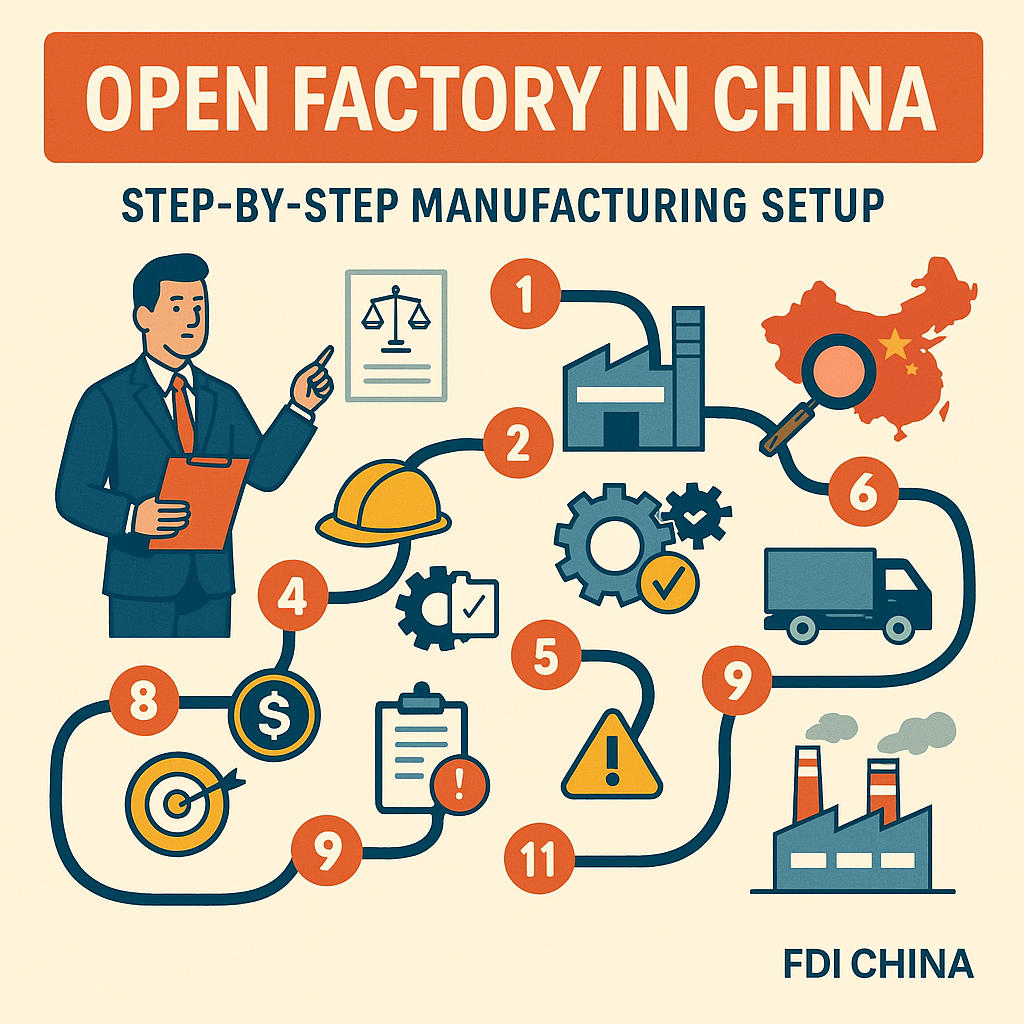
Open factory in China is a strategic move that can transform your business’ global footprint. But doing it right means navigating entity registration, factory site selection, supply-chain logistics, compliance and staffing. This guide gives you the full blueprint.
Why “open factory in China” remains highly relevant in 2025
Despite rising costs and supply-chain shifts, China continues to offer unmatched scale, industrial depth and access to global buyers. As a 2025 strategic shift, more foreign firms are choosing to open factory in China not just for exports, but for the domestic market and integrated supply services. Experts note that setting up a manufacturing facility in China now demands full planning—from planning to production.
Legal entity types and manufacturing registration steps
Before you can manufacture, you’ll need a legal vehicle. Foreign investors typically choose a Wholly Foreign-Owned Enterprise (WFOE) or a manufacturing JV. The registration process involves name approval, business licence, environmental assessment, company registration, tax & customs filings.
Key steps include:
- Business licence from State Administration for Market Regulation (SAMR)
- Environmental Impact Assessment (EIA) for manufacturing projects
- Local approvals for heavy manufacturing in certain zones
- Opening corporate RMB accounts, filing with tax, customs
Site selection criteria, industrial parks and cost models
Choosing the right location is critical when you decide to open factory in China. You’ll evaluate lease/land cost, utilities, logistics access, labour pool, incentives and FTZ (Free Trade Zone) status.
Considerations:
- Industrial parks often offer preferential land leases and tax incentives
- Regions like Guangdong, Jiangsu and Chongqing have mature ecosystems
- Land-use permits and infrastructure readiness vary widely
- Cost model should include utilities, transport, duties, warehousing
Labour, wages and local workforce management
When you open factory in China, managing labour efficiently is a key cost driver. China’s labour pool remains strong, but wage inflation and social insurance requirements increase overheads.
Labour insights:
- Compare wage levels in coastal vs inland zones
- Mandatory social insurance + housing fund contributions
- Local hiring and labour‐contract rules apply
- Training, retention and quality management influence output
Manufacturing process setup, equipment sourcing and quality control
Having a factory means sourcing equipment, setting up production lines and ensuring quality. To open factory in China successfully you’ll need to integrate sourcing, supplier networks and quality systems.
Important areas:
- Machinery import duty vs local sourcing decisions
- Quality control protocols aligning with global standards
- Supplier network proximity reduces lead times and cost
- Continuous improvement culture essential for scale
Environmental, health & safety compliance obligations
Manufacturing in China comes with strong HSE (health, safety, environment) obligations. If you plan to open factory in China you must meet local regulations on waste, emissions, safety, worker welfare and reporting.
Compliance checklist:
- EIA submission and local department approval
- Ongoing monitoring & local inspections Harris Sliwoski LLP
- Waste management licences, safety training, factory audits
- Align with CSR and ESG frameworks (global buyers expect this)
Supply-chain integration and export logistics
Manufacturers looking to open factory in China benefit from integrated supply-chains, ports and logistics infrastructure. Export from a Chinese factory is often efficient, but internal logistics and customs still matter.
Logistics advantages:
- Supplier clusters reduce procurement cost
- Multimodal transport (road, rail, sea) access
- Export-efficient zones in coastal provinces
- Bonded warehousing, FTZs can optimize costs and duties
Cost, timeline and ROI benchmarks
| Stage | Typical timeline | Cost drivers | Notes |
|---|---|---|---|
| Site & lease negotiation | 4–12 weeks | Land cost, utilities, local incentives | Inland sites cheaper but may lack infrastructure |
| Entity registration & licensing | 6–14 weeks | Legal fees, documentation, local approvals | Manufacturing entities need more approvals QualityInspection.org |
| Equipment installation & commissioning | 8–20 weeks | Machinery cost, import duties, installation, training | Phased rollout reduces risk |
| Break-even timetable | 12–24 months | Volume ramp-up, labour productivity, input cost | Trade war/back-shoring risk must be factored |
Common pitfalls and risk mitigation strategies
When you open factory in China, you face risks: regulatory delays, local partner issues, labour disputes, quality failures. Mitigation matters.
Key risk areas:
- Assuming all zones have same incentives — check local policy
- Underestimating environmental approvals — carve buffer time
- Not building local relationships — (often cited as major issue)
- Relying on a single supplier or region — diversify
- Currency & repatriation risks — RMB conversion, dividend rules
Use-case scenarios for foreign manufacturers
Scenario A: SME electronics brand
Use case: Open factory in China to serve domestic + ASEAN markets. Benefit: production cluster, logistics savings.
Scenario B: European automotive parts supplier
Use case: near coastal port, contract manufacturing for global OEMs. Choose area with export-oriented zone.
Scenario C: Luxury goods brand
Use case: light manufacturing, global export from China; here you might consider Hong Kong holding + China factory to open factory in China but route via Hong Kong parent.
FAQ for investors
Q: What entity type is required to open factory in China?
A: Usually a WFOE manufacturing company or JV, with full compliance.
Q: Can I open factory in China without local partner?
A: Yes, via WFOE in many sectors, though some industries still require JV.
Q: Is it cheaper now to open factory in China than 10 years ago?
A: Labour costs have risen, but ecosystem and incentives still make China competitive.
Q: How long before the factory starts production?
A: Typical timeline from planning to production is 6–12 months, depending on complexity and approvals.
If you’re planning to open factory in China, let us help streamline your setup—from entity formation to factory commissioning and supply-chain integration. For full support, visit FDI China.