
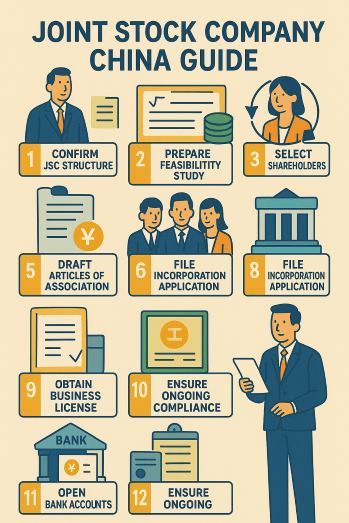
Joint stock company China registration is one of the most regulated corporate structures available to foreign investors. A Joint Stock Limited Company is the closest equivalent to a Western “corporation,” allowing equity to be divided into shares, held by multiple shareholders, and—under specific conditions—publicly issued or listed on Chinese stock exchanges. Compared with a typical Limited Liability Company (LLC), a joint stock company China structure has stricter capital requirements, a more complex governance model, mandatory board and supervisory systems, and enhanced disclosure obligations. Because of these regulatory complexities, foreign investors must thoroughly understand the legal requirements, suitability, and compliance expectations before setting up a joint stock company in China.
This comprehensive guide outlines how foreign companies can register a joint stock company China entity, key regulations they must follow, and 12 powerful steps to ensure a successful and compliant setup.
Below is a summary of what this guide covers:
- What a Joint Stock Company Is in China
- Who Should Choose a JSC Structure
- 12 Steps to Register a Joint Stock Company in China
- Capital, Governance, and Disclosure Requirements
- Common Challenges for Foreign Investors
What Is a Joint Stock Company China?
A joint stock company China entity is a company whose capital is divided into equal shares, and whose shareholders are liable to the company only to the extent of their subscribed shares. This structure supports multi-shareholder arrangements, institutional investment, and eventual listing on China’s stock exchanges.
JSCs in China must comply with the Company Law of the People’s Republic of China, under the regulatory oversight of the State Administration for Market Regulation (SAMR) and, in the case of public share issuance, the China Securities Regulatory Commission (CSRC).
Who Should Consider a Joint Stock Company China Structure?
Foreign investors typically use a JSC structure for:
- large-scale investment projects
- ventures requiring substantial capital injection
- businesses planning for eventual public listing
- corporate structures involving multiple shareholders
- institutional or private equity participation
If a business does not require complex governance or future listing, foreign investors often choose a WFOE (LLC) instead of a joint stock company China entity due to simpler compliance.
12 Powerful Steps to Register a Joint Stock Company China
The registration process for a joint stock company China structure is more complex than for an LLC and requires detailed planning, legal documentation, and multi-level regulatory approval.
1. Confirm That a JSC Structure Is Appropriate
Foreign investors should confirm industry restrictions under the foreign investment negative list published by the NDRC.
2. Prepare Feasibility Study and Business Plan
The government typically requires a detailed feasibility study explaining why a JSC structure is needed and how it will be capitalized.
3. Determine Registered Capital and Capital Contribution Plan
Historically, JSCs required a minimum capital of RMB 5 million. While the Company Law is more flexible today, large projects still need substantial capital for approval.
4. Select Shareholders and Allocate Shares
Foreign investors may act as sole shareholder or partner with Chinese shareholders. The allocation must reflect voting and governance intentions.
5. Draft the Articles of Association
The Articles must specify governance structure, shareholder rights, equity transfer rules, and profit distribution methods.
6. Appoint Board of Directors and Supervisory Board
A joint stock company China entity must have:
- a Board of Directors
- a Supervisory Board (or one supervisor)
- a legal representative
7. Submit Pre-Approval Applications
Depending on industry, pre-approvals may be required from sector regulators such as the Ministry of Finance, Ministry of Transport, or the National Health Commission (NHC).
8. File Incorporation Application With the AMR
All documents—including Articles, shareholder identity documents, feasibility study, and capital plan—must be filed with the AMR.
9. Obtain the JSC Business License
Once approved, the AMR issues a business license stating the company name, legal representative, business scope, registered capital, and shareholder information.
10. Complete Tax Registration
The company must register with the local tax bureau and comply with requirements published by the State Taxation Administration.
11. Open Bank Accounts and Capital Verification
Capital contributions must be deposited into a capital account and verified by a licensed accounting firm.
12. Conduct Ongoing Governance, Reporting, and Disclosure
JSCs must maintain strict governance, including:
- annual audit
- annual reporting to AMR
- financial disclosure obligations
- board meeting minutes and resolutions
Governance Requirements for a Joint Stock Company China
A joint stock company China structure must follow strict governance rules:
- Board of Directors responsible for strategy and operations
- Supervisory Board overseeing compliance and financial integrity
- Shareholder General Meeting as the highest authority
- Mandatory disclosures for shareholders, capital, and operations
Publicly listed JSCs must additionally comply with CSRC disclosure and listing rules.
Capital Requirements for a Joint Stock Company China
Capital contributions may be made in cash, technology, IP, or equipment. Foreign exchange rules require SAFE filings for cross-border contributions.
Minimum capital expectations are higher than for an LLC, especially for companies planning IPO in China’s Shanghai Stock Exchange, Shenzhen Stock Exchange, or Beijing Stock Exchange.
Compliance Requirements for a Joint Stock Company China
Foreign investors must follow:
- Company Law for governance
- SAMR procedures for registration changes
- CSRC rules for public offerings
- sector-specific regulations for restricted industries
- tax regulations for capital, revenue, and share transfers
For legal interpretations and regulatory updates, investors may refer to the Pkulaw legal database.
Common Challenges for Foreign Investors Registering a Joint Stock Company China
Foreign companies frequently encounter:
- high governance and compliance requirements
- complex board and supervisory obligations
- difficulties with capital verification
- industry approval delays
- regulatory differences across provinces
Despite these challenges, the JSC structure offers foreign investors access to large-scale financing, institutional partnerships, and long-term strategic flexibility.
For additional corporate setup support, refer to FDI China’s China Company Setup Guide.
Conclusion
Setting up a joint stock company China entity provides foreign investors with a powerful corporate structure suitable for large projects, high capital needs, and future listing ambitions. Although compliance requirements are stricter than for LLCs, a well-planned JSC structure offers scalability, credibility, and strong governance foundations. By following the 12 steps in this guide and complying with regulatory rules from SAMR, CSRC, MOFCOM, and tax authorities, foreign investors can establish a fully compliant and strategically sound joint stock company China structure.