
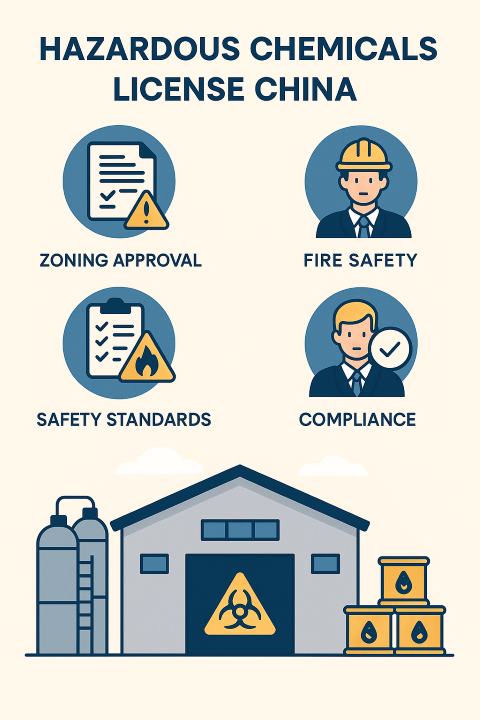
Hazardous chemicals license China is the critical legal approval that any company must secure before engaging in the production, storage, transportation, or distribution of hazardous substances within the country. Because hazardous chemicals may cause fires, explosions, toxic exposures, and large-scale environmental damage, China enforces one of the most comprehensive and strict licensing systems in the world. As a result, foreign investors must understand hazardous chemicals license China requirements, safety obligations, chemical classifications, environmental rules, and long-term compliance duties to operate legally and build a sustainable chemical-handling business in China.
To support investors, this article provides a detailed explanation of China’s regulatory system, licensing procedures, storage standards, environmental protection requirements, staff training, inspection rules, and risk-management strategies. Understanding these requirements is essential because hazardous chemicals license China approval affects every stage of a company’s operations and is closely monitored by national and provincial regulatory agencies.
- China’s hazardous chemical regulatory framework
- Hazardous chemicals license China requirements
- China dangerous goods licensing rules
- Hazardous materials permit China process
- Chemical storage and facility compliance
- Environmental protection and EIA reviews
- Safety personnel and training requirements
- Foreign investment limitations and business scope planning
- Reporting, inspections, and long-term supervision
- Common compliance challenges and risk-prevention strategies
China’s Regulatory Framework for Hazardous Chemicals
China’s supervisory system for hazardous chemicals is built on multiple national laws, including the Regulations on the Safety Management of Hazardous Chemicals, the Work Safety Law, and the Environmental Protection Law. Together, these laws regulate how hazardous materials must be labeled, stored, transported, documented, and managed. Additionally, the Emergency Management Bureau (EMB) oversees licensing, while the Ministry of Ecology and Environment (MEE) evaluates environmental risks. To understand global chemical-safety principles, companies often reference international guidelines from the International Organization for Standardization, the World Health Organization, and the EU Food Safety Authority. Although international standards are useful, China’s licensing system remains significantly stricter and more documentation-driven.
Hazardous Chemicals License China Requirements
Companies applying for the hazardous chemicals license China must satisfy a robust set of requirements. These include establishing a compliant business entity, defining hazardous chemical activities in their business scope, hiring certified safety professionals, implementing a safety-management system, and preparing emergency-response plans. Regulators will also verify that the facility has ventilation systems, spill-control devices, labeling systems, explosion-proof wiring, and fire-protection equipment that meet national standards. Without these essential components, a hazardous chemicals license China application cannot move forward and may be rejected during preliminary review.
Furthermore, companies must maintain detailed storage plans, classification files, material safety datasheets (MSDS), equipment inspection logs, and staff training documentation. Regulators also check zoning certificates to ensure that the chosen property is legally approved for hazardous chemical activities. Because of the high level of risk, hazardous chemicals license China requirements are enforced through strict on-site inspections and ongoing supervision.
China Dangerous Goods Licensing Rules
China dangerous goods licensing rules categorize chemicals into flammable liquids, compressed gases, corrosive substances, toxic materials, reactive compounds, and explosive precursors. Each group has unique requirements for storage distance, ventilation, temperature control, and documentation. Inspectors compare classification codes with national chemical catalogs and international guidance from the ISO and similar institutions. Misclassification may result in fines or delays in the hazardous chemicals license China approval process.
Hazardous Materials Permit China Process
The hazardous materials permit China process is long and detailed. Companies must complete several safety evaluations, environmental filings, administrative submissions, and on-site inspections. The main steps include business-scope verification, safety-risk assessments, environmental impact assessments (EIA), application submission, on-site inspections, and final approval. Because hazardous chemicals pose severe risks, the hazardous chemicals license China approval process includes multiple escalation layers, which may involve local, municipal, or provincial authorities depending on the chemical category and storage volume.
- Business scope confirmation: The company’s business license must explicitly include hazardous chemical activities.
- Safety evaluation: Certified agencies analyze structural safety, ventilation, equipment, and zoning compliance.
- Environmental impact assessment: MEE evaluates the ecological impact of chemical operations.
- Application submission: Companies upload facility blueprints, emergency plans, equipment certificates, and classification files.
- On-site inspection: Regulators check labeling, PPE availability, emergency exits, fire-control devices, and operational readiness.
- Final licensing: The hazardous chemicals license China is issued once all requirements are met.
Hazardous Chemicals License China Requirements During Inspections
Inspectors verify whether hazardous chemicals license China requirements are implemented in daily operations. They examine storage areas, anti-static flooring, temperature logs, spill-containment systems, ventilation, and forklift operations. They also review chemical-movement logs to ensure accurate and complete traceability.
Chemical Storage and Facility Compliance
China maintains strict rules for chemical storage to prevent reactions, contamination, fires, and structural hazards. Facilities must separate incompatible chemicals, maintain stable temperatures, and install explosion-proof equipment. Warehouses must be located in legally approved zones and include distance buffers from sensitive locations. Additionally, companies must maintain lighting systems, emergency-shower stations, and alarm systems that comply with Chinese safety codes.
China Chemical Storage Compliance
China chemical storage compliance also includes mandatory documentation. Companies must maintain purchase records, inventory logs, waste-disposal documents, compatibility charts, equipment inspection reports, and emergency-drill records. These documents help regulators confirm compliance with hazardous chemicals license China requirements during both scheduled and surprise audits.
Environmental Protection Requirements
Environmental protection obligations form a major part of the hazardous chemicals license China review. Facilities must install pollution-prevention systems, drainage-isolation structures, emissions-control devices, and hazardous-waste classification zones. For global comparison, companies examine environmental compliance frameworks published by the OECD. However, China’s environmental review system requires additional filings, especially when toxic chemicals or sensitive regions are involved.
Safety Personnel and Employee Training
China requires companies applying for the hazardous chemicals license China to employ qualified personnel. Safety managers, chemical technicians, and emergency responders must complete mandatory certification. Training must cover hazard identification, spill management, fire-control procedures, chemical classification, protective-equipment use, and emergency-response coordination. Training records must be maintained throughout the life of the business and reviewed during inspections.
Foreign Investment Restrictions and Business Scope
The Foreign Investment Negative List restricts some hazardous-chemical manufacturing activities. Although storage and distribution are generally open to foreign companies, some substance categories require joint ventures or may be prohibited. Businesses therefore review setup requirements through resources like FDI China’s China Market Entry Guide before planning operations. Misalignment between business scope and hazardous chemicals license China requirements leads to immediate rejection.
Reporting, Inspections, and Long-Term Supervision
After obtaining the hazardous chemicals license China, companies must maintain continuous compliance by submitting annual safety reports, conducting maintenance inspections, updating emergency plans, and maintaining chemical-movement logs. Authorities may also conduct unannounced inspections to review storage conditions, equipment functionality, labeling accuracy, and environmental protection measures. If companies modify facility layouts, change chemical categories, or increase storage quantities, they must file updates to maintain their hazardous chemicals license China.
Conclusion
The hazardous chemicals license China approval system protects public safety, environmental health, and industrial operations. By meeting regulatory requirements, preparing compliant facilities, hiring certified personnel, and maintaining detailed safety documentation, foreign investors can operate legally and confidently in China’s highly regulated chemical sector. With full compliance and continuous monitoring, companies reduce operational risks and build sustainable hazardous-chemical operations in the Chinese market.