Last Updated: March 2026 — This guide has been fully reviewed and updated to provide the most current information, insights, and best practices for 2026.
Food Production License China regulations determine how food manufacturers, importers, and processing facilities legally operate within China’s strictly governed food-safety ecosystem. These rules apply to foreign-invested companies as well, requiring businesses to understand licensing procedures, compliance obligations, inspection systems, risk controls, and documentation standards.
- Understanding the purpose and scope of the Food Production License China
- Key regulatory authorities supervising food manufacturing
- License categories and what businesses they apply to
- Application requirements for foreign-invested enterprises
- Step-by-step licensing and inspection procedure
- Documentation required for approval
- Compliance rules and HACCP-related obligations
- Tax and reporting considerations for food manufacturers
- Regulations for imported ingredients and equipment
- Common challenges and how to avoid rejections
Understanding the Food Production License China Framework
China’s food-production regulatory framework is built to ensure safety, traceability, and quality control. The Food Production License China system is overseen by national authorities that enforce standards across the supply chain. Manufacturers must align their processes with internationally recognized food-safety expectations, including microbiological controls, labeling accuracy, traceability management, and production-site hygiene.
To understand global regulatory alignment, companies may refer to standards outlined by the ISO food safety management framework as well as international guidelines curated by the World Health Organization.
Regulatory Authorities Overseeing Food Production
Multiple government bodies work together to regulate the Food Production License China process. These organizations are responsible for ensuring companies follow correct labeling, sanitation, process engineering, and hazard-control systems.
Authorities monitoring compliance include national standards agencies, customs regulators, and scientific bodies that maintain internationally aligned food-safety frameworks such as the European Commission Food Safety Platform.
License Categories Under the Food Production License China System
The license categories define exactly what production activities a company may legally perform. Categories may include beverage manufacturing, dairy processing, condiments, snack foods, imported pre-packaged foods, or food additives.
Primary Manufacturing License
Every facility conducting food processing must apply for a primary manufacturing license. Inspectors review the production area layout, ventilation system, wastewater controls, equipment calibration, protective gear, and overall hygiene conditions. Additional compliance tools can be found in global guidance such as FDA food safety recommendations.
Requirements for Foreign-Invested Food Manufacturers
Foreign-invested companies face the same regulatory requirements as domestic businesses but often require more detailed documentation. A Food Production License China approval requires operational legitimacy, demonstrable experience, and traceability systems that align with local and international safety expectations.
Foreign investors often rely on strategic resource hubs such as OECD global compliance guidelines when establishing corporate governance frameworks for China-based production sites.
Foreign companies expanding into China can reference essential setup procedures via this internal resource: FDI China’s company registration and compliance guide.
Step-by-Step Food Production License China Application Procedure
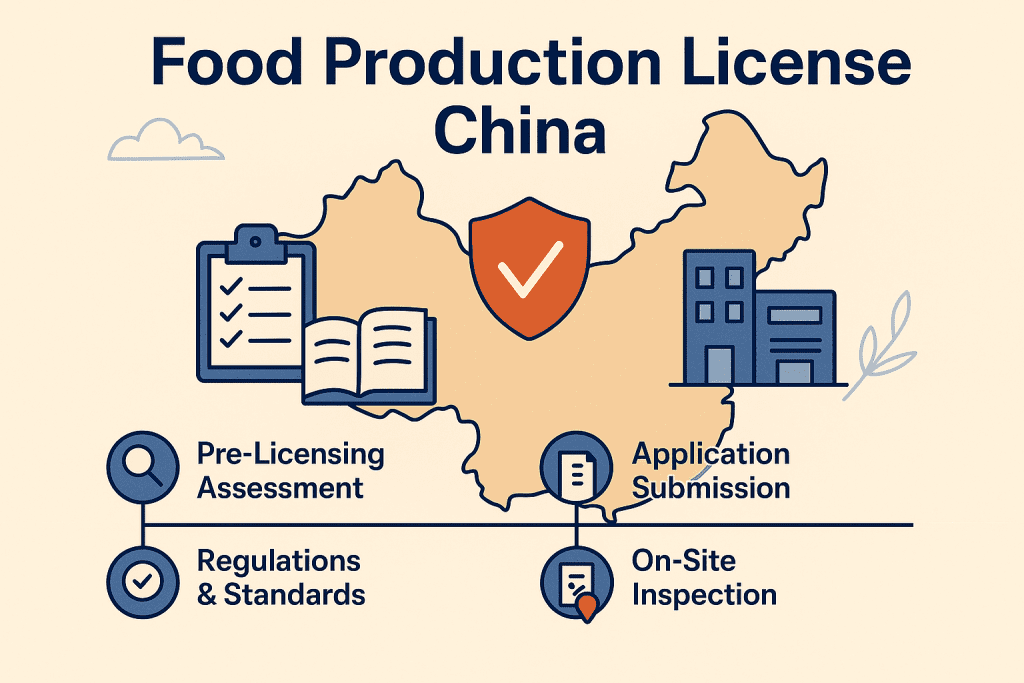
Obtaining approval requires completing registration, undergoing a preliminary review, receiving onsite inspection, and passing sampling checks. Afterward, businesses undergo continuous supervision through routine audits and spot inspections.
Documentation Required for Approval
The Food Production License China application requires various technical documents, including:
- Factory layout plans with production flow diagrams
- Sanitation control and disinfection protocols
- Equipment calibration logs
- Staff hygiene and training records
- Incoming raw-material inspection records
- Traceability and record-retention documentation
Compliance Rules and Inspection Standards
Inspection rules mandate thorough verification of hazard controls, cleanliness, and operational risk management. Companies must implement preventive controls equivalent to international frameworks curated by organizations such as GB Standards.
Tax and Reporting Considerations for Food Manufacturers
While preparing for licensing, companies must also factor in financial compliance. Topics such as China tax filing requirements, China VAT rules, China corporate tax rules, and foreign company tax in China play a direct role in cost planning for manufacturing operations. Facilities often integrate tax-compliance assessments into their annual reporting cycle to maintain full operational integrity.
Regulations for Imported Ingredients and Equipment
Businesses importing ingredients, machinery, or food additives must follow customs inspection rules enforced by agencies that set international trade benchmarks such as World Bank import evaluation guidelines.
Common Challenges in the Food Production License China Process
Applicants frequently experience issues such as incomplete documentation, insufficient sampling logs, poor sanitation design, lack of personnel training, or labeling inaccuracies. Another area of failure involves foreign manufacturers using overseas safety standards instead of local equivalents, which may not match China’s stringent requirements.
Market Outlook for Food Production Compliance in 2026
China’s food production regulatory environment continues evolving to match global standards. Manufacturers that prioritize compliance infrastructure, automation, traceability, and quality management systems are best positioned for long-term stability and market expansion.
Organizations that proactively upgrade compliance frameworks, conduct regular audits, and align with evolving global standards strengthen credibility and reduce regulatory risk. Because food safety remains one of the most strictly enforced areas of consumer protection, investments in proper licensing systems directly support brand reputation and operational continuity.
Conclusion
Obtaining a Food Production License China approval requires careful preparation, regulatory understanding, and ongoing operational discipline. Companies that follow international best practices, maintain transparent records, and adapt to inspection expectations benefit from streamlined approvals and stronger long-term performance in China’s vast and evolving food market.