
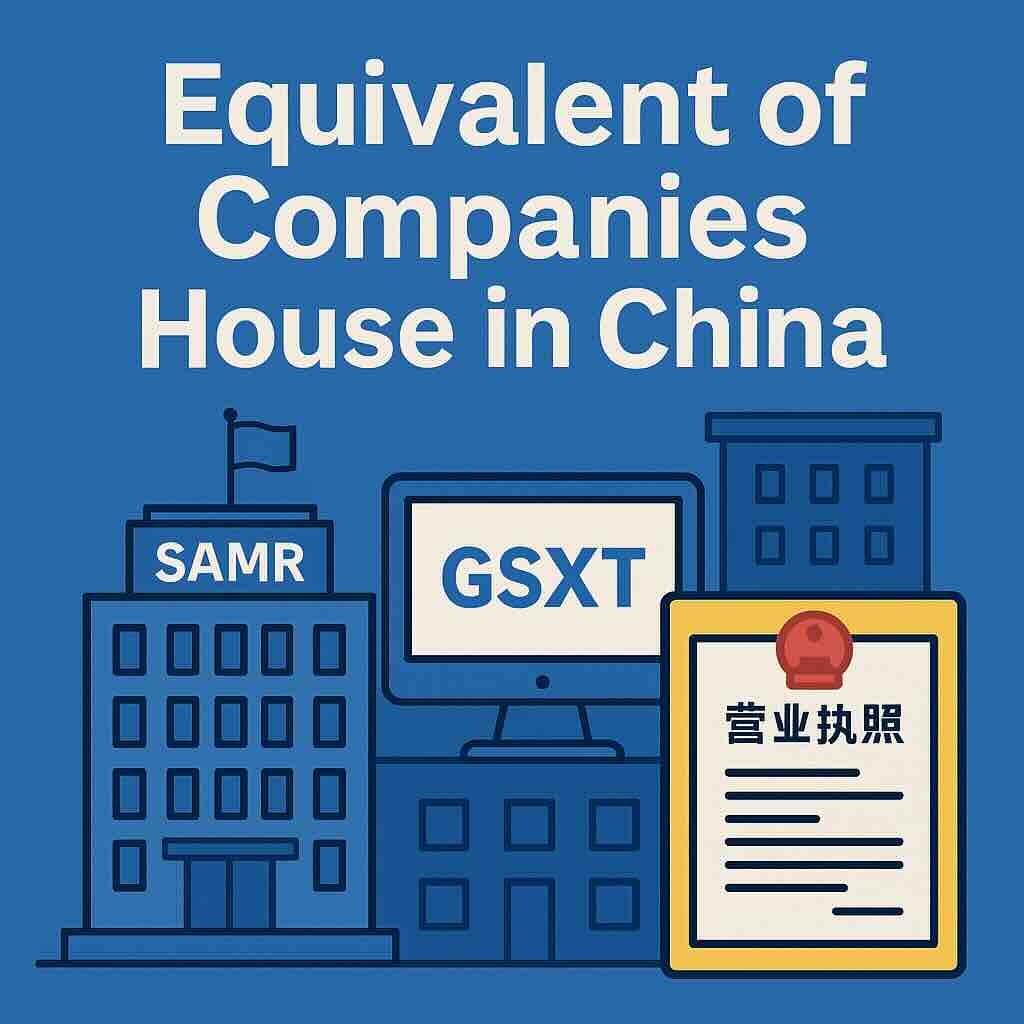
If you’re used to the UK and you’re researching China, the natural question is: what is the equivalent of Companies House in China? In practice, China’s closest equivalent of Companies House is the State Administration for Market Regulation (SAMR) together with its local market‑regulation bureaus and the online National Enterprise Credit Information Publicity System (NECIPS / GSXT), which hosts public company data. China Company Lookup
Understanding the equivalent of Companies House in China vs UK Companies House
To understand the equivalent of Companies House in China, it helps to start with the UK benchmark. Companies House is the UK government’s registrar of companies, responsible for incorporating companies and maintaining a public register of company information. Wikipedia
China doesn’t have a single agency branded like “China Companies House,” but the functional role is split between:
- SAMR at national level, which supervises and guides market‑entity registration across the country FDI China
- Local market‑regulation bureaus (often abbreviated “AMR”) that process day‑to‑day company registration
- GSXT / NECIPS, the National Enterprise Credit Information Publicity System, which is the public‑search platform for registered entities FDI China
So, the equivalent of Companies House in China is best seen as this combined architecture rather than a single legal entity.
SAMR as the national equivalent of Companies House in China
From a regulatory standpoint, the equivalent of Companies House in China at the top of the pyramid is SAMR (State Administration for Market Regulation):
- SAMR is responsible for supervising and guiding market‑entity registration nationwide under the Regulation on Market Entity Registration. FDI China
- It was created in 2018 by merging several agencies, including the old Administrations for Industry and Commerce (AICs), which older articles describe as the closest thing to a “China Companies House.” chinacheckup.com
- SAMR also oversees NECIPS / GSXT, the online system that publishes official company data. The US-China Business Council
So when someone asks for the “government body that’s the equivalent of Companies House in China,” SAMR is the answer at the national policy and oversight level.
Local AMRs as the operational equivalent of Companies House in China
The next layer in the equivalent of Companies House in China is the local market‑regulation bureaus (“AMRs”). They are the ones that foreign investors interact with during incorporation:
- The Regulation on Market Entity Registration explicitly states that local people’s governments and their market‑regulation departments are responsible for market‑entity registration within their jurisdictions. FDI China
- Cities such as Beijing direct investors to an enterprise registration e‑window where they handle name approval, incorporation and post‑registration formalities—this is the on‑the‑ground equivalent of going to Companies House in Cardiff or filing online. Beijing.gov.cn
In practice, when you set up a WFOE or JV, you deal with a district‑level or city‑level AMR, not SAMR’s Beijing headquarters. But these local bureaus are operating under SAMR’s unified rules.
If you’d like step‑by‑step support for incorporating with these AMR offices, FDIChina’s overview of China Company Registration breaks down the process by entity type and city.
GSXT / NECIPS as the search equivalent of Companies House in China
The public‑search equivalent of Companies House in China is the National Enterprise Credit Information Publicity System (NECIPS), often simply called GSXT:
- NECIPS is a centralized online platform run by SAMR that provides official company information, including registration status, legal representative, registered address, and unified social credit code (USCC). China Company Lookup
- Official and practitioner guides explain that foreign and Chinese users should use GSXT to verify whether a company actually exists and whether the Chinese name and registration number match what’s on contracts and invoices. China Justice Observer
In other words, if Companies House’s online portal is where you search UK companies, GSXT is the closest online equivalent of Companies House in China.
For a detailed walkthrough (in English) of how to use GSXT to verify partners, you can refer to this independent explainer:
What is China’s National Enterprise Credit Information Publicity System?
Using the equivalent of Companies House in China for WFOE and JV registration
When you set up a WFOE, JV, or other FDI structure, you’ll work with the equivalent of Companies House in China at several stages:
- Name pre‑approval with the local AMR – submitting Chinese and English names for the new entity. Beijing.gov.cn
- Entity registration – filing Articles, investor documents, and address proofs; the AMR issues your business license, which is the Chinese equivalent of a certificate of incorporation. chinacheckup.com
- Publication on GSXT – once registered, core details appear on NECIPS, just like a UK company appears on the Companies House register. China Justice Observer
- Ongoing filing and change registration – changes to name, capital, business scope or legal representative must be filed with the AMR; the updated information is then visible on GSXT, just as changes are filed at Companies House in the UK. Hanling Law
For foreign investors, this means the equivalent of Companies House in China both creates your on‑shore entity and publishes its key details.

Due‑diligence: how to use the equivalent of Companies House in China to check partners
If you’re evaluating a Chinese supplier, distributor or JV partner, you’ll use the equivalent of Companies House in China primarily for due‑diligence:
- Guides from European IP and export‑support programs advise foreign companies to search GSXT by the Chinese legal name, then cross‑check the USCC, legal representative, registered address and status with the business card and contract you received. IP Helpdesk
- NECIPS shows whether the entity is active, deregistered, merged, or in abnormal operation status, which is essential before you sign long‑term distribution or large purchase contracts. China Company Lookup
In short, if you would normally search Companies House before dealing with a UK company, you should search GSXT—the online equivalent of Companies House in China—before wiring funds or signing binding agreements.
Business licenses, USCC & e‑licenses within the equivalent of Companies House in China
Another piece of the puzzle when you talk about the equivalent of Companies House in China is the business license and electronic business license:
- Every registered market entity in China is issued a business license containing its name, unified social credit code, type, legal representative, capital, address and business scope. chinacheckup.com
- That license is now mirrored by an electronic business license, a digital credential with equal legal effect that companies use to log into government platforms and sign up for services. Beijing.gov.cn
- The USCC (统一社会信用代码) visible on the license is similar to a company registration number and links directly to the GSXT entry, just like a UK company number links to the Companies House profile. FDI China
So when you download a copy of a Chinese partner’s business license, you’re effectively looking at the China‑specific output of the equivalent of Companies House, just in a different format and language.
Key differences between the equivalent of Companies House in China and UK Companies House
Even though SAMR + AMRs + GSXT function as the equivalent of Companies House in China, there are structural differences foreign investors should understand:
- Multi‑layer vs single‑agency: the UK has one corporate registrar; China has a national regulator (SAMR) plus many local AMRs executing registration. Beijing.gov.cn
- Business license vs certificate of incorporation: China’s business license is both proof of incorporation and a license to operate in a defined scope, while UK certificates and licenses are more modular. chinacheckup.com
- Public data depth: both systems publish basic company data, but China’s GSXT also hosts annual reports and “credit information” supplied by multiple agencies, not just the registrar. China Company Lookup
Understanding these differences helps you avoid one‑to‑one assumptions when you apply your Companies House experience to the equivalent of Companies House in China.
Action checklist: working with the equivalent of Companies House in China
Here’s a practical checklist you can follow when using the equivalent of Companies House in China:
- Get the official Chinese name of any partner (ideally from their business license).
- Search GSXT / NECIPS using that legal name; confirm the USCC, status, address, and legal representative match your documents. FDI China
- For your own entity, register through the local AMR or its online e‑window; SAMR’s rules govern the process. FDI China
- Download and archive both the paper and electronic business licenses; these are your Chinese equivalent of a certificate of incorporation. chinacheckup.com
- When you change directors, capital, address or business scope, file change registration with the AMR so GSXT stays accurate—just as you’d update Companies House in the UK. Hanling Law+
FAQs about the equivalent of Companies House in China
1. What is the closest institutional equivalent of Companies House in China?
At the national level, it’s SAMR, which supervises and guides market‑entity registration and runs NECIPS/GSXT. Locally, city and district AMRs carry out registration and change filings. FDI China
2. What’s the online equivalent of Companies House in China where I can search companies?
That’s the National Enterprise Credit Information Publicity System (NECIPS / GSXT), managed by SAMR, which provides official company information to the public. FDI China
3. Is a Chinese business license the same as a UK certificate of incorporation?
Functionally, yes: it proves the company exists and shows core registration data—but it also acts as a license to operate within a defined scope, which is a key difference from many Western systems. chinacheckup.com
4. As a foreign investor, do I work with SAMR directly?
Usually no. You work with a local AMR (often via agents), following SAMR’s unified rules. Think of SAMR as the policy‑maker and the AMRs as the local “Companies House counters.” FDI China
5. Where can I read more about market‑entity registration rules in China?
SAMR’s Regulation on Market Entity Registration and related implementation rules explain how registration, change filings, and license revocations work under the unified national system. FDI China
About FDIChina
FDIChina supports international investors with China LLC registration, China JSC registration, China RO registration, Hong Kong LLC & Branch Office registration, China Free Trade Zones, China Tax & Accounting, Company Closure, and Import/Export Licenses. If you’d like hands‑on help navigating SAMR, local AMRs and GSXT—the practical equivalent of Companies House in China—our team can guide you through every step. Contact us.