
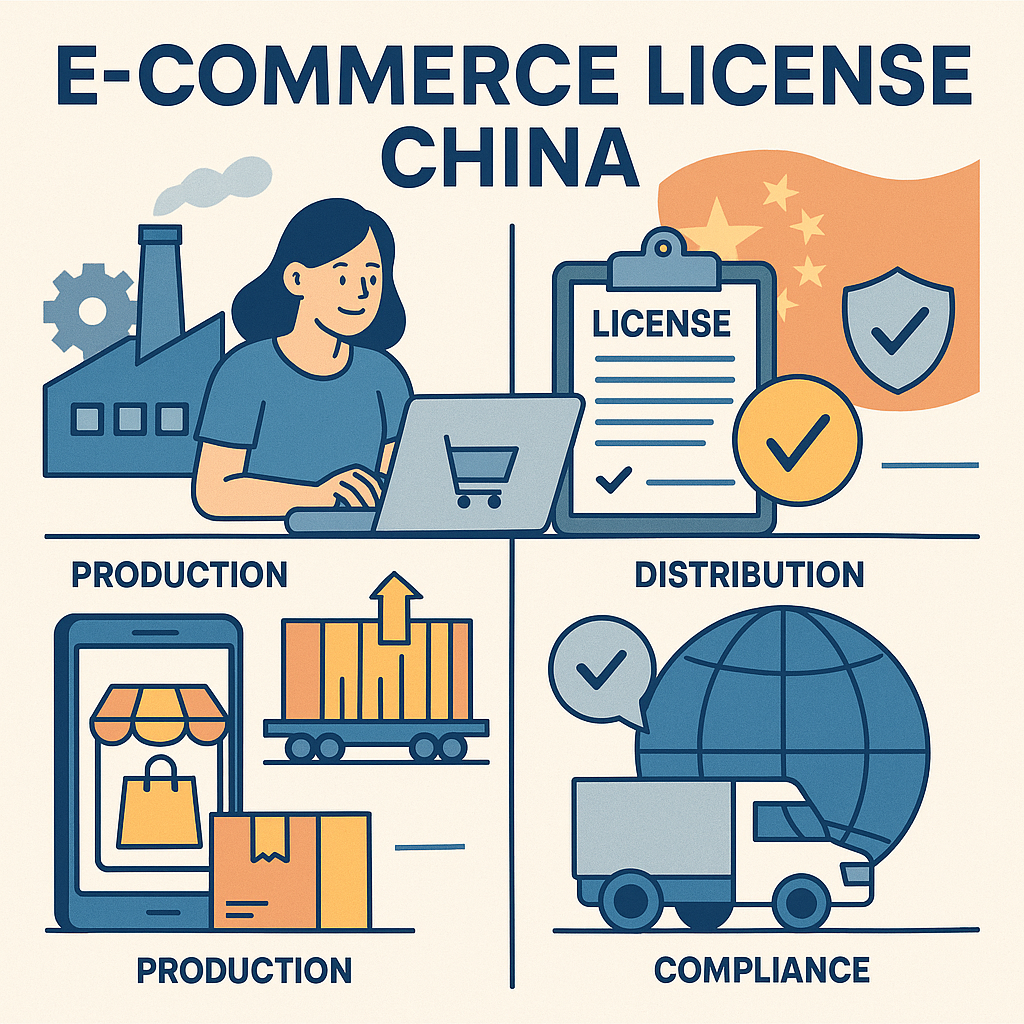
e-commerce license China is now one of the most essential regulatory approvals for foreign companies planning to operate online businesses in China. Whether you want to run an online store, cross-border e-commerce site, marketplace platform, or digital service business, you’ll need to follow strict licensing, compliance, and regulatory rules before legally going live.
- Which authorities regulate e-commerce license China applications
- What licenses foreign companies must obtain before launching online operations
- ICP requirements and when foreign investors need an ICP Filing or ICP License
- Business scope rules related to online retail and digital platforms
- Cross-border e-commerce compliance requirements
- Advertising, data protection, and cybersecurity obligations
- Tax rules for e-commerce operations in China
- Common reasons foreign companies get rejected
- How to legally operate as a foreign-owned online business
- Best practices and FDI market-entry insights
Understanding the e-commerce License System in China
The regulatory framework behind e-commerce license China involves several licensing layers that vary depending on business model, platform type, and whether the company is domestic or foreign-owned. China does not allow foreign companies to freely operate online platforms without proper approvals, and certain activities—such as operating an online marketplace or providing internet services—require additional permits.
To increase transparency and align with international digital regulations, China’s compliance expectations are often analyzed alongside frameworks issued by global organizations such as the UNCTAD digital trade guidelines and governance policies published by the OECD investment and digital economy reports.
Which Authorities Oversee e-commerce License China Approvals
Several Chinese regulators jointly supervise e-commerce license China applications. Different authority levels handle different aspects of online operations, digital platforms, and cross-border activities.
- Ministry of Industry and Information Technology (MIIT): oversees ICP Filing and ICP Commercial License for internet-based businesses.
- State Administration for Market Regulation (SAMR): approves the business license and business scope for e-commerce activities.
- Cyberspace Administration of China (CAC): regulates data protection, cybersecurity, and online content.
- General Administration of Customs (GACC): supervises cross-border e-commerce imports and exports.
Foreign investors often benchmark China’s regulatory approach with international digital standards from organizations such as the International Organization for Standardization (ISO) and cross-border trade practices from UNCTAD.
Business License Requirements for Foreign-Owned E-Commerce Companies
To begin the e-commerce license China process, the foreign investor must first establish a legal entity, usually a WFOE. The company’s business license must explicitly include business scope references such as “online retail,” “internet-based services,” or “information technology services.”
Foreign investors often design their business structure following proven compliance strategies described in FDI China’s China Market Entry Solutions to ensure that the business scope aligns with e-commerce licensing expectations.
When Foreign Companies Need ICP Filing or ICP License
One of the most important aspects of e-commerce license China is determining whether an ICP Filing or an ICP Commercial License is required. The distinction is crucial:
- ICP Filing: required for informational websites that do NOT provide commercial or paid services.
- ICP Commercial License: required for websites that operate e-commerce or provide any paid service online.
MIIT regulations closely follow technical and online service standards promoted by global regulatory organizations such as the World Health Organization (WHO) in areas related to content safety and consumer protection.
Cross-Border E-Commerce Licensing Requirements
Cross-border sellers face additional e-commerce license China requirements involving customs supervision, logistics declaration, and platform compliance. Companies handling international shipments, bonded warehouses, or overseas fulfillment centers must meet inspection guidelines enforced by customs authorities.
For trade compliance and tariff classification, foreign companies often refer to cross-border trade standards published by organizations such as the World Trade Organization (WTO) and digital trade insights from the OECD trade reports.
Data Protection and Cybersecurity Obligations for Online Businesses
The e-commerce license China framework requires companies to follow China’s Cybersecurity Law, Data Security Law, and Personal Information Protection Law (PIPL). These regulations are essential for ensuring lawful data collection, user consent, and secure handling of personal information.
Key compliance obligations include:
- Obtaining explicit user consent for data collection
- Storing data in China (localization requirements)
- Maintaining cybersecurity protection systems
- App security and content moderation rules
Global investors often compare China’s data regulation requirements with governance policies studied by the OECD’s digital economy reports to understand international alignment.
Tax and Financial Compliance for E-Commerce Operators
Tax obligations are a critical part of e-commerce license China compliance. E-commerce companies must manage VAT, Corporate Income Tax, and cross-border tax filings. Documentation for digital transactions must be accurate and supported by valid electronic fapiao (invoices).
- VAT rates vary from 6% to 13% depending on category.
- Cross-border e-commerce may qualify for reduced tariffs through customs pilot programs.
- Foreign-owned e-commerce WFOEs must maintain detailed accounting books.
- Online platforms must issue proper fapiao for consumer transactions.
For broader taxation context, companies often reference global fiscal frameworks published by the International Monetary Fund (IMF) and economic guidance from the World Bank.
Common Reasons Foreign Companies Get Rejected
Many applications for e-commerce license China fail due to:
- Incorrect business scope on business license
- Lack of required ICP Commercial License
- Non-compliant server hosting or domain registration
- Weak internal data security systems
- Misaligned cross-border operations without customs filing
- Improper tax documentation
Understanding these risks early helps foreign companies avoid costly delays and compliance breaches.
How Foreign Companies Can Stay Compliant Under the E-Commerce License Framework
Foreign investors entering China’s digital economy should build a strong compliance foundation before launching operations. A successful e-commerce license China strategy typically includes:
- Choosing the correct legal entity (often a WFOE)
- Ensuring business scope accurately reflects online activities
- Preparing server hosting and domain registration in accordance with MIIT rules
- Securing proper ICP Filing or ICP Commercial License
- Implementing cybersecurity and data security systems aligned with legal requirements
- Maintaining accurate accounting books and e-fapiao systems
- Aligning cross-border logistics with customs supervision guidelines
Companies also benefit from benchmarking regulatory frameworks using international resources such as the UNCTAD digital economy reports and OECD e-commerce policy guidelines to understand how China’s regulations compare globally.
FDI Insight: Structuring a Market Entry Plan for E-Commerce in China
Foreign investors planning to enter China’s digital market should integrate licensing considerations into their broader market-entry strategy. Entity structure, tax compliance, operational workflows, and technology systems all influence the success of an e-commerce operation.
A robust compliance roadmap often starts with guidance similar to FDI China’s guide on establishing a company in China, helping foreign investors build a strong regulatory and operational base before launching digital platforms.
Once the right structure is in place, companies can focus on growth activities such as online branding, supply chain optimization, and customer acquisition—knowing their compliance foundation is secure and aligned with e-commerce license China requirements.
Conclusion: Why E-Commerce Licensing Matters for a Successful China Strategy
The e-commerce license China framework is more than a regulatory formality—it’s a strategic gateway for foreign companies looking to succeed in the world’s largest digital marketplace. By understanding which licenses are required, how to prepare documentation, and how to navigate cybersecurity, tax, and cross-border rules, companies can reduce compliance risks and enter China with confidence.
As China continues to strengthen oversight of online platforms, foreign enterprises that adopt a proactive, well-structured compliance approach will gain a significant competitive advantage. With the correct licenses and regulatory alignment, your business can accelerate growth and operate securely within China’s fast-evolving e-commerce ecosystem.