
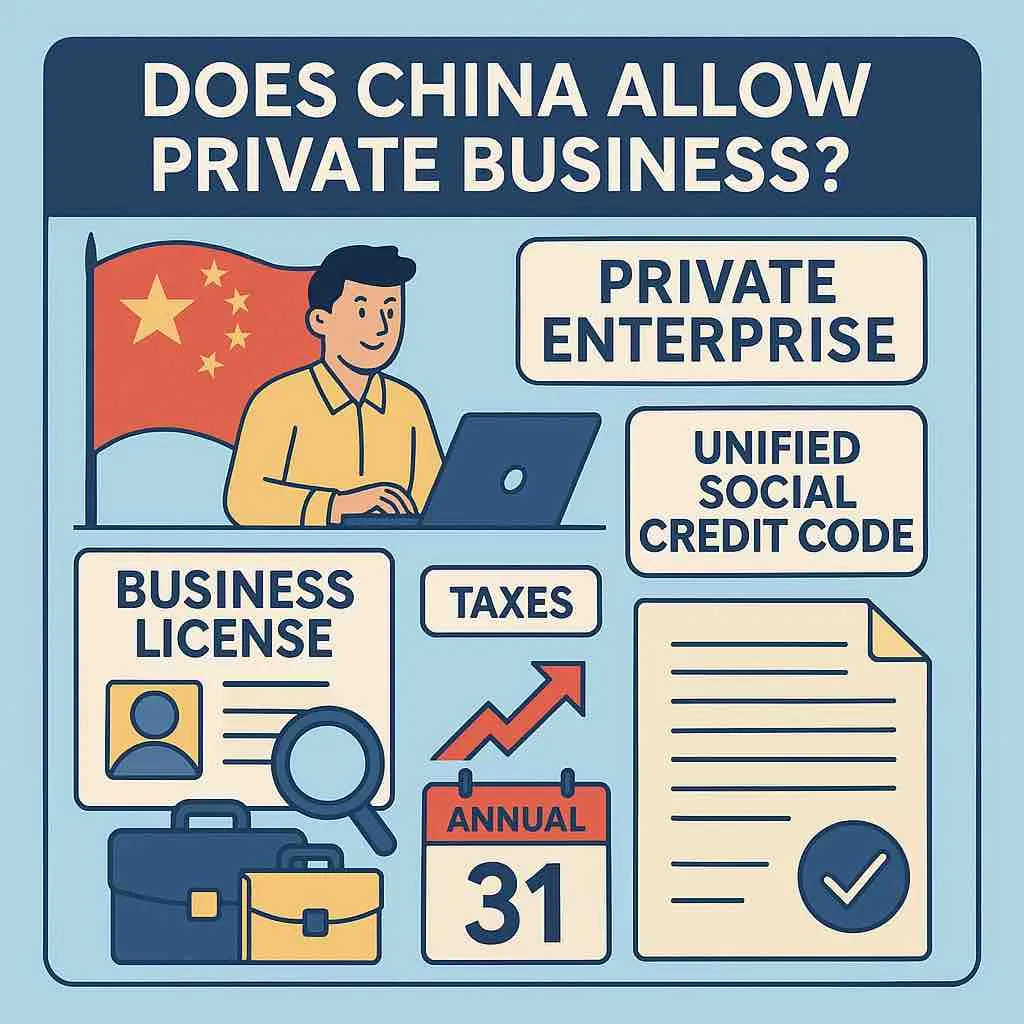
Does China allow private business? Yes—China explicitly allows and promotes private business. In May 2025, the Standing Committee of the National People’s Congress enacted the Private Economy Promotion Law (PEPL) to safeguard equal access, fair competition, property rights, and financing for the private economy. This sits alongside the PRC Company Law (amended effective July 1, 2024) and unified market‑entity registration rules that cover private companies and sole proprietors nationwide. China Briefing
Short answer & legal definition of private business in China
When people ask “does China allow private business,” they mean: can non‑state individuals or companies own and run a business for profit? Under the Private Economy Promotion Law, the state protects and supports privately run economic activity, reinforcing equal treatment and property‑rights protections for privately owned market entities. Moj.gov.cn
China recognizes several private‑sector forms, including limited liability companies, partnerships, sole proprietorship enterprises, and individual industrial and commercial households. Registration for all market entities is governed by a unified, national system. China Briefing
How big is China’s private economy (numbers that matter)
- As of May 2024, private business entities numbered 180.45 million—96.4% of all market entities. State Council Information Office
- In 2024, private enterprises contributed over half of China’s foreign trade and tax revenue, and more than 80% of urban employment. State Council Information Office
- Official statistics also show that value added by private enterprises kept expanding through 2024–2025. National Bureau of Statistics of China
These facts make the answer to “does China allow private business” not only “yes,” but “yes—and at massive scale.”
Core laws that allow private business (PEPL, Company Law, registration rules)
- Private Economy Promotion Law (PEPL, effective May 20, 2025): China’s first dedicated law to bolster the private economy—codifying equal treatment in market access, fair competition, finance, and property rights. Moj.gov.cn
- Company Law (effective July 1, 2024): Modernizes governance and requires shareholders of LLCs to fully pay in subscribed registered capital within five years—a key rule for new private companies. Pillsbury Law
- Administrative Regulation on Registration of Market Entities (effective 2022): Uniform framework for registering all market entities with the regulator. China Briefing
Together, these confirm that China legally permits and regulates private business nationwide.

Who can start a private business (companies, partnerships, solo traders)
Companies (LLCs & joint‑stock companies)
Most private firms incorporate as limited liability companies under the Company Law and operate across manufacturing, services, and tech. The five‑year capital timeline applies to new LLCs. Pillsbury Law
Partnerships & sole proprietorship enterprises
These remain common in services and professional fields; they must register as market entities and meet sector licensing where applicable. China Briefing
Individual industrial & commercial households (IICHs)
Natural persons can run small private businesses as IICHs, governed by national regulations that promote development and equal market access. State Council of China
How private firms register: license + unified social credit code
All private businesses register with the State Administration for Market Regulation (SAMR) (or local branches) to obtain a business license and a Unified Social Credit Code, the unique ID used for tax, banking, and compliance. The registration regulation provides the national basis for this one‑stop process. China Briefing
Need help navigating forms and scope wording? A turnkey partner like FDI China can guide planning, licensing, payroll, and ongoing filings.

Taxes at a glance (CIT 25%, VAT framework, invoices)
- Enterprise Income Tax (CIT): 25% standard rate in law (treaties and incentives may apply). National People’s Congress
- VAT: The VAT Law was enacted on Dec 25, 2024 and takes effect Jan 1, 2026, keeping the familiar 13%/9%/6% tiers while modernizing rules. EY
- Invoices (fapiao): After tax registration, businesses issue electronic fapiao according to local tax bureau procedures.
These baselines apply whether you’re a micro IICH or a nationwide private company.
Annual reporting & the NECIPS deadline
Private businesses must file an annual report via the National Enterprise Credit Information Publicity System (NECIPS). The widely cited compliance window is January 1–June 30 each year; missing it risks “abnormal operations” flags in the public registry—hurting banking and contracting. Yale Law School
Where private business faces limits: the “negative list”
China follows an “entry unless prohibited” approach. Some activities are restricted by Negative Lists (for market access, or for foreign investment access). In April 2025, authorities cut the market‑access negative list from 117 to 106 items, continuing a multi‑year liberalization trend. The 2024 national negative list for foreign investment (effective Nov 1, 2024) removed all access restrictions in manufacturing. Private businesses still need to confirm sector‑specific requirements. State Council Information Office
Compliance table: common private‑business forms
| Form (private sector) | Who can own | May issue invoices? | Key registrar | Typical taxes | Notable rules |
|---|---|---|---|---|---|
| LLC (limited liability company) | Individuals/companies | Yes (e‑fapiao) | SAMR | CIT 25%; VAT 13/9/6 | Capital fully paid within 5 years for new LLCs. (Pillsbury Law) |
| Partnership / Sole proprietorship enterprise | Individuals or entities | Often yes (varies by scope) | SAMR | As applicable (VAT/IIT/CIT per structure) | Register as market entity; follow sector licensing. (China Briefing) |
| Individual Industrial & Commercial Household (IICH) | Natural person | Yes (per local tax rules) | SAMR | Usually VAT + IIT | Regulated & promoted at national level. (State Council of China) |
Foreigners & private business: what changes (WFOE, JV)
Foreigners often own private businesses via companies:
- WFOE (wholly foreign‑owned LLC) in permitted sectors;
- Joint venture where rules require Chinese participation;
- Portfolio routes (for investing without operating a company).
These are still private enterprises under PRC law, but must comply with foreign‑investment access rules (the foreign‑investment negative list) in addition to domestic market‑access rules. The 2024–2025 updates further opened many sectors (notably manufacturing), while others remain licensed or capped. State Council of China
Practical tips to stay compliant in 2025
- Use the right form (IICH vs. LLC) based on risk, scale, and invoicing needs.
- Draft a clear business scope that fits market‑access rules; when in doubt, check if the activity appears on a negative list. State Council Information Office
- Plan registered capital to meet the five‑year deadline (LLCs). Pillsbury Law
- Register for taxes & e‑invoicing early; VAT rules will codify in 2026 without changing the 13/9/6 framework. EY
- File the NECIPS annual report on time to avoid an “abnormal operations” tag. Yale Law School
FAQ
Q1. So…does China allow private business?
Yes. The PEPL (2025) and existing company/registration laws affirm and promote private enterprise across China. Moj.gov.cn
Q2. Can one person run a small shop legally?
Yes—as an individual industrial & commercial household under national regulations, registered with SAMR. State Council of China
Q3. What taxes apply to a private company?
Plan for CIT 25% and VAT per activity; payroll triggers IIT for employees. National People’s Congress
Q4. Where can I verify a company’s status?
Check the public NECIPS portal for licenses and annual reports (operated by SAMR). Yale Law School
Q5. Is access to every industry open?
No. Confirm the negative lists (market access and foreign‑investment versions). Openness expanded in 2024–2025, but some lines remain. State Council of China
Sources
- Ministry of Justice (PRC) — Law adopted to promote private sector & Private Economy Promotion Law overview (effective May 20, 2025). Moj.gov.cn
- State Council Information Office (SCIO) — Private sector scale & contributions; Negative list reduction (2025) press briefing. State Council Information Office
Additional references:
- NPC (official): Enterprise Income Tax Law (25%). National People’s Congress
- EY / Reuters: VAT Law enacted Dec 25, 2024, effective Jan 1, 2026; keeps 13/9/6 tiers. EY
- Pillsbury / Pinsent Masons: Company Law five‑year capital rule for LLCs (effective July 1, 2024). Pillsbury Law
- State Council Gazette: Regulations promoting individual industrial & commercial households. State Council of China
- State Council policy watch: 2024 foreign‑investment negative list eliminated manufacturing restrictions (effective Nov 1, 2024). State Council of China
- NBS (press releases): macro & ownership‑type growth snapshots. National Bureau of Statistics of China
Post‑Article Message
Regulations evolve. Before you act on “does China allow private business,” confirm your industry’s latest negative list, align your registered‑capital plan with the five‑year rule, and lock in your NECIPS and tax calendars. For a turnkey path from registration to payroll, consider on‑the‑ground support from FDI China.