
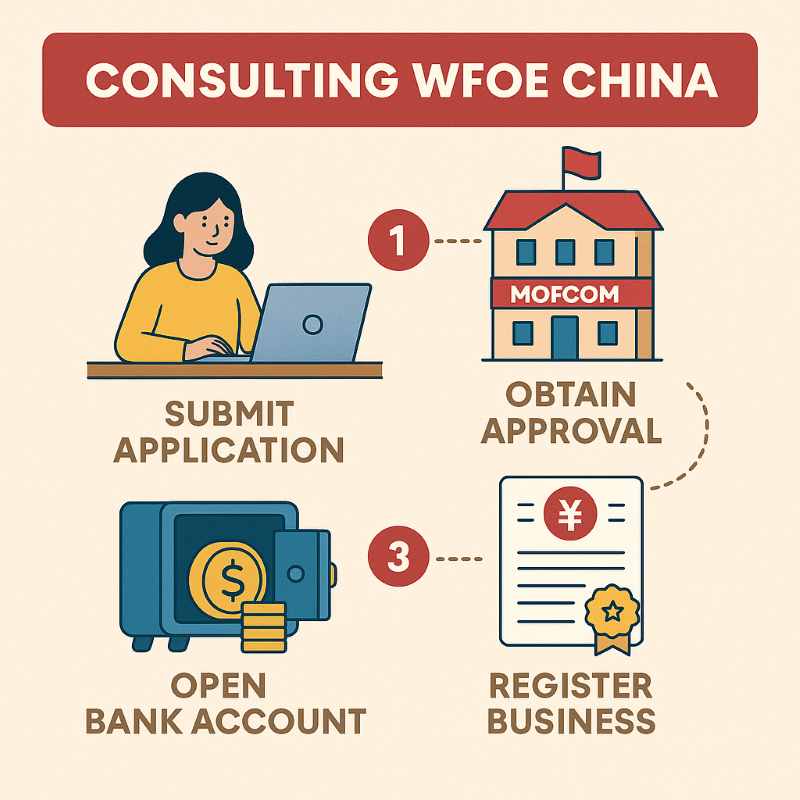
Consulting WFOE China setup is one of the simplest and most common market entry methods for foreign companies entering China’s professional services and advisory sectors. Unlike manufacturing or trading WFOEs, a Consulting WFOE China entity does not require industrial approvals, customs registration, or product-related licensing. Instead, it operates under a service-based business scope, providing consulting, advisory, market research, data analysis, or training services. However, foreign investors must still meet strict requirements regarding business scope, address registration, tax compliance, and limitations on certain industries that require additional licenses.
This comprehensive guide outlines the essential requirements, restrictions, and step-by-step process for establishing a fully compliant Consulting WFOE in China—along with 12 powerful rules every foreign firm must understand before launching operations.
Here is a summary of what this guide includes:
- What a Consulting WFOE China is
- What consulting WFOEs can and cannot do
- 12 powerful requirements and restrictions
- Business scope rules for consulting companies
- Compliance and tax obligations
What Is a Consulting WFOE China?
A Consulting WFOE China is a Wholly Foreign-Owned Enterprise registered in China for providing advisory, market research, strategy, management consulting, business services, or technical consulting activities. Unlike trading or manufacturing WFOEs, consulting WFOEs primarily deliver service-based revenue models.
They fall under the regulatory oversight of:
- SAMR – State Administration for Market Regulation (samr.gov.cn)
- MOFCOM – Ministry of Commerce (mofcom.gov.cn)
- State Taxation Administration (chinatax.gov.cn)
Consulting WFOEs are common among foreign-owned marketing agencies, advisory firms, training companies, management consulting firms, research agencies, and IT consulting service providers.
What a Consulting WFOE China Can Do
Consulting WFOEs may legally provide the following services:
- business advisory and corporate strategy consulting
- marketing and branding consulting
- human resources and training services (non-recruitment)
- data analysis and research reporting
- technical consulting
- information and management consulting
These activities must fit within the approved business scope on the WFOE’s business license.
What a Consulting WFOE China Cannot Do
Due to industry-specific regulations, consulting WFOEs are prohibited from:
- providing legal consulting services (requires a Chinese law firm license)
- providing medical or clinical consulting
- offering financial securities consulting
- conducting construction engineering consulting without additional licensing
- providing headhunting or recruitment services (requires HR Service License)
- selling products, e-commerce, or physical goods
Certain service categories may require industry licensing, and investors should verify restrictions through the National Enterprise Credit Information Publicity System (gsxt.gov.cn).
12 Powerful Requirements and Restrictions for Consulting WFOE China
The following 12 requirements form the core of Consulting WFOE setup and compliance.
1. Business Scope Must Be Carefully Drafted
Chinese authorities require precise wording. Common business scope items include:
- enterprise management consulting
- business information consulting
- market information consulting and research
- technical consulting services
Overly broad business scope wording may cause AMR rejection.
2. Office Address Must Be a Commercial Property
Consulting WFOEs cannot use residential addresses or virtual spaces. A real office lease is required for business license issuance.
3. Registered Capital Must Align With the Business Model
There is no minimum capital requirement, but foreign startups typically declare RMB 100,000–500,000 depending on the city.
4. Articles of Association Must Define Governance
This document outlines shareholder rights, capital contribution, voting rules, and legal representative responsibilities.
5. WFOE Must Choose a Legal Representative Carefully
The legal representative carries personal legal liability in China, even if they are not based in China full-time.
6. Tax Registration and Fapiao Activation Are Mandatory
After business license approval, the consulting WFOE must complete:
- VAT taxpayer registration
- fapiao system activation
- accounting setup and monthly tax filing
7. Consulting WFOEs Cannot Operate in Restricted Industries
Foreign investment negative lists restrict consulting services related to education, culture, publishing, and finance.
8. Payroll, Social Insurance, and HR Compliance Required
Foreign companies must enroll all employees in social insurance and manage payroll according to labor bureau rules.
9. Foreign Exchange Rules Apply to Cross-Border Services
Service fees remitted overseas require:
- contract verification
- tax declaration
- SAFE documentation
Details available from the State Administration of Foreign Exchange (safe.gov.cn).
10. Annual Audit and Annual Reporting Are Mandatory
WFOEs must file annual reports with the AMR and conduct a statutory annual audit.
11. Consulting WFOEs Cannot Invoice for Products
Only service-based invoices can be issued unless the business scope is updated via AMR approval.
12. Business Scope Expansion Requires AMR Review
Adding new services—especially licensed activities—requires formal amendment filings.
Business Scope Rules for Consulting WFOE China
The business scope controls what activities the WFOE can legally perform. For consulting companies, typical approved scopes include:
- management consulting
- information consulting
- technology consulting
- market analysis services
- business advisory services
Foreign investors must ensure this scope aligns with actual operations to avoid penalties for “operating beyond approved scope,” a violation monitored by SAMR.
Compliance Requirements for Consulting WFOE China
Key compliance obligations include:
- monthly tax filing
- social insurance payments
- business license renewal (if limited term)
- lease contract updates
- annual inspection and audit reports
Consulting WFOEs should maintain accurate accounting records to support VAT filings and cross-border service invoices.
For additional company setup insights, refer to FDI China’s China Company Setup Guide.
Common Challenges for Consulting WFOE China
Foreign firms often encounter challenges such as:
- unclear business scope causing AMR rejection
- incorrect office address classification
- bank account opening delays
- payroll and HR compliance issues
- SAFE approval delays for overseas payments
These issues highlight the importance of proper planning and accurate regulatory alignment.
Conclusion
A successful consulting WFOE China setup requires accurate business scope wording, compliant office registration, careful governance planning, and full alignment with SAMR, MOFCOM, tax bureau, SAFE, and HR regulations. By following the 12 requirements and restrictions outlined in this guide, foreign consulting firms can confidently launch and operate service-based businesses in China’s rapidly evolving market.