
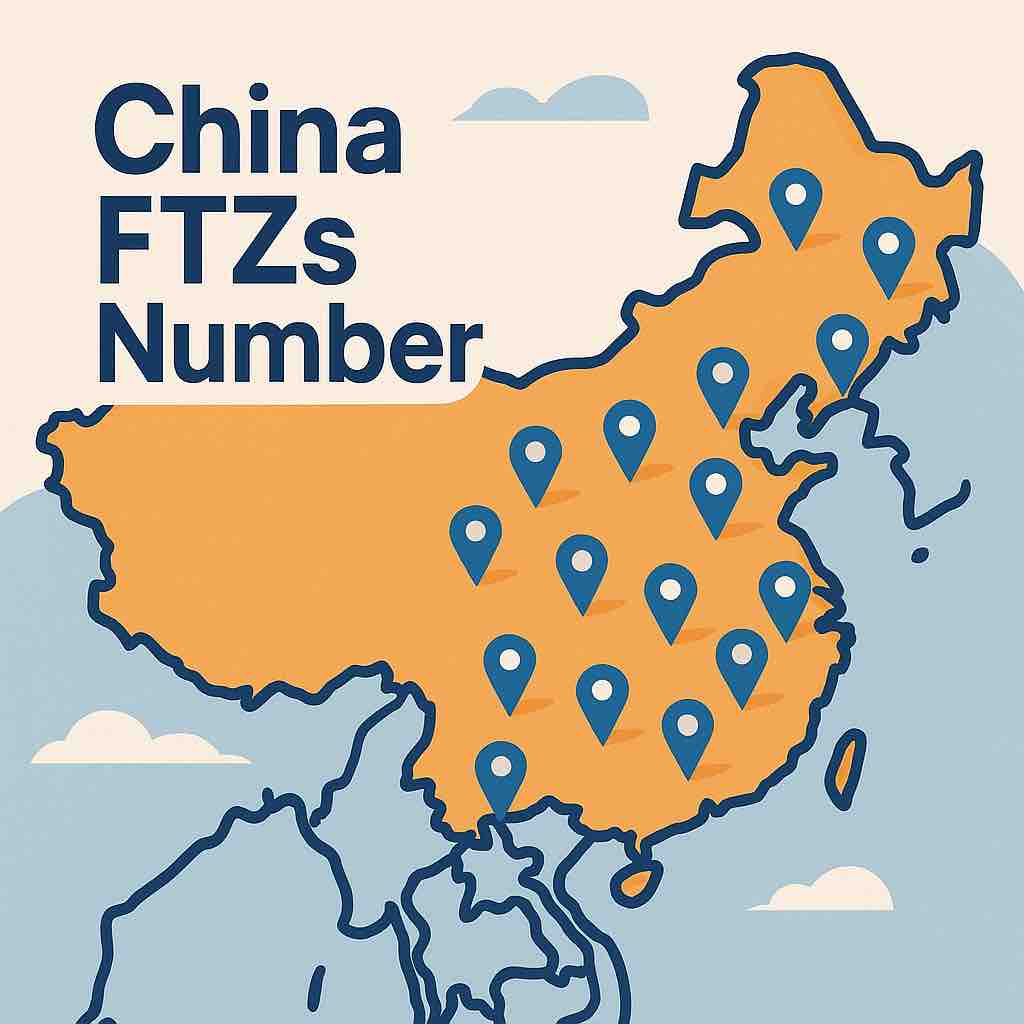
The China FTZs number is 22 as of 2025. These pilot free trade zones span the country and serve as testbeds for high‑standard opening‑up and regulatory innovation; they attracted US$28.25 billion in actual FDI in 2024—24.3% of China’s total, underscoring their strategic pull for international investors. State Council of China
China FTZs number: the short answer
The China FTZs number totals 22 pilot zones. The State Council confirms the count and highlights their rising role in actual‑use FDI. State Council of China
What counts (and what doesn’t): pilot FTZs vs Hainan Free Trade Port
When discussing the China FTZs number, remember: Hainan is transitioning to an island‑wide Free Trade Port (FTP) with independent customs operations; it’s often mentioned alongside FTZs but operates under a separate, more comprehensive framework geared for zero‑tariff regimes once customs independence starts. In practice, investors treat Hainan FTP as distinct, even though many official enumerations of the 22 pilot FTZs historically include a Hainan entry. Xinhua News
The 22 pilot FTZs: provinces and municipalities at a glance
Authoritative sources list 22 pilot FTZs across Shanghai, Guangdong, Tianjin, Fujian, Liaoning, Zhejiang, Henan, Hubei, Chongqing, Sichuan, Shaanxi, Shandong, Jiangsu, Guangxi, Hebei, Yunnan, Heilongjiang, Beijing, Hunan, Anhui, Hainan, and Xinjiang. Use this as a quick compass for site scouting. info.gov.hk
Xinjiang’s addition and border‑gateway role
The Xinjiang pilot FTZ, launched 2023, covers Urumqi, Kashgar, and Horgos—a powerful western gateway linking China with Central Asia and Europe. Ministry of Commerce
Why the China FTZs number matters for FDI in 2025
- Scale & share: FTZs accounted for 24.3% of actual‑use FDI in 2024; their performance continues to outpace the national average. Ministry of Commerce
- Trade traction: In early 2024, foreign trade across the 22 FTZs expanded at a double‑digit clip—one more signal that FTZs punch above their weight. en.imsilkroad.com
- Replication engine: Measures pioneered in the Shanghai FTZ are being replicated nationwide—smoothing friction for companies even beyond FTZ borders. State Council of China
Policy momentum: upgrades, negative lists, and “replicate 77 measures”
China released a 2025 guideline to upgrade pilot FTZs, calling for deeper opening in goods, services, and digital trade. Meanwhile, the 2024 national negative list removed all manufacturing restrictions, while FTZ‑specific regimes continue to pilot wider access in services and data. State Council of China
Service‑trade negative lists and cross‑border data pilots
China introduced national negative lists for trade in services and a pilot FTZ version—plus city‑level pilots easing cross‑border data flows in FTZs like Tianjin, Beijing, and Shanghai. These reduce compliance friction for finance, biotech, cloud, and other services businesses. State Council of China
What’s actually different inside an FTZ
Inside an FTZ, you typically see:
- Faster market access via trimmed negative lists and streamlined licensing. Shanghai International Services
- Customs facilitation and bonded models that lower working capital needs. State Council of China
- Financial pilots (e.g., FT accounts) that improve cross‑border settlement. State Council of China
- Institutional innovation that later rolls out country‑wide. State Council of China
If you’re comparing zones and incentives, browse FDI China’s Free Trade Zones Guide for practical entry and setup support.
Site‑selection playbook for your project
Start with your value chain, then pick a zone that removes the most friction:
- If you export components: look for deep‑water ports and bonded facilities.
- If you run shared‑services or R&D: target FTZs piloting service‑trade opening and cross‑border data measures. State Council of China
- If you’re a digital seller: prioritize e‑commerce logistics and VAT/refund workflows.
- If you’re west‑bound: consider Xinjiang FTZ for China‑Europe rail connectivity. Ministry of Commerce
Manufacturing & supply‑chain clusters
- Shanghai & Jiangsu: equipment, semis, and Lingang‑adjacent automation. en-shftz.pudong.gov.cn
- Guangdong: advanced manufacturing and global sourcing via Qianhai/Nansha/Shekou. State Council of China
Services, finance, and digital trade
- Beijing/Shanghai/Tianjin: FT accounts, data‑flow pilots, and pro‑services ecosystems. State Council of China
Table: China FTZs number—22 zones and typical strengths
| Region / Municipality | Example Areas (non‑exhaustive) | Typical Strengths |
|---|---|---|
| Shanghai | Lingang, Waigaoqiao, Yangshan | Advanced manufacturing, logistics, FT finance. (en-shftz.pudong.gov.cn) |
| Guangdong | Qianhai, Nansha, Shekou | Supply‑chain depth, cross‑border services. (State Council of China) |
| Tianjin | Airport & Binhai areas | Aviation MRO, FT accounts, shipping. (State Council of China) |
| Fujian | Fuzhou, Xiamen | Maritime trade, chemicals, electronics. (State Council of China) |
| Liaoning | Dalian | Heavy industry, port logistics. |
| Zhejiang | Zhoushan (oil & gas), Hangzhou area | Commodities trading, digital. |
| Henan | Zhengzhou | Air cargo, bonded logistics. |
| Hubei | Wuhan | Optics, auto, inland waterways. |
| Chongqing | Liangjiang | Rail to Europe, electronics. |
| Sichuan | Chengdu | Western services hub, semis. |
| Shaanxi | Xi’an | Aerospace, rail hub. |
| Shandong | Qingdao, Yantai | Petrochemicals, shipping. |
| Jiangsu | Nanjing, Suzhou | Precision manufacturing, biopharma. |
| Guangxi | Qinzhou | ASEAN gateway. |
| Hebei | Xiongan / Caofeidian | Greenfield development, ports. |
| Yunnan | Kunming | South‑Asia gateway. |
| Heilongjiang | Harbin | Russia trade, food processing. |
| Beijing | Daxing, high‑end services | Tech services, finance pilots. |
| Hunan | Changsha | Equipment, auto. |
| Anhui | Hefei | New‑energy, display tech. |
| Hainan | Island‑wide (FTP) | Tourism, duty‑free, services (separate FTP regime). (Xinhua News) |
| Xinjiang | Urumqi, Kashgar, Horgos | BRI logistics, textiles, new energy. (Ministry of Commerce) |
Note: The China FTZs number here reflects 22 pilot FTZs; Hainan is building a Free Trade Port that is administratively distinct but commonly referenced alongside pilot FTZs in official communications. State Council of China
FAQs: will the China FTZs number change soon?
- Is China planning more FTZs? As of April–September 2025, official releases still reference 22 pilot FTZs; policy focus is on upgrading and replicating successful pilots nationwide rather than adding many new zones. State Council of China
- What about the negative list? The 2024 update removed all manufacturing restrictions, with services opening expanding via pilots—including FTZ service‑trade negative lists. Shanghai International Services
30‑day action plan for investors
- Confirm scope: Use the China FTZs number and the province list above to narrow 3 candidate FTZs that best match your value chain. info.gov.hk
- Check access: Compare national negative list (2024) with FTZ pilots for your sector; flag licensing needs early. Shanghai International Services
- Model incentives: Map customs savings, bonded flows, and any service‑trade facilitation for data and cross‑border ops. State Council of China
- Replicate‑ready: Track which Shanghai FTZ measures are being rolled out nationally, so your playbook scales. State Council of China
- On‑the‑ground help: For entity setup, payroll, and compliance, partner with an advisor who works inside your target FTZ. Explore FDI China’s services.
Sources & further reading
We keep the top two source websites inside this article for quick verification:
- State Council (english.www.gov.cn) — confirms the China FTZs number is 22 and reports 2024 FDI into pilot FTZs. State Council of China
- MOFCOM (english.mofcom.gov.cn) — press conference notes the 22 FTZs’ 2024 FDI (US$28.25 b) and pilot initiatives in data, services, and market access; also explains the Xinjiang FTZ layout. Ministry of Commerce+1
Additional references used in this guide:
- Imsilkroad / Xinhua finance portal — trade growth across 22 FTZs in early 2024. en.imsilkroad.com
- State Council policy releases — FTZ upgrade guideline (2025) and the push to replicate 77 Shanghai FTZ measures. State Council of China
- NDRC/MOFCOM negative list (2024) — confirmation of manufacturing access fully opened. Shanghai International Services
- Hainan Free Trade Port — policy briefings on the FTP’s expanding duty‑free scope and independent customs operations. Xinhua News
For broader investment policy context, see UNCTAD’s Investment Policy Monitor on China’s FTZ negative lists. UNCTAD Investment Policy Hub