
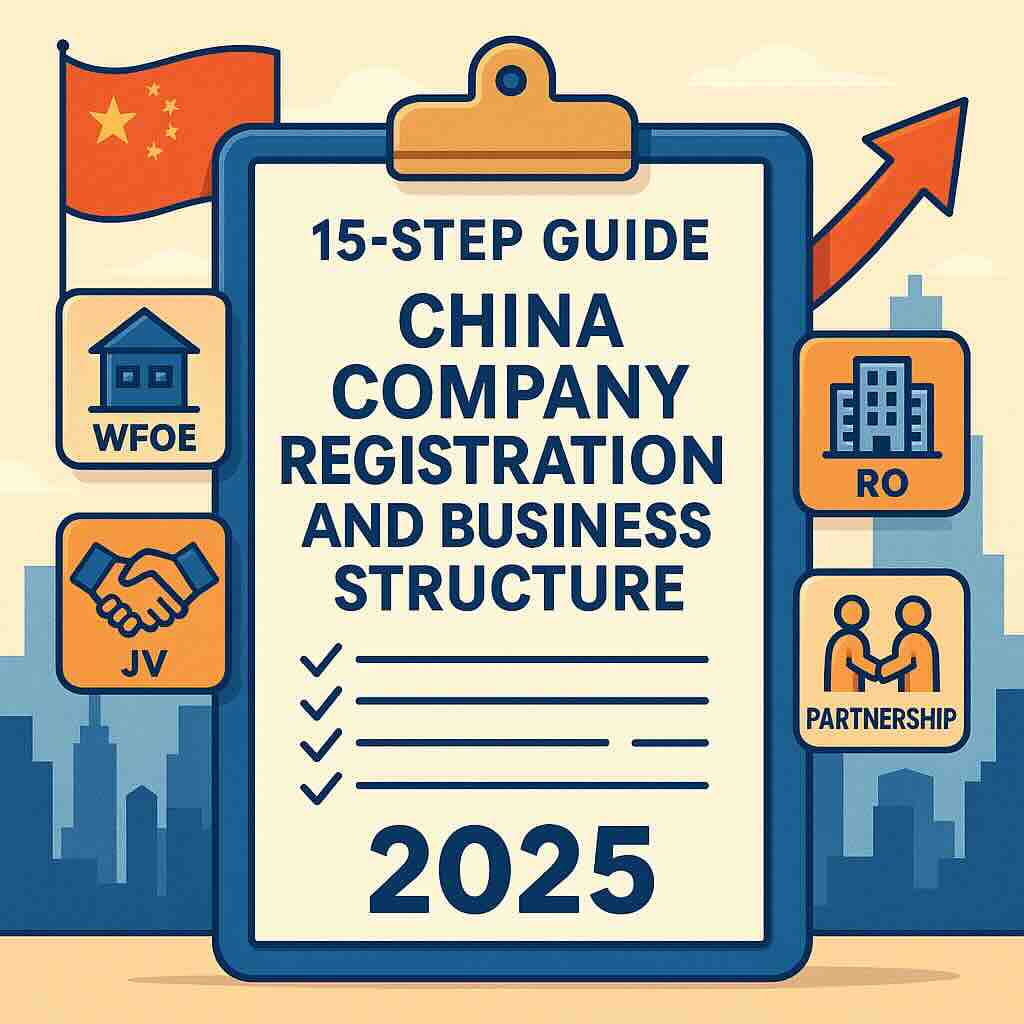
China company registration and business structure decisions determine who can own what, how fast you can launch, and which approvals you’ll need. In 2025, the borders of market access are set by the Negative List (entry unless restricted), while the revised Company Law adds a clear five‑year timeline to contribute subscribed capital for new LLCs. Put differently: pick a compliant structure, confirm access, and plan capital and identity (USCC/GSXT) from day one. State Council of China
China company registration and business structure: the quick answer
Choose your China company registration and business structure by checking market access first: if your activity is not on the Negative List, a 100%‑owned WFOE (foreign‑invested LLC) is normally available; if it is on the list, consider a JV, a pilot/FTZ route, or an alternate scope. An RO is fast but non‑profit and can’t invoice. Partnerships (FIPE) and joint‑stock entities serve niche needs. Plan your capital under the new five‑year rule and align all public data under your USCC on GSXT. State Council of China+2China Briefing+2
Market access first: how the Negative List shapes your choices
China grants pre‑establishment national treatment to foreign investors, then limits a short list of industries via the Negative List. In 2024, authorities reduced the list from 31 to 29 and removed the last manufacturing restrictions effective Nov 1, 2024, a meaningful opening for industrial WFOEs. State Council of China+1
2024 milestone: manufacturing caps removed
Policy notices and official summaries confirm zero foreign‑investment caps remain in manufacturing under the 2024 list—so factory and advanced‑manufacturing projects typically proceed as WFOE/FIE LLCs, subject to normal sector approvals. State Council of China

Core business structures in China (for foreign investors)
Wholly foreign‑owned enterprise (WFOE) / FIE LLC
The modern WFOE is a foreign‑invested limited liability company with 100% foreign ownership when the scope is off‑list. It issues fapiao, hires staff, holds IP, and contracts directly. It’s the default for most services, trading, and (now) manufacturing. fdi.mofcom.gov.cn+1
Joint venture (JV) — equity/contractual
A JV pairs foreign and Chinese investors, typically used where market access still imposes conditions, or where a local partner brings licenses/data/distribution. JVs are established as LLCs (equity JV) or contractual JVs depending on the deal. kaizencpa.com
Representative office (RO) — non‑profit liaison
An RO is quick to file but cannot engage in profit‑making or issue fapiao; it’s limited to liaison activities such as market research and meetings under long‑standing rules. If you need to sell or invoice, pick a WFOE/JV instead. lexology.com
Partnerships (FIPE) and joint‑stock companies
Foreign investors may set up general/limited partnerships or joint‑stock companies; these serve investment funds, co‑ventures, or listing paths. The Foreign Investment Guide (2024) from the State Council outlines company and partnership forms recognized under market‑entity regulations. State Council of China
New Company Law: the five‑year capital contribution clock
Since July 1, 2024, new LLCs must fully contribute subscribed capital within five years of establishment (Article 47), strengthening creditor protection and tightening capitalization discipline. Align your Articles of Association and cash/in‑kind/IP contributions to a realistic schedule. Pillsbury Law

Identity matters: USCC (18‑digit) and the GSXT registry
Every registered entity receives an 18‑character Unified Social Credit Code (USCC) printed on the business license and used across tax and other systems; public records live on the official National Enterprise Credit Information Publicity System (GSXT). Reconcile name + USCC on license, GSXT, bank KYC, and e‑fapiao. Wikipedia
Location & FTZs: when an FTZ helps your structure
Pilot Free Trade Zones (FTZs) don’t automatically change national access rules, but they often pilot faster customs/finance/data measures that reduce friction for logistics‑heavy or cross‑border services businesses. Your China company registration and business structure choice should weigh these operational advantages, not just the initial filing steps. State Council of China
Banking, tax, and fapiao: going live after registration
After licensing, open basic RMB and capital/FX accounts, complete KYC, register for VAT/CIT, and enable e‑fapiao. Your enterprise taxpayer ID will typically be the USCC. This identity discipline keeps collections smooth and filings consistent. Wikipedia
Table: business structures vs. control, scope, tax, and speed
| Structure | Ownership & control | Can invoice (fapiao)? | Typical scope & use‑case | Speed to launch | Notes |
|---|---|---|---|---|---|
| WFOE / FIE LLC | 100% foreign if off Negative List | Yes | Services, trading, now manufacturing | Medium | Default vehicle for most off‑list activities. (China Briefing) |
| JV (equity/contractual) | Shared with Chinese partner | Yes | Sectors with conditions or partner value | Medium | Use when access caps or partner assets matter. (kaizencpa.com) |
| Representative Office (RO) | No local entity w/ independent capacity | No | Liaison, research, meetings | Fast | No profit‑making; no invoicing. (lexology.com) |
| Partnership (FIPE) | Flexible GP/LP model | Possibly (via registered partnership) | Funds, co‑ventures | Medium | Partnership liabilities follow GP/LP rules. (State Council of China) |
| Joint‑stock company | Share‑based | Yes | Larger/delisting/listing plans | Slower | Governance suited to raising capital. (State Council of China) |
Decision playbook: how CFOs & founders should choose
- Map access first. If off the Negative List, default to WFOE; if on‑list, evaluate JV or pilots. Manufacturing is now fully open (2024 list). State Council of China
- Choose scope that fits reality. Draft precise bilingual scope you can execute now plus near‑term additions.
- Plan capital over five years. Don’t over‑subscribe; align AoA and banking story to cash flow. Pillsbury Law
- Decide location for operations, not just filing speed. Use FTZs when customs/finance/data pilots matter. State Council of China
- Lock identity early. Reconcile USCC across license, GSXT, bank, and invoicing. Wikipedia
Need hands‑on help with China company registration and business structure? See FDI China’s services for entity setup, payroll, VAT/IIT filings, and ongoing compliance.
15‑step checklist to register, fund, and operate
- Confirm market access against the Negative List (2024 baseline). State Council of China
- Pick the structure: WFOE, JV, RO, partnership, or joint‑stock. State Council of China
- Draft a bilingual business scope mapped to access rules.
- Choose city/zone (consider FTZ for ops). State Council of China
- Prepare Articles of Association with a five‑year capital schedule. Pillsbury Law
- File at AMR to obtain your business license (USCC printed).
- Pull and save your GSXT page; match name + USCC. Wikipedia
- Carve official/financial/legal‑rep chops with governance rules.
- Open basic RMB and capital/FX accounts; complete bank KYC.
- Register VAT/CIT; enable e‑fapiao (USCC as taxpayer ID). Wikipedia
- Enroll social insurance & housing fund for employees.
- Add sector licenses (food, medical devices, telecom VATS, etc.).
- Set an annual GSXT report and tax‑reconciliation calendar.
- Build a document room: license, GSXT PDF, chops, bank KYC, e‑fapiao samples.
- Review quarterly: access changes, capital progress, identity alignment.
In conclusion, understanding China company registration and business structure is the foundation for building a compliant, scalable, and profitable presence in the Chinese market. Whether you choose a WFOE for full control, a JV for strategic collaboration, or an RO for research and liaison, each structure carries distinct legal, tax, and operational implications. By aligning your entity type with the latest Company Law reforms, the 2024 Negative List, and GSXT/USCC registration standards, you ensure both compliance and efficiency from day one. A well-planned approach to China company registration and business structure not only minimizes risk but also sets your business up for sustainable growth in one of the world’s most dynamic economies.
Sources & further reading
We keep the top two official sites inside this article for verification:
- State Council — Foreign Investment Guide (2024 edition): market‑access logic, company/partnership forms, FTZ direction. State Council of China
- State Council (NDRC/MOFCOM notice) — Negative List (2024): items cut 31→29; manufacturing restrictions removed effective Nov 1, 2024. State Council of China
Additional authoritative references cited above:
- Norton Rose Fulbright — Company Law revision and the five‑year capital contribution limit. Norton Rose Fulbright
- Pillsbury — Article 47: five‑year maximum for new LLCs from July 1, 2024. Pillsbury Law
- China Briefing — Entity types, WFOE/RO/JV essentials. China Briefing
- Lexology / China Law Blog — RO limitations (no profit‑making; liaison only). lexology.com
- USCC basics — 18‑character identifier and GSXT registry context. Wikipedia
Official PDF: Foreign Investment Guide of the People’s Republic of China (2024) — practical overview of structures and policies. State Council of China