
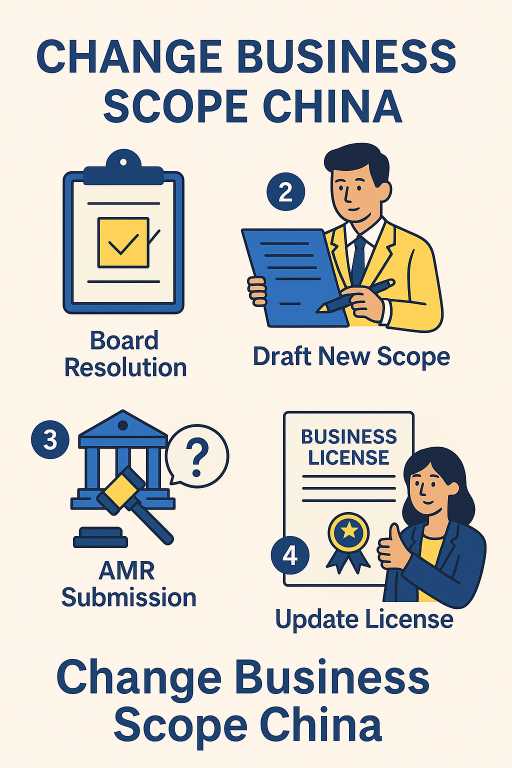
Change business scope China is a crucial legal procedure for foreign companies and domestic enterprises that need to expand, reduce, or adjust their approved business activities. In China, the business scope recorded on the business license defines what a company is legally permitted to do. Any activity outside the approved scope can lead to penalties, tax issues, and compliance risks. Because of this, updating or modifying the business scope is a tightly regulated process involving the Administration for Market Regulation (AMR), tax authorities, and—if relevant—industry-specific regulators.
Below is a quick overview of everything covered in this guide:
- What Is a Business Scope in China?
- Why Companies Need to Change Business Scope
- 10 Steps to Change Business Scope in China
- Compliance Requirements and Documentation
- Common Challenges Companies Face
What Is a Business Scope in China?
The business scope is a legally defined description of the products, services, and activities a company is allowed to perform in China. It appears on the company’s business license and is filed with the AMR. This scope determines:
- the taxes applicable to the company
- the licenses required for operation
- the regulatory bodies overseeing the business
For foreign companies—especially WFOEs and Joint Ventures—the business scope directly affects operational freedom. If a company performs activities outside the approved scope, authorities such as the State Administration for Market Regulation can impose fines or restrict operations.
Why Companies Need to Change Business Scope China
Companies may decide to modify their scope for several reasons:
- Expanding into new services or product categories
- Entering a regulated industry needing pre-approval
- Restructuring operations after acquisition or business pivot
- Complying with new tax or licensing policies
- Removing discontinued business lines
According to China’s business legislation issued by the Ministry of Justice, operational activities must always match the approved scope to maintain legal compliance and avoid administrative penalties.
10 Powerful Steps to Change Business Scope China
The process to change a business scope typically takes 2–6 weeks depending on complexity, industry approvals, and city-level AMR requirements. Below are the 10 essential steps companies must follow.
1. Hold a Board Resolution to Approve the Change
The company’s shareholders or board must formally approve changing the business scope. This resolution becomes the foundation for all subsequent filings.
2. Draft the New Business Scope Precisely
Business scopes in China follow standardized wording. The new scope must match local AMR standards to avoid rejection. Companies must ensure the terminology complies with regulatory categories and industry lists.
3. Check Whether Pre-Approval Is Required
Some business activities require special permission before applying to the AMR. Examples include:
- food production or food trading
- medical devices
- internet services
- education and training
- logistics and customs-related activities
Information about industries requiring pre-approval is published on the Ministry of Industry and Information Technology website.
4. Update the Company Articles of Association
The Articles must be amended to include the new business scope wording. This document will be submitted to the AMR along with the application.
5. Prepare Required Documentation
- Board resolution
- Revised Articles of Association
- Application form from the local AMR
- Lease agreement (if scope affects location)
- Industry license (if required)
6. Submit the Change Application to the AMR
The local AMR reviews business scope change applications. If the wording is unclear or too broad, the AMR will request modifications. Approval times vary by district.
7. Apply for Updated Business License
Once approved, the AMR issues an updated business license showing the new scope. Companies must replace their old license with the new version.
8. Update Tax Registration Information
Any new business activities may trigger tax category changes or require new invoicing qualifications. Companies must file updates with the tax bureau to avoid compliance issues.
9. Update Bank Records and Customs Information
If the change impacts import/export activities or capital flows, companies must update related bank documents and customs filings. The China Customs authority requires current business scope details for compliance.
10. Notify Internal Departments, Partners, and Vendors
After the business scope change is complete, companies must notify relevant stakeholders such as partners, suppliers, banks, and employees to ensure smooth operational transitions.
Compliance Requirements for Change Business Scope China
To maintain compliance, companies must ensure:
- their accounting system reflects the new business scope
- they obtain any new qualifications required by law
- their tax filings correctly match their operational activities
- they maintain complete records of all AMR and tax filings
For additional regulatory guidance, companies can consult China’s business compliance framework outlined in the Pkulaw legal database.
For internal compliance insights, refer to FDI China’s China Business Compliance Guide.
Common Challenges When Companies Change Business Scope China
Companies often face the following obstacles during the process:
- AMR rejecting the new wording for being too broad or vague
- failure to obtain required industry pre-approvals
- tax complications caused by new business activities
- inconsistencies between old and new operational models
- delays in updating banking and customs records
These challenges can significantly delay operations if not managed properly. Many companies choose to work with compliance experts to ensure the wording, documentation, and sequencing of approvals meet AMR and regulatory expectations.
Conclusion
Successfully completing a change business scope China application requires accuracy, regulatory awareness, and strategic planning. By following the 10 steps in this guide—while ensuring all pre-approvals, documentation, and tax updates are properly handled—foreign companies can smoothly expand or pivot their business legally in China. With a strong compliance foundation, companies can confidently adjust their operations and seize new market opportunities.