
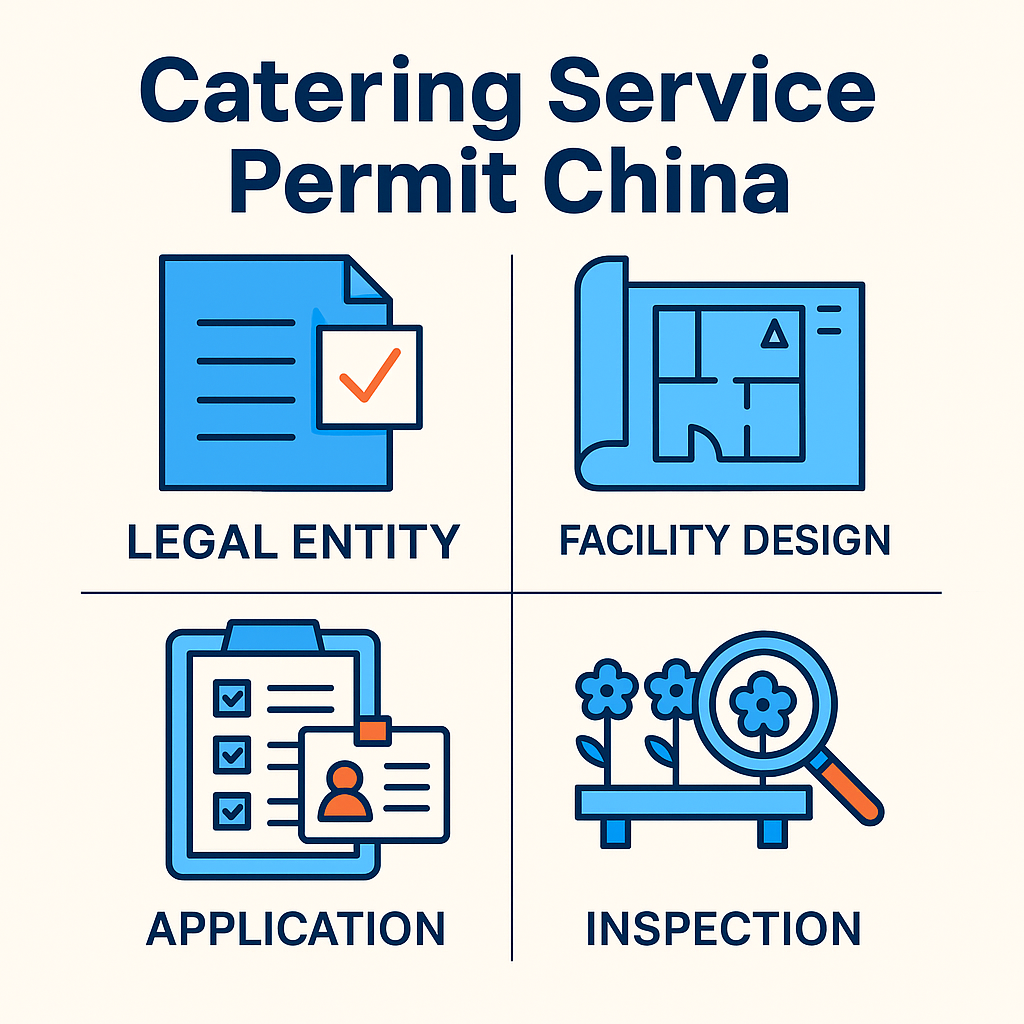
Catering service permit China is the mandatory regulatory approval required for any business planning to operate a restaurant, café, central kitchen, cloud kitchen, bakery, bar, or catering service in China. Since the food sector is highly regulated and closely monitored, investors must understand the full licensing procedure, safety rules, and ongoing operational requirements to remain compliant. To help you navigate the full process with confidence, this guide covers:
- Overview of catering licensing requirements in China
- China food business licensing requirements
- Facility design and kitchen layout approval
- Employee health, hygiene, and training obligations
- Food safety compliance rules and documentation
- Catering service permit China process (step-by-step)
- Inspection requirements and compliance checks
- Foreign investment structures and market-entry considerations
- Common mistakes when applying for a China restaurant license
- Long-term compliance, renewal, and risk prevention

Understanding the Catering Service Permit China Requirements
The catering service permit China is issued by local Market Supervision Bureaus (MSB), formerly known as the Food and Drug Administration. The permit ensures all food-service operators meet the mandatory hygiene, safety, and facility standards outlined in China’s Food Safety Law and related administrative measures. These rules correspond with general practices promoted by the World Health Organization and global food-safety regulators such as the European Food Safety Authority.
Catering Service Permit China Process: Step-by-Step Licensing Breakdown
The catering service permit China process is structured, detailed, and inspection-heavy. Businesses must pass several administrative and on-site reviews. Here’s the general workflow:
Step 1: Obtain a Legal Business Entity
Foreign investors typically set up a WFOE (wholly foreign-owned enterprise) with food-service operations in its business scope. This ensures the company can legally apply for the catering service permit China. The approval sequence must follow the local administrative rules published by provincial regulators and national guidelines from MOFCOM.
Step 2: Prepare China Food Business Licensing Requirements
China food business licensing requirements include kitchen facility designs, zoning diagrams, equipment specifications, ventilation systems, and wastewater treatment details. These drawings must be professionally prepared and meet technical specifications to avoid approval delays.
Step 3: Submit the China Restaurant License Application
The China restaurant license application requires operators to upload ID documents, business licenses, lease agreements, facility drawings, and sanitation plans. Regulators use these documents to verify that every part of the kitchen is correctly zoned and meets safety requirements.
Step 4: Pass an On-Site Facility Inspection
Inspectors review food-preparation areas, equipment installation, storage zones, water sources, air circulation systems, and cleaning facilities. They also verify that raw and cooked foods are separated and that cross-contamination risks are controlled. This step is crucial for obtaining the catering service permit China.
Step 5: Receive the Catering Service Permit China
Once approved, the permit must be displayed prominently at the business entrance. It includes the business’s name, legal representative, address, and permitted business scope. This certificate is essential for legally operating any food-related business in China.
China Food Safety Compliance Rules
China food safety compliance rules require businesses to maintain strict sanitation, implement food-traceability systems, and record daily safety checks. These practices are aligned with international risk-prevention frameworks. Monitoring food safety rules is essential for long-term survival, as China enforces inspections rigorously. Global institutions like the International Organization for Standardization also offer guidelines for food-safety management systems.
Facility Design Rules for Catering Businesses in China
Food-service facilities must comply with kitchen zoning standards, which include separating raw processing, cooked processing, cleaning, storage, and employee sanitation areas. Continuous workflow from “clean to dirty” reduces cross-contamination risks. Incorrect zoning is the most common reason catering service permit China applications get rejected.
Long-Tail Keyword: China Restaurant License Application Challenges
Many foreign investors discover that their imported kitchen layouts don’t meet local standards. Ventilation, smoke exhaust, gas-line installation, and drainage systems all require government-approved configurations.
Employee Health and Hygiene Requirements
All employees involved in food handling must obtain health certificates. These certificates confirm that workers are free from infectious diseases. Staff must also undergo food-safety training, which is documented and reviewed during inspections.
Regulatory Inspections and Ongoing Compliance
After obtaining the catering service permit China, businesses must undergo routine inspections. Authorities check sanitation logs, equipment records, cleaning procedures, oil-quality monitoring, and temperature-control logs. Surprise inspections are common, and violations can lead to fines or license suspension.
Long-Tail Keyword: China Food Safety Compliance Rules
Maintaining accurate food-safety documentation, including supplier records and daily sanitation logs, is essential. These records demonstrate ongoing compliance and reduce regulatory risk.
Foreign Investment Considerations for Food-Service Businesses
Foreign investors must ensure that their business structure complies with China’s foreign-investment regulations. The best structure for most restaurant and catering businesses is a WFOE with food-service operations. To better understand registration procedures, companies often reference FDI China’s China Market Entry Guide.
Common Problems During the Catering Service Permit China Application
Typical pain points include:
- Kitchen plans not meeting zoning rules
- Insufficient ventilation or smoke-extraction systems
- Sanitation facilities not correctly placed
- Improper waste-management configuration
- Lack of employee health certificates
- Missing supplier or cleaning documentation
How to Maintain the Catering Service Permit China Long Term
To reduce regulatory risks, companies should implement internal audits, train employees regularly, record all sanitation activities, and keep equipment in good condition. Reviewing policy updates from national agencies helps ensure continuous compliance.
Conclusion
The catering service permit China is a critical regulatory requirement for any foreign investor entering the food-service market. By understanding the complete approval process, preparing compliant facility designs, training employees, and maintaining accurate documentation, companies can obtain the permit efficiently and operate safely. With strong compliance procedures, businesses build credibility, reduce risks, and ensure long-term success in China’s fast-growing food-service industry.