
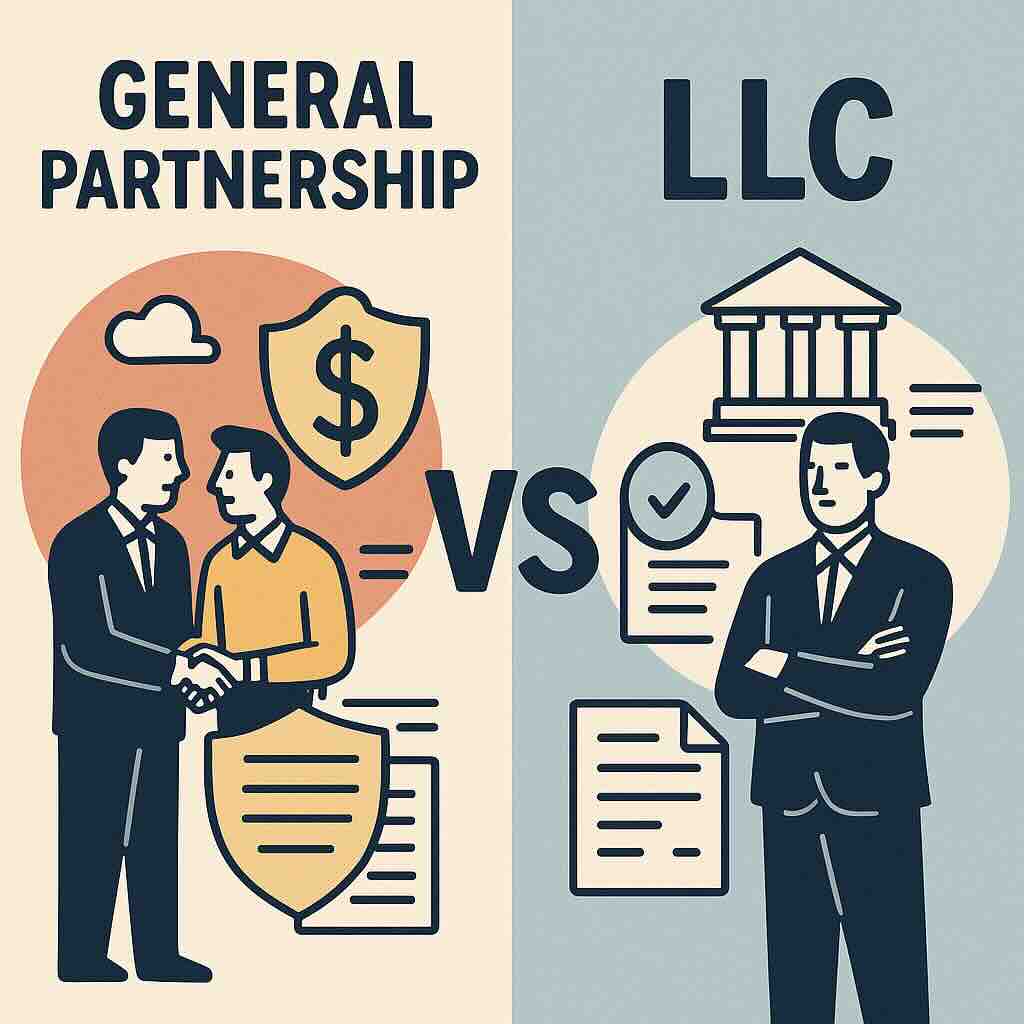
General partnership vs LLC is a simple question with a powerful answer: they’re not the same. A general partnership forms when two or more people do business together without a formal shield. An LLC (limited liability company) is a registered entity that can protect owners’ personal assets. If you’re comparing general partnership vs LLC to launch in the U.S. or to align with cross-border FDI plans, this guide shows the key differences in plain English.
Quick answer: is a general partnership vs LLC the same thing?
No. A general partnership is not the same as an LLC. In general partnership vs LLC, the headline difference is liability. Partners in a general partnership have unlimited personal liability for business debts and lawsuits. Members in an LLC typically enjoy limited liability, so their risk is capped at what they invest (exceptions apply for fraud, personal guarantees, and mixing funds). Taxes, management, paperwork, and funding options also differ. If you keep general partnership vs LLC front and center, your risk, tax, and growth plans stay aligned.
Side-by-side comparison
| Feature | General Partnership | LLC |
|---|---|---|
| Liability | Unlimited personal liability for each partner (joint and several). | Limited liability for members; company is a separate legal person. |
| Formation | Often automatic by conduct; minimal or no filing. | State filing (Articles of Organization) + registered agent. |
| Governance | Partnership agreement (recommended). | Operating agreement (strongly recommended). |
| Taxes (default) | Pass-through; partners pay on shares; self-employment tax applies. | Pass-through by default; may elect S corp/C corp taxation. |
| Funding | Harder to raise from outside investors. | Easier to add members, issue profits interests, or raise equity. |
| Continuity | Dissolves on partner exit unless agreement says otherwise. | Perpetual life in most states; membership changes don’t dissolve. |
| Compliance | Few formalities but high personal risk. | Annual/biennial reports and fees; better risk management. |
| FDI fit | Rarely ideal for cross-border deals. | Common entry vehicle; flexible for foreign co-founders. |
You can see how general partnership vs LLC structures directly affect your exposure and credibility — especially when expanding internationally. For a deeper dive on China-specific options, check out the China Company Registration Guide on FDI China.
Key takeaways
- general partnership vs LLC boils down to unlimited vs limited liability.
- general partnership vs LLC also differs on default taxes and election options.
- general partnership vs LLC influences investor readiness and credibility.
- general partnership vs LLC affects continuity when owners join or leave.
- general partnership vs LLC changes compliance costs and reporting habits.
- general partnership vs LLC shapes FDI readiness, banking, and cross-border contracts.
Taxes explained
When you compare general partnership vs LLC, you’ll see both are usually pass-through for U.S. federal tax. That means profit flows to owners and gets taxed on their personal returns. But there are key twists:
- Self-employment tax: In a general partnership, active partners usually pay self-employment tax on their full share. In an LLC, members may reduce exposure if they validly choose S-corp status and take a reasonable salary.
- Flexibility: An LLC can elect to be taxed as a C corporation or S corporation (if it qualifies), while a partnership can’t make the same elections directly.
- Foreign partners: Cross-border founders comparing general partnership vs LLC must consider withholding on effectively connected income (ECI) and reporting (Forms K-1, 8804/8805, ITIN/EIN issues).
For authoritative background, review the IRS Business Structures Guide and the SBA’s comparison of business structures.
Risk and liability: the big fork in general partnership vs LLC
With general partnership vs LLC, liability often decides the matter. In a general partnership, each partner can be on the hook for the full amount of a judgment—even for another partner’s actions in the ordinary course. In an LLC, members usually aren’t personally liable for company debts. Courts can “pierce the veil” when owners commit fraud or fail to respect corporate formalities (like mixing business and personal funds).
LLC vs partnership liability protection (in practice)
Courts look at behavior. Keep clean books, sign contracts in the entity’s name, use limited-liability signatures, and don’t commingle funds. Insurance still matters.

Management, control, and paperwork in general partnership vs LLC
- General partnership: Usually managed by partners as equals unless the partnership agreement says otherwise.
- LLC: Managed by members or appointed managers. Requires state filings and an operating agreement.
- Paperwork trade-off: Less paperwork in a general partnership, but higher personal risk. More paperwork in an LLC, but better risk control.
As you weigh general partnership vs LLC, decide how much control you need and how much risk you can stomach.
Partnership agreement vs LLC operating agreement (what to include)
- Ownership percentages and capital contributions
- Decision-making and voting thresholds
- Profit/loss allocations and distributions
- Roles, titles, and management authority
- Transfer restrictions, buy-sell terms, and exit paths
- Dispute resolution and governing law
For detailed templates, see Investopedia’s partnership agreement breakdown.
General partnership vs LLC compliance requirements
Partnerships file fewer state forms but create more personal risk. LLCs file annual or biennial reports and pay fees but gain predictability and credibility.
General partnership vs LLC bank account and EIN
Both can open business bank accounts and need an EIN for payroll and many vendors. Banks often prefer LLC documentation for KYC and risk scoring.
FDI angle: how general partnership vs LLC plays out for cross-border founders
Foreign investors often need bank accounts, payment gateways, and clean cap tables. In practice, LLCs tend to fit FDI needs better than a general partnership. If your end game is China market entry, note that China’s common vehicles—WFOE (LLC-type), JV, and Representative Office—mirror the limited liability principle. A lean way to align global structure is to form a U.S. or Hong Kong LLC as a holding or operating company, then register a China entity if needed.
You can find detailed procedures in FDI China’s China Company Registration Guide.
When to choose which structure? (general partnership vs LLC)
Pick a general partnership if:
- You’re testing an idea fast and low-cost.
- You accept full personal liability and simple profit sharing.
- You don’t plan to raise outside capital.
Pick an LLC if:
- You want a liability shield with clear governance.
- You expect investors, employees with equity, or IP assignments.
- You want tax election flexibility (pass-through, S-corp, or C-corp).
A simple way to decide in general partnership vs LLC: If you want to protect personal assets and raise money later, an LLC is usually the better call. That’s the short way to compare general partnership vs LLC when speed and risk matter.
How to convert a general partnership to an LLC (step-by-step)
If you started as a general partnership and your general partnership vs LLC analysis points to an LLC, here’s a common path:
- Name check: Confirm the LLC name is available in your state.
- File formation: Submit Articles of Organization and pay the fee; appoint a registered agent.
- Operating agreement: Draft terms for ownership, voting, profits, and exits.
- EIN and taxes: Get an EIN for the LLC; choose your tax treatment where eligible.
- Transfer assets and contracts: Assign bank accounts, leases, IP, and customer contracts to the LLC.
- Notify counterparties: Let banks, vendors, and clients know about the change.
- Close old accounts: Wind up partnership accounts to prevent co-mingling.
- Compliance: Calendar annual reports and state fees.
This roadmap works for most founders moving from partnership to LLC, and official steps can be confirmed on your state’s Secretary of State website.
FAQs on general partnership vs LLC
Is a general partnership the same as an LLC?
No. A general partnership is not the same as an LLC. That’s the core takeaway in general partnership vs LLC.
Can a partnership be an LLC?
An LLC can be treated as a partnership for tax by default, but it’s still a separate legal entity with limited liability. That’s why founders compare general partnership vs LLC so often.
Which is better for taxes?
It depends. In many cases an LLC offers more choices. That’s a key reason general partnership vs LLC matters to founders.
What documents should I create?
- Partnership: a clear partnership agreement.
- LLC: an operating agreement, even for a single-member LLC.
Do I need a lawyer for general partnership vs LLC?
It’s wise to get one. The right counsel will tailor terms, filings, and tax elections so your general partnership vs LLC choice supports your growth plan.
Bottom line on general partnership vs LLC
If you remember nothing else, remember this: liability drives the decision. A general partnership exposes personal assets; an LLC protects them in most cases. Taxes and control also push the choice. When you weigh general partnership vs LLC across liability, taxes, and growth, the LLC often comes out ahead. For cross-border growth, the LLC usually wins. When in doubt about general partnership vs LLC, talk to a qualified advisor.
Post-article message: For tailored help matching your market entry to general partnership vs LLC, FDI China can coordinate cross-border structure, banking, and compliance with vetted local partners.