
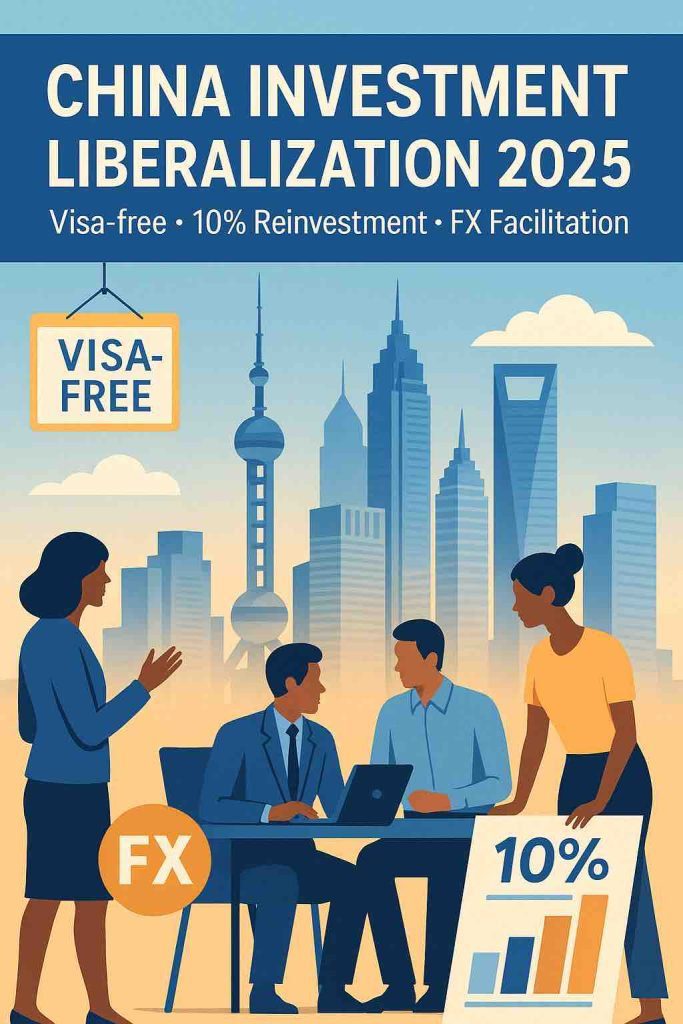
China Investment Liberalization 2025 is the umbrella policy package announced on September 11, 2025, signaling a coordinated shift from simply “opening the door” to actively reducing friction for capital, talent, and projects. Rather than isolated tweaks, these measures form a multi‑agency program to bolster national treatment, simplify cross‑border finance, and speed in‑person business engagement.
What changes now for operators
Against a backdrop of steadily shortened negative lists (with manufacturing already fully open), the policy thrust moves toward market integration—ensuring foreign‑invested enterprises (FIEs) can access local incentives, procurement, and domestic financing on equal terms. China Investment Liberalization 2025 reframes China from a “barrier‑management” market to a “facilitation‑first” market for qualified projects.
The 10% dividend‑reinvestment credit—patient capital rewarded
Under China Investment Liberalization 2025, foreign investors who reinvest dividends in encouraged industries may claim a 10% corporate income tax credit for qualifying capital increases, new entities, or eligible share acquisitions (effective Jan 1, 2025–Dec 31, 2028). This tilts the math toward onshore reinvestment and aligns funds with the Catalogue of Encouraged Industries for Foreign Investment.
Visa‑free Shanghai Eastern Hub—face‑to‑face, faster
A centerpiece of China Investment Liberalization 2025 is the Shanghai Eastern Hub International Business Cooperation Zone near Pudong Airport. With a valid invitation from an entity registered in the zone, foreign business travelers may enter visa‑free for up to 30 days, extendable once by 30 days, enabling rapid conferences, demos, and negotiations before transitioning to standard procedures for travel beyond the zone.
FX and capital‑account ease—SAFE’s quiet unlock
Banks are empowered to process more service‑trade FX on KYC and due‑diligence principles; non‑investment FIEs can deploy registered capital for domestic equity investments; and constraints around certain capital accounts and M&A margin‑account settlements are relaxed. In practice, China Investment Liberalization 2025 reduces operational bottlenecks and shortens time‑to‑fund across M&A and equity transfers.
Align with the Encouraged Catalogue for outsized support
Linking reinvestment incentives to the Encouraged Catalogue turns it into a financial roadmap. Projects mapped to high‑priority sectors (advanced manufacturing, modern services, green tech) benefit most under China Investment Liberalization 2025, improving eligibility for tax credits and local facilitation.
Regional execution models you can sequence
Treat the visa‑free Shanghai hub, CEPA‑driven services integration in the Greater Bay Area, and free‑trade‑port experiments like Hainan as complementary paths—select the model that accelerates each stage of your China program within China Investment Liberalization
A 90‑day playbook to convert policy into ROI
Build a reinvestment worksheet using the 10% credit, reserve dates in the Shanghai hub for executive sessions, and update treasury SOPs to reflect streamlined SAFE documentation. Use a “national‑treatment audit” to validate equal access to grants, procurement, and RMB debt—cornerstones of China Investment Liberalization 2025 that directly improve cost of capital and deal velocity.
Why partner with an in‑market specialist
Execution beats headlines. A specialist can validate tax‑credit eligibility, coordinate visa‑free hub invitations, align projects with the Encouraged Catalogue, and operationalize banking flows shaped by China Investment Liberalization 2025. For hands‑on support with setup, hiring, and payroll, talk to FDI China.