
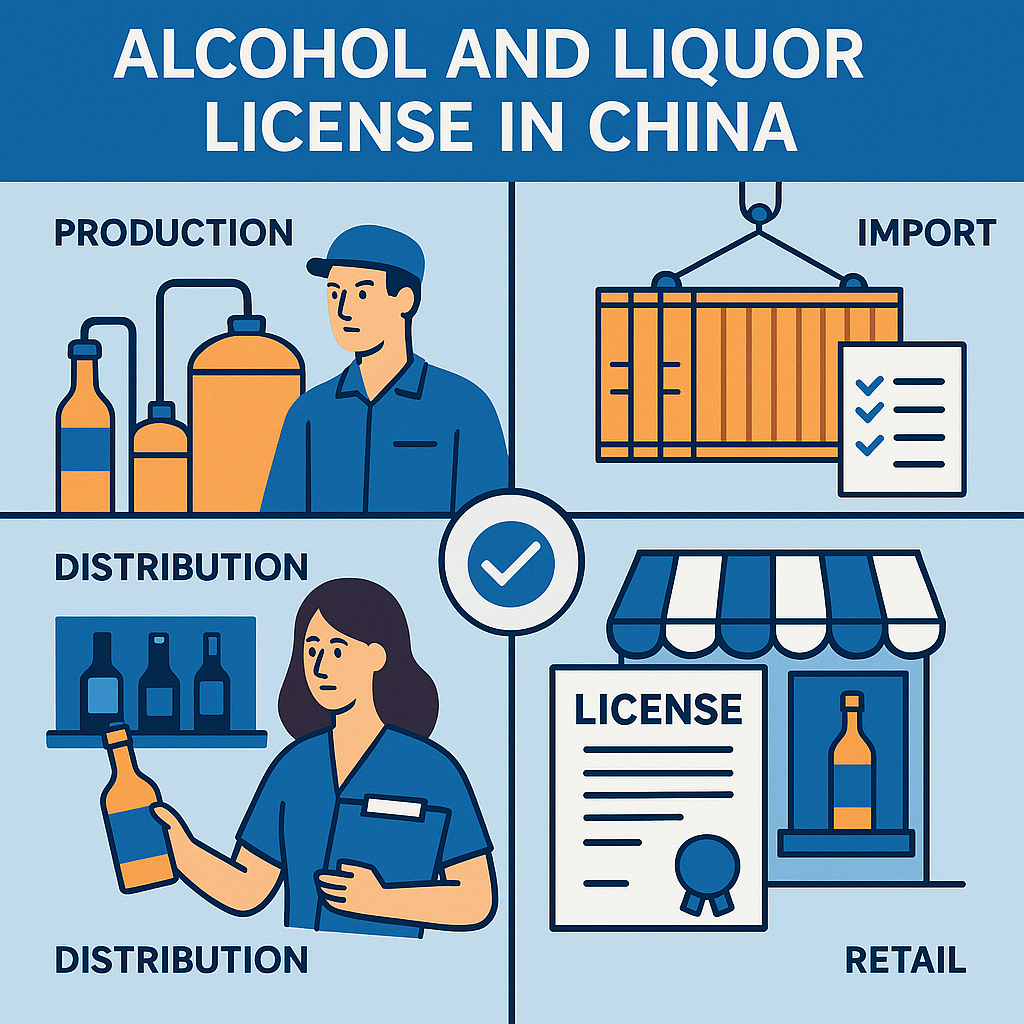
Alcohol and Liquor License in China defines how companies can legally produce, import, distribute, and sell alcoholic beverages in the Chinese market. If you want to bring a foreign alcohol brand into China or expand a local liquor business, you’ll need to understand the licensing framework, key regulators, and practical compliance steps from day one.
- Regulatory foundations and what Alcohol and Liquor License in China actually covers
- Key authorities involved in alcohol licensing and enforcement
- Main license categories for production, import, distribution, and retail sales
- Core regulatory framework for Alcohol and Liquor License in China and related food safety laws
- Step-by-step approach on how to obtain alcohol licenses in China
- Document checklist for foreign and domestic alcohol businesses
- Typical timelines, bottlenecks, and how to avoid delays
- Ongoing compliance duties, inspections, and record-keeping
- Penalties for non-compliance and operating without a valid license
- Strategic tips and FDI perspectives for entering China’s alcohol market
What Alcohol and Liquor License in China Really Means
When people talk about Alcohol and Liquor License in China, they’re not referring to a single, universal license. Instead, it’s a set of approvals and filings that match different activities in the value chain. A producer, an importer, a wholesaler, and a bar owner will not hold the same license, even though they all deal with alcohol.
In practice, you’ll usually see separate approvals for food production, food business operations, import filing with customs, distribution, warehousing, and retail sales. Understanding which part of the chain you occupy is the first step toward choosing the correct licenses.
Key Regulatory Framework for Alcohol and Liquor License in China
China treats alcohol as a special category of food. That means the Alcohol and Liquor License in China system is built on broad food safety legislation and then refined by alcohol-specific rules, advertising standards, and customs measures.
Some of the main pillars include:
- Food Safety Law and related implementing regulations
- National GB standards for beverages and labeling, published via resources like China GB Food Safety Standards
- Customs and import rules available on the China Customs English portal
- Advertising and e-commerce regulations for selling alcohol online
- Local implementation rules issued by municipal regulators
These layers work together to control who can operate in the alcohol supply chain and how products reach Chinese consumers.
Authorities Overseeing Alcohol and Liquor License in China
Several regulators share responsibility for Alcohol and Liquor License in China, and each has a slightly different role. At the national level, market regulators focus on food licensing and enforcement, while customs and health bodies supervise imports and technical standards.
China’s approach also echoes global public health guidance from organizations such as the World Health Organization alcohol resources, which highlight risks linked to irresponsible alcohol marketing and sales.
From an international trade angle, investors often look at references like the OECD trade guidelines or data from financial institutions such as the International Monetary Fund and the World Bank to benchmark China’s regulatory environment against other markets.
Main License Categories in the Alcohol and Liquor License in China System
To make the landscape easier to digest, you can group Alcohol and Liquor License in China obligations into a few main categories: production, imports, wholesale distribution, retail, and e-commerce. Each category comes with different conditions and approval processes.
| Activity Type | Typical License or Filing |
|---|---|
| Domestic production (brewery, distillery, winery) | Food Production License plus environmental and safety approvals |
| Importing foreign alcohol into China | GACC import filing, customs clearance, label review |
| Wholesale distribution to retailers | Food Circulation or similar distribution filing |
| Retail sales (supermarkets, liquor stores, bars) | Food Business License, sometimes alcohol retail filing |
| E-commerce alcohol platforms | Food Business License, platform registration, additional compliance |
Getting this mapping right is crucial before you sign contracts or commit to a warehouse or retail location.
Domestic Production and Alcohol Licensing Requirements
If you’re planning to produce alcohol inside China, the Alcohol and Liquor License in China framework requires you to obtain a Food Production License and pass strict inspections. Authorities will look at your facility layout, equipment, sanitation procedures, and quality management systems.
Producers often adopt international standards to strengthen their internal controls. For example, some refer to the work of the International Organization for Standardization when designing quality management systems for food and beverage manufacturing. This helps demonstrate that they’re serious about safety and traceability.
Importing Alcohol and Liquor into China: Licensing and Compliance
For foreign brands, the import side of Alcohol and Liquor License in China is often the most visible pain point. You’ll need to classify your product correctly under HS codes, arrange customs clearance, and ensure the label meets Chinese requirements.
Many companies cross-check technical and labeling rules using references like the U.S. FDA food labeling guidance or the EU alcohol and beverage safety guidelines, then align those with China’s GB standards to avoid conflicts.
For U.S.-origin spirits and wine, exporters may also interact with agencies such as the Alcohol and Tobacco Tax and Trade Bureau, which provides regulatory guidance on production and export compliance before goods even leave the United States.
Distribution, Wholesale, and Retail Under Alcohol and Liquor License in China
Once alcohol is in the country, it moves through a network of distributors and wholesalers. These players must hold valid food distribution or circulation licenses and sometimes additional alcohol-specific filings. Their role is to move products from production or import hubs to stores, bars, hotels, and online platforms.
Retailers must maintain Food Business Licenses and follow rules on how alcohol is displayed and sold. For higher-end brands, industry events and competitions, such as those organized by the International Wine & Spirits Competition, often influence which labels retailers decide to stock, so compliance and brand story go hand in hand.
Core Compliance Pillars for Alcohol and Liquor License in China
Core Compliance Pillars for Alcohol and Liquor License in China
From an operational point of view, compliance with Alcohol and Liquor License in China requirements sits on a few recurring pillars. These include product safety, correct labeling, traceable logistics, honest advertising, and responsible marketing.
- Product safety: Meeting technical specifications, passing inspection, keeping contamination risks low.
- Labeling: Using compliant Chinese labels in line with GB standards and modelled on global best practices from bodies like the U.S. FDA.
- Documentation: Keeping clear records of purchases, sales, and inventory.
- Marketing: Avoiding misleading claims and respecting restrictions on how alcohol can be promoted.
Global investors who are used to structured regulatory environments often feel more comfortable when they see that China’s liquor licensing regime, while strict, is stable and backed by norms that are broadly consistent with guidance from groups such as the OECD.
How to Obtain Alcohol and Liquor License in China: A Practical Roadmap
If you’re wondering how to obtain an alcohol license in China, a step-by-step view can make the process feel more manageable. While local details will vary, the basic roadmap looks like this:
- Clarify your business model: producer, importer, distributor, retailer, or a mix.
- Confirm local zoning and property suitability for alcohol-related operations.
- Identify all required licenses based on your activities.
- Prepare corporate documents, safety systems, and technical files.
- Submit applications to local market regulators and, for imports, to customs.
- Respond to follow-up questions and arrange site inspections.
- Receive approvals and register with tax and reporting systems.
For foreign-invested companies, choosing the correct legal entity and scope is just as important as filing for the right alcohol licenses. Many investors use models similar to those described in FDI China’s guide on establishing a company in China to make sure that licensing, tax, and operational design all line up.
Document Checklist for Foreign and Domestic Alcohol Businesses
Every region in China has its own detailed checklist, but most Alcohol and Liquor License in China applications rely on a common set of documents. These often include:
- Business license and articles of association
- Identification of the legal representative
- Lease contract and floor plan of the premises
- Food safety management procedures
- Health certificates for staff involved in food handling
- Supply contracts or brand authorization letters for imported products
- Testing reports or compliance declarations where required
Investors focused on risk management sometimes draw on best practices discussed in international risk and governance resources from institutions like the World Bank or IMF when designing their internal control frameworks.
Timelines and Common Bottlenecks in Alcohol Licensing
Timelines for Alcohol and Liquor License in China approvals vary by city and license type, but you should expect weeks or months rather than days. Production licenses may take several months, while retail Food Business Licenses might be processed in a few weeks if your site is straightforward and your documentation is complete.
Common bottlenecks include non-compliant premises, weak documentation of food safety systems, and label designs that don’t match Chinese GB standards. Early coordination with local regulators and consultants can reduce the number of back-and-forth rounds of questions.
Ongoing Compliance and Inspection Under Alcohol and Liquor License in China
Once your Alcohol and Liquor License in China approvals are in place, the real test is ongoing compliance. Regulators can conduct spot checks, review records, and test product batches. Violations can lead to warnings, fines, or even suspension of your ability to trade.
To stay ahead, many companies build monitoring systems that mirror global governance norms and public health goals promoted by bodies such as the World Health Organization. Regular internal audits, employee training, and digital tools for traceability can turn compliance from a burden into a business advantage.
Conclusion: Strategic Outlook for Alcohol and Liquor License in China
China’s alcohol market is large, growing, and competitive. A solid understanding of Alcohol and Liquor License in China requirements helps you treat licensing and compliance as strategic foundations rather than last-minute hurdles. By mapping your business model to the right license categories, learning how regulators interpret the rules, and aligning your operations with both local law and international best practices, you can reduce risk and move faster than competitors who underestimate regulatory complexity.
When your licensing roadmap is clear, you can focus on brand building, channel development, and customer experience, confident that your regulatory footing is strong.