
The integration of autonomous AI agents into daily business operations has fundamentally reshaped the global technological landscape in 2026. At the forefront of this monumental shift is the OpenClaw framework. By empowering the “One Person Company” (OPC) model, international developers and tech entrepreneurs are now capable of deploying sophisticated AI systems that manage end-to-end workflows independently, from code generation to full-scale customer acquisition.
For foreign investors, venture capitalists, and tech innovators looking to capitalize on this paradigm shift within the Asian market, securing proper OpenClaw Company Registration in China is not just an administrative hurdle; it is a critical strategic imperative. Chinese technology hubs are actively incentivizing AI integration, but accessing these funding pools requires rigorous corporate structuring, precise tax planning, and strict data compliance.
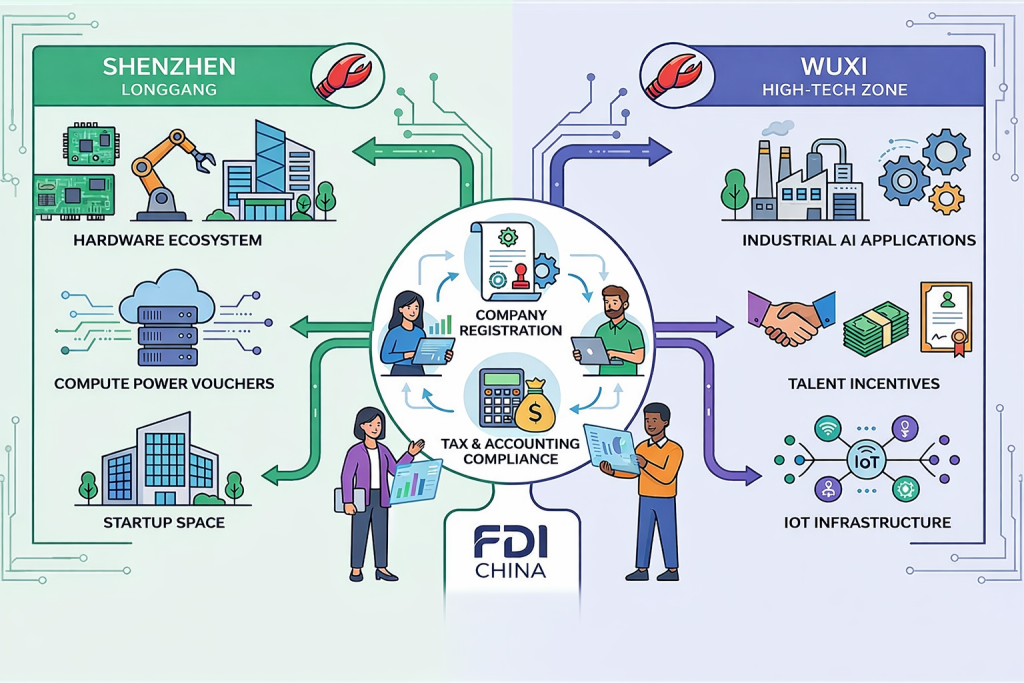
This comprehensive guide provides an authoritative comparison of the leading AI innovation hubs—Shenzhen Longgang District and Wuxi High-Tech Zone. Furthermore, it outlines the definitive roadmap for incorporating, maintaining financial compliance, and safely managing the entire lifecycle of your AI enterprise in China.
1. The Strategic Imperative of Corporate Liability Shielding
Unlike previous iterations of generative AI, which merely responded to prompts, OpenClaw operates as a fully autonomous agent capable of executing complex, multi-step system commands across networks. This technological leap introduces unprecedented legal and operational liabilities.
Operating an autonomous agent without a properly registered corporate entity exposes the individual developer or foreign parent company to unlimited personal liability. If an AI agent inadvertently breaches data privacy protocols or causes financial disruption to a third party, the legal fallout can be catastrophic.
Establishing a formal legal entity, such as a Wholly Foreign-Owned Enterprise (WFOE), serves as a vital corporate shield. It protects founders from personal liability while unlocking access to robust regional government incentives, venture capital ecosystems, and legal protections under Chinese corporate law.
2. Shenzhen Longgang District: The AI Hardware Nexus
Shenzhen’s Longgang District has aggressively positioned itself as the premier ecosystem for AI hardware integration and embodied intelligence. The district’s recent policy initiatives focus heavily on accelerating the deployment of autonomous systems by providing substantial financial backing.
Strategic advantages for foreign tech firms locating in Shenzhen include:
- Targeted R&D Subsidies: Companies that successfully complete their corporate setup and deploy OpenClaw-based architectures can apply for substantial research and development grants.
- Computing Power Vouchers: To alleviate the high cloud architecture costs associated with 24/7 AI operations, Longgang offers significant proportional subsidies on computing power and API call expenditures.
- Incubation Infrastructure: Newly established AI enterprises benefit from subsidized, state-of-the-art office spaces within designated tech parks.
(For official policy announcements, government grant applications, and detailed local administrative guidelines, please refer to the Shenzhen Longgang District Government Official Website. For broader macroeconomic insights into China’s tech sector policies, readers can also refer to authoritative financial publications such as Caixin Global.)
3. Wuxi High-Tech Zone: Championing Industrial AI Integration
Wuxi High-Tech Zone offers a distinct, highly lucrative alternative, prioritizing the application of AI within advanced manufacturing, the Internet of Things (IoT), and industrial internet sectors. For developers building B2B OpenClaw applications, Wuxi provides an unparalleled real-world testing ground.
Key policy highlights from Wuxi include:
- Industrial Integration Incentives: Wuxi provides direct financial rewards for AI startups that successfully integrate their OpenClaw agents into local manufacturing supply chains (e.g., automated quality control or predictive maintenance).
- Long-Term Rent Exemptions: To support the extended development cycles inherent in industrial AI, eligible startups can secure multi-year rent exemptions in designated industrial tech parks.
- High-Caliber Talent Acquisition: The zone offers competitive relocation packages and housing allowances to attract top-tier international AI talent.
(Detailed subsidy structures, enterprise qualification requirements, and industrial park mapping can be verified directly on the Wuxi High-Tech Zone (Xinwu District) Official Portal.)
4. The Roadmap: OpenClaw Company Registration in China
Executing an OpenClaw Company Registration in China requires meticulous attention to the Foreign Investment Law. A minor error can result in months of delays. The process generally follows these crucial phases:
- Corporate Structuring & Name Approval: Selecting the appropriate entity type (typically a WFOE to ensure IP protection). You must submit a proposed Chinese company name to the State Administration for Market Regulation (SAMR).
- Defining the Business Scope: Your business scope must be crafted to reflect software development, AI consulting, and data processing, ensuring it avoids restricted sectors on the Negative List.
- Strategic Site Selection: Registering your legal address within the specific jurisdictions of Longgang or Wuxi is mandatory to ensure eligibility for local incentive programs.
- License Issuance & Chops: Upon SAMR approval, the Business License is issued. The company must then carve its official legal seals (chops) with the Public Security Bureau.
- Capital Verification: Opening specialized corporate bank accounts that comply with the State Administration of Foreign Exchange (SAFE) to facilitate the injection of registered capital.
To ensure a legally compliant market entry, our dedicated experts handle the entire Company Registration in China process, tailored explicitly for high-tech enterprises.
5. Optimizing Corporate Tax and Accounting Compliance
Securing government incentives is only the beginning; maintaining them requires flawless financial records. Chinese tax authorities and high-tech park administrative bodies conduct rigorous audits on all grant recipients.
Tech startups must implement advanced accounting practices that accurately categorize software amortization, R&D expenditures, and server depreciation. Furthermore, AI companies may qualify for significant preferential tax treatments:
- High and New Technology Enterprise (HNTE) Status: Achieving this reduces the corporate income tax rate from the standard 25% to 15%.
- R&D Super Deduction: Tech companies can often deduct up to 100% of their qualified R&D expenses from their taxable income.
Our specialized Accounting and Tax Services ensure your enterprise remains fully compliant with PRC GAAP, allowing you to maximize tax efficiency without distraction.
6. Lifecycle Management: The Criticality of Company Deregistration
A prudent business strategy must account for the entire corporate lifecycle. The AI sector is characterized by rapid innovation and market consolidation. Whether your OpenClaw OPC is acquired, you pivot your model, or you decide to exit, structuring a clean legal exit is vital.
Simply abandoning a Chinese corporate entity is a severe legal violation. It leads to the revocation of the business license, severe tax penalties, and the legal representative being placed on a national credit blacklist, restricting future travel and investment in China.
To mitigate this risk, we provide professional Company Deregistration services. We navigate the complex bureaucratic process of tax clearance audits, bank closures, and SAMR dissolution, ensuring your exit is handled flawlessly.
7. Navigating MIIT Data Security and Algorithm Regulations
Because autonomous agents like OpenClaw require extensive system access, they are subject to stringent oversight by the Ministry of Industry and Information Technology (MIIT) and the Cyberspace Administration of China (CAC).
Foreign tech companies must rigorously comply with the Data Security Law (DSL) and the Personal Information Protection Law (PIPL). This includes:
- Algorithm Filing: Registering your AI models with the CAC registry.
- Data Localization: Ensuring that critical data generated within China is stored on domestic servers.
- Security Assessments: Conducting mandatory security audits before executing cross-border data transfers.
Robust localized server architecture is no longer an optional best practice; it is an absolute legal requirement.
8. Conclusion: Converting Tech to Sustainable Growth
The widespread adoption of the OpenClaw framework in 2026 presents a high-yield opportunity for global tech entrepreneurs. By leveraging the strategic policy environments of Shenzhen Longgang or Wuxi High-Tech Zone, founders can drastically accelerate their operational growth and subsidize their R&D.
However, converting this technological edge into a sustainable, profitable business demands absolute professional rigor. From initial incorporation to ongoing tax compliance, and eventually to secure exit strategies, expert advisory is indispensable.
Ready to launch your AI venture? Contact our corporate advisory team today to initiate your OpenClaw Company Registration in China and ensure your business is structured for maximum conversion and compliance.