

Date: February 26, 2026. Author: FDIChina Team. Reading Time: 12 Minutes.
Introduction: The “Blueprint Year” for Foreign Investment
Here is our exclusive China Two Sessions 2026 Forecast. In just a few days, Beijing will host the 2026 “Two Sessions” (Lianghui). While annual meetings typically focus on short-term targets, the 2026 session carries historical weight: It marks the official commencement of China’s 15th Five-Year Plan (2026-2030).
For corporate strategists, the first year of a Five-Year Plan is the single most important economic signal of the decade. As outlined by the National People’s Congress (NPC), industries prioritized in the “Plan Year” historically receive the widest market access and the fastest administrative approvals for the subsequent half-decade.
Based on the policy trajectory established in late 2025 and the signals from recent provincial meetings, we forecast that the 2026 Two Sessions will pivot from broad stimulus to “Targeted Industrial Support” under the banner of “New Quality Productive Forces.”
What does this mean for your China entry strategy? It means the “Golden Window” for WFOE Registration is opening wide, but only for specific sectors. Here is our detailed China Two Sessions 2026 Forecast on the Top 3 Sectors poised for new setup opportunities.
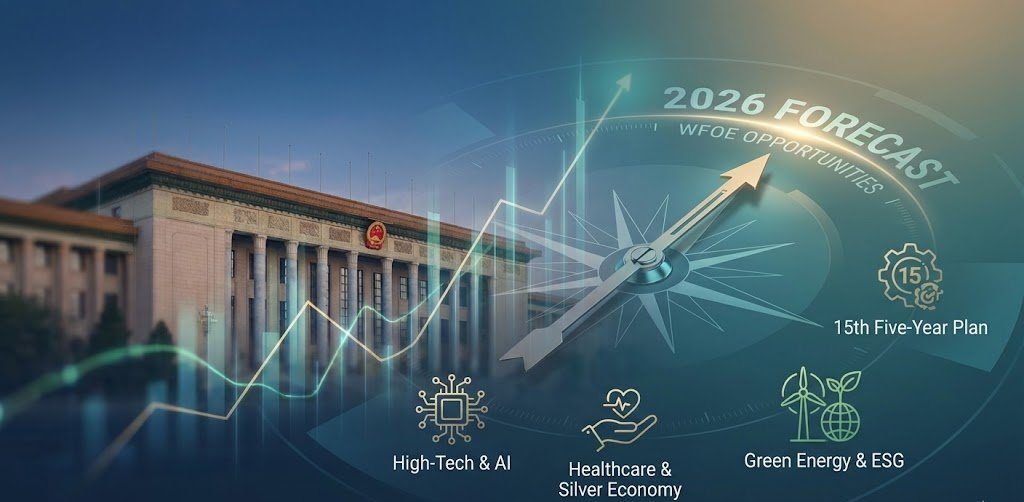
1. The “New Quality” Tech Sector: AI & Advanced Manufacturing
The concept of New Quality Productive Forces is the core guiding principle of the current economic agenda. It refers to productivity led by disruptive innovation rather than traditional heavy investment, serving as the filter through which future government approvals will pass.
The Policy Forecast:
Our China Two Sessions 2026 Forecast indicates that the Work Report will explicitly encourage foreign participation in Industrial AI, Advanced Materials, and SaaS.
- Fact-Based Context: In 2024-2025, China already removed all manufacturing restrictions from the “Negative List.”
- 2026 Forecast: The focus will shift to “Service Liberalization” for tech companies, specifically streamlining the Value-Added Telecommunications Service (VATS) licensing process in Pilot Free Trade Zones (FTZs) like Shanghai Lingang and Hainan.
The Corporate Setup Strategy:
To capture these incentives, the structure of your WFOE matters.
- The “Tech-Dev” Scope: Do not register a generic “Consulting WFOE.” You must register as a “Technology Development” entity. This specific business scope is a prerequisite for:
- Applying for local R&D subsidies available in high-tech zones.
- Qualifying for the 15% High-New Tech Enterprise (HNTE) tax rate later (down from the standard 25%).
FDI China Action: We specialize in drafting compliant Business Scopes that align with the “New Quality” catalog to ensure your entity is eligible for future grants.
2. The “Silver Economy” & Healthcare Opening
With China’s aging population, the State Council has elevated the “Silver Economy” to a national strategic level. This demographic shift represents the world’s largest market opportunity for care services.
The Policy Forecast:
According to our China Two Sessions 2026 Forecast, the meetings will confirm the nationwide rollout or expansion of the “Wholly Foreign-Owned Hospital” pilot program.
- Fact-Based Context: In September 2024, the Ministry of Commerce (MOFCOM) announced a pilot program allowing wholly foreign-owned hospitals in Beijing, Shanghai, Guangdong, and Hainan.
- 2026 Forecast: We anticipate the easing of restrictions on foreign-invested elderly care institutions and vocational training centers (specifically for nursing), moving from “Pilot” status to “Standard” practice.
The Corporate Setup Strategy:
If you are a medical device maker, a senior care provider, or a specialized training academy, the Service WFOE model is now viable with 100% ownership.
- Strategic Timing: Medical and education licenses involve “Pre-approval” or “Post-filing” procedures. Starting the Company Registration in Q1 2026 allows you to secure the business license before the mid-year application surge. This positions you perfectly to apply for industry permits once the new Five-Year Plan details are released in Q2.
3. The Green Supply Chain & ESG
“Dual Carbon” (Peaking Carbon and Carbon Neutrality) remains a rigid constraint. Furthermore, global regulations like the EU CBAM (Carbon Border Adjustment Mechanism) are forcing global supply chains to localize green certification.
The Policy Forecast:
As a key part of our China Two Sessions 2026 Forecast, We anticipate stricter Green Procurement Standards for State-Owned Enterprises (SOEs) and large domestic firms.
- Fact-Based Context: China continues to dominate global renewable energy manufacturing.
- 2026 Forecast: Policies will likely favor “Localized Green Manufacturing.” Importing finished goods may face higher scrutiny or tariffs, while products managed, assembled, or certified by a local Chinese entity will be preferred in government procurement.
The Corporate Setup Strategy:
This creates a massive opportunity for Trading WFOEs specializing in new materials, ESG solutions, and energy-saving technologies.
- The “Importer of Record” Advantage: Establishing a Trading WFOE allows you to be the legal “Importer of Record.” This gives you direct control over the Green Certification and VAT Invoicing processes—critical for selling to large Chinese clients who require full ESG compliance.
FDI China Action: We handle the specific Import/Export License and Customs Registration required for Trading WFOEs.
4. Why Q2 2026 is the Critical “Action Window”
You might ask: “Why not wait until the policies are fully confirmed?”
Here is the reality of China business cycles:
- March (Two Sessions): The signal is given. The “Outline of the 15th Five-Year Plan” is approved.
- April – May (Implementation Rules): Ministries (MOFCOM, MIIT, SAMR) issue detailed implementation rules.
- June Onwards (The Rush): The flood of applications begins. Administrative bureaus become overwhelmed.
The Strategic Advantage: By starting your WFOE Registration process now (which typically takes 4-6 weeks), your legal entity will be fully established just as the new policy incentives go live in Q2. You will have your Business License and Bank Account ready to sign contracts while your competitors are still engaging lawyers.
Conclusion: Don’t Guess. Execute.
In conclusion, our China Two Sessions 2026 Forecast confirms that the opportunities in China are shifting from “low-cost labor” to “High-Tech, Healthcare, and Green Energy.”
For corporate decision-makers, the question is not “Should we invest?” but “Is our corporate structure ready to capture the 15th Five-Year Plan dividends?”
FDI China specializes in corporate structuring for this new era. We design the foundation that allows you to operate compliantly and secure your market entry license.
Ready to seize the Policy Window?
Step 1: Identify which sector your business fits into. Step 2: Request a customized registration proposal.