
GSXT information is the primary source used to verify company registration and credit records in China. For foreign investors, compliance teams, and due diligence professionals, understanding GSXT information is essential when checking Chinese companies.GSXT is the primary public platform used in China to disclose company registration and credit information. For foreign investors, compliance teams, and due diligence professionals, understanding what information can be found on GSXT is essential when verifying Chinese companies.
This article explains the types of information publicly available on GSXT, how it is typically used, and what limitations foreign users should be aware of.
What Is GSXT and Why It Matters
GSXT refers to the National Enterprise Credit Information Publicity System, China’s official database for company registration and credit disclosure. It is operated under the supervision of the State Administration for Market Regulation (SAMR) .
In practice, GSXT is the starting point for verifying whether a Chinese company legally exists and whether it is in good standing.
If you are unfamiliar with GSXT or how it compares to company registries in other jurisdictions, you may find our overview on whether GSXT is the official China Companies House helpful.
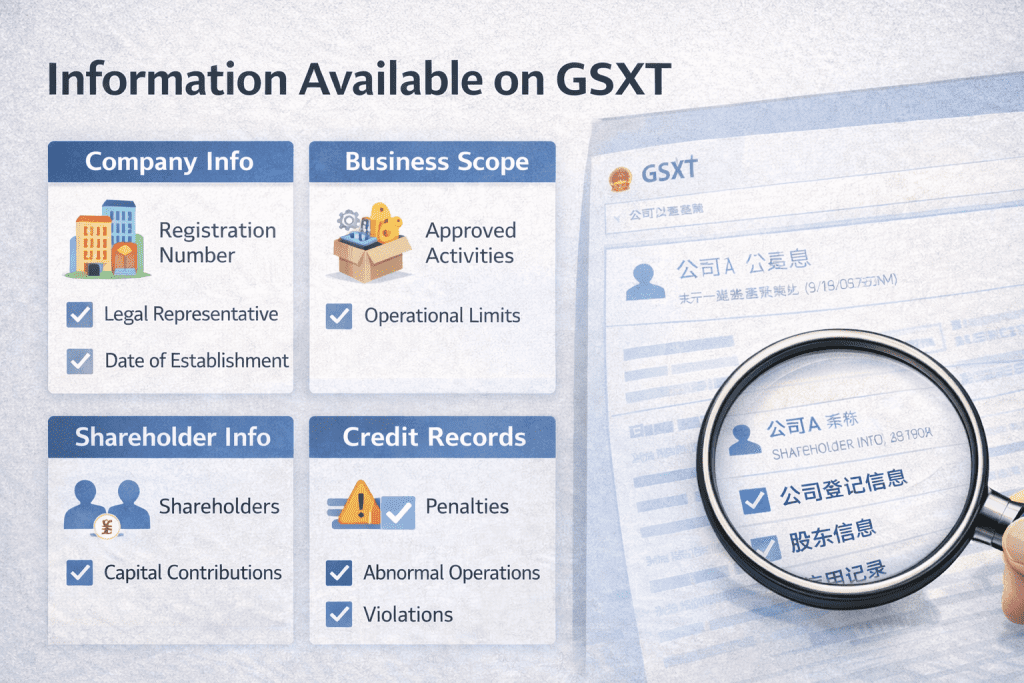
GSXT Information Available for Company Registration
The most commonly accessed information on GSXT relates to basic company registration details.
- Official Chinese company name
- Unified Social Credit Code (company registration number)
- Company type (e.g. WFOE, domestic company, joint venture)
- Registration status (active, revoked, deregistered)
- Date of establishment
- Registered address
- Legal representative
This information allows users to confirm whether a company is legally registered and currently active.
Business Scope and Operational Details
GSXT also displays the company’s approved business scope, which defines the activities the company is legally permitted to conduct in China.
Reviewing the business scope is important when:
- Assessing whether a supplier or partner can legally provide certain services
- Conducting preliminary compliance checks
- Evaluating regulatory exposure
Shareholding and Investment Information
Depending on the company and region, GSXT may show limited shareholding information, including:
- Shareholders’ names (for many domestic companies)
- Capital contribution commitments
- Equity structure changes recorded with regulators
For foreign-invested enterprises, shareholder information is often more limited in public disclosure.
Administrative Penalties and Compliance Records
One of the most valuable features of GSXT is its disclosure of regulatory actions.
GSXT may list:
- Administrative penalties imposed by regulators
- Inclusion on abnormal operation lists
- Serious violation records
This information is commonly reviewed during initial risk screening and compliance assessments.
Annual Reporting and Credit Disclosure
GSXT is also used as the platform for annual reporting disclosure. Companies are required to submit certain annual information, portions of which become publicly visible.
Publicly available elements may include:
- Confirmation that annual reporting obligations were completed
- Basic operational indicators
- Changes to registration details
Failure to complete annual reporting may result in negative credit indicators on GSXT.
What Information Is Not Fully Available on GSXT
Despite its importance, GSXT does not provide a complete picture of a company’s financial or legal position.
Information typically not available or only partially available includes:
- Detailed financial statements
- Tax filing records
- Banking information
- Private contracts or litigation details
As a result, GSXT should be viewed as an initial verification tool rather than a substitute for full due diligence.
How Foreign Users Typically Use GSXT
Foreign investors and firms commonly use GSXT to:
- Confirm basic company registration details
- Locate a company’s Unified Social Credit Code
- Screen for obvious compliance red flags
- Support onboarding and counterparty verification
If your primary goal is locating or verifying a company registration number, you may also refer to our step-by-step guide on Chinese company registration number search in 2025 .
Conclusion
GSXT provides a centralized and authoritative source of public company information in China. Users can find essential registration data, business scope details, and selected compliance records that help establish whether a company is legally registered and operating normally.
While GSXT does not replace full legal or financial due diligence, it remains an indispensable first step for foreign firms conducting company verification and compliance screening in China.