
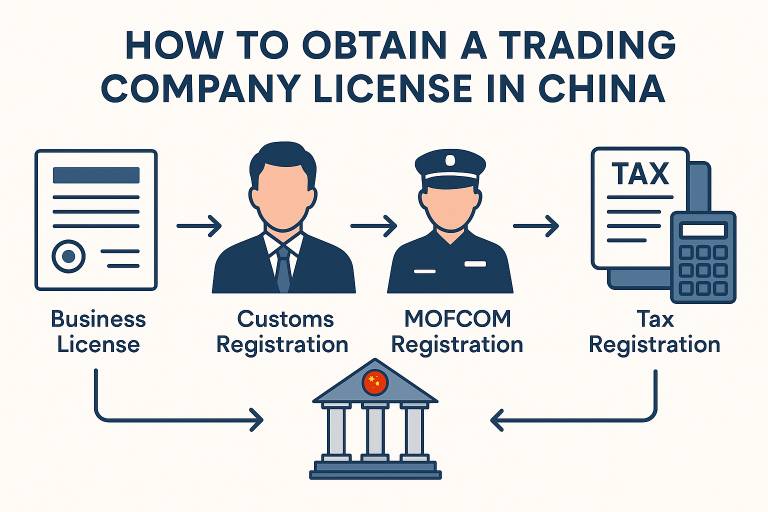
Trading company license China rules determine how foreign investors can legally engage in import, export, distribution, wholesale, and cross-border trading activities in the Chinese market. Unlike a service-based WFOE, a foreign-invested trading company (commonly known as an FICE) requires multiple layers of registration and approval—including business license configuration, customs registration, foreign trade operator filing, foreign exchange permission, VAT registration, and in many cases, export tax rebate eligibility. Because trading companies interact with customs, banks, tax bureaus, logistics providers, and overseas partners, the licensing process is more complex than forming a typical consulting WFOE.
This comprehensive guide explains how foreign firms can obtain a trading company license China, what approvals are required, and 12 powerful steps for full compliance.
Below is a summary of the major sections covered:
- What is a trading company license in China?
- What foreign firms can and cannot do
- 12 steps required to obtain the full license
- Customs, foreign exchange, and tax requirements
- Common challenges and how to avoid them
What Is a Trading Company License China?
In China, a “trading company license” does not refer to a single standalone certificate. Instead, it is a combined qualification framework that allows a Foreign-Invested Commercial Enterprise (FICE) to import and export goods legally. This qualification suite includes:
- Business License with “import & export” in the registered business scope (SAMR)
- Customs Declaration Enterprise Registration (GACC)
- Electronic Port Card (电子口岸卡)
- Foreign exchange registration for trade settlement (SAFE)
- VAT tax control system and e-fapiao activation
The legal foundation for these licenses can be found on official government websites such as the Ministry of Commerce MOFCOM and China Customs GACC.
What Foreign Trading Companies Can Do
Once fully licensed, a trading company can legally:
- Import and export goods
- Conduct domestic wholesale and retail distribution
- Act as an international trading agent
- Issue fapiao (tax invoices) for sales
- Hold inventory and manage logistics
- Receive foreign and domestic payments
Trading companies are often used for e-commerce operations, cross-border supply chain management, wholesale distribution, sourcing activities, and export-driven manufacturing.
What Trading Companies Cannot Do
Foreign trading companies may not engage in:
- Trading goods restricted by China’s negative list (e.g., news publications, certain chemicals)
- Special regulated industries without additional permits (food import, cosmetics, pharmaceuticals, medical devices)
- Import or export activities without customs approval
- Trade settlement using personal bank accounts
Sensitive products may require approval from other regulators such as the National Medical Products Administration (NMPA) or the Ministry of Agriculture.
12 Powerful Steps to Obtain a Trading Company License China
The following 12 steps summarize the complete licensing process for foreign trading companies entering the Chinese market.
1. Determine Business Scope and Company Structure
Your business scope must explicitly include “import and export of goods,” “technology import/export,” or “domestic trade.” This is required by the State Administration for Market Regulation (SAMR).
2. Select the Right City and Physical Office Location
A valid commercial lease is required. Virtual offices are not accepted for trading companies due to customs verification requirements.
3. Complete WFOE/FICE Registration
Foreign investors must obtain their business license first. This includes Articles of Association, investment documents, identification, and office lease filings.
4. Obtain the Electronic Port Card (电子口岸卡)
(Note: The former MOFCOM Foreign Trade Operator Filing was officially abolished on December 30, 2022). Today, after securing your business license with an import/export scope, you proceed directly to applying for the Electronic Port Card (IC Card). This digital key enables your company to handle customs declarations, tax refunds, and foreign exchange reporting online.
5. Register with Customs (GACC)
This is essential for import/export activities. Customs registration creates your enterprise customs code and activates your entry in the GACC system.
6. Set Up China’s Tax Control System
Trading companies must activate:
- VAT taxpayer registration
- fapiao system and UKey
- tax digital filing authority
7. Register for Foreign Exchange Settlement (SAFE)
All import/export companies must register with SAFE for trade-related foreign exchange settlement. Information is available on the SAFE official website at safe.gov.cn.
8. Open All Required Corporate Bank Accounts
A trading company requires:
- Basic RMB account
- Capital account
- Foreign currency settlement account
9. Apply for Export Tax Rebate Qualification
Export-driven foreign companies benefit significantly from tax refunds. This requires:
- tax bureau audit
- accounting compliance
- accurate HS code classification
10. Evaluate Industry-Specific Licenses (If Needed)
Standard customs registration allows for the import/export of general goods. However, restricted or specialized products require additional annual qualifications or batch-by-batch permits:
Food, Cosmetics & Medical Devices: Requires registration with the NMPA, GACC food importer filings, or medical device operation permits.
Automobiles & Used Cars: An ordinary trading company does not automatically receive auto export permits. Exporting used cars requires specific annual enterprise qualifications and batch export licensing.
11. Establish Internal Compliance for Invoices, Customs, and Logistics
Foreign firms must adopt:
- proper HS code classification
- customs declaration procedures
- supplier screening
- logistics risk management
12. Begin Import/Export Operations and Maintain Compliance
Ongoing obligations include:
- monthly VAT filing
- customs reporting
- foreign exchange settlement compliance
- annual cooperative inspection for foreign trade operators
Compliance Requirements for Trading Company License China
Trading companies must carry out:
- regular customs filings
- accurate VAT invoice management
- cross-border payment documentation
- multi-department reporting (customs, tax, SAFE)
Additionally, China’s enterprise credit system (gsxt.gov.cn) monitors compliance across agencies.
For general company registration guidance, refer to FDI China’s China Company Setup Guide.
Common Challenges for Foreign Firms Seeking a Trading Company License China
Foreign trading companies often struggle with:
- incorrect business scope wording
- failure to obtain customs registration
- complex VAT and fapiao rules
- SAFE documentation issues
- misclassification of imported/exported goods
- delays with export tax rebate approvals
These challenges highlight the importance of accurate filings and working with experienced advisors.