
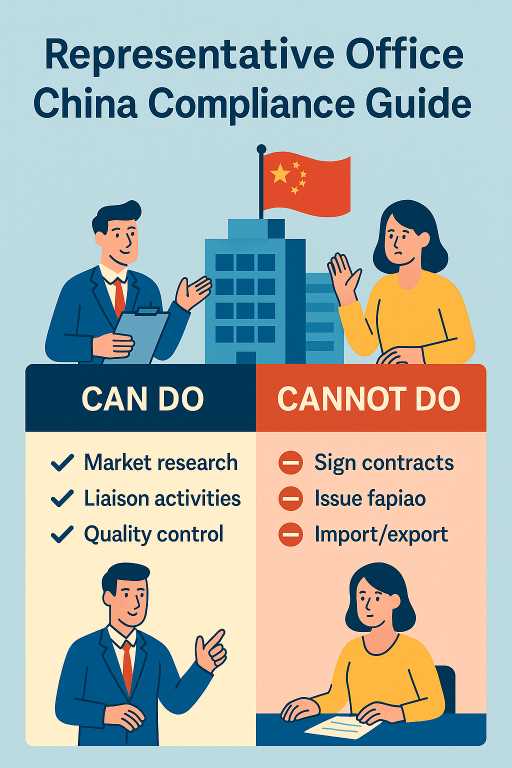
Representative office China is one of the simplest legal structures available to foreign companies seeking a presence in China without conducting commercial or profit-generating activities. A Representative Office (RO) can engage in liaison, market research, vendor coordination, and quality control—but it cannot invoice, cannot sign contracts, and cannot operate as a revenue-generating entity. Because of these strict limitations, foreign companies must fully understand what an RO can and cannot do, along with its compliance obligations under Chinese law.
Below is a summary of the major sections included in this guide:
- What Is a Representative Office in China?
- What a Representative Office Can Do
- What a Representative Office Cannot Do
- 12 Critical Rules Foreign Investors Must Know
- Compliance Requirements and Annual Obligations
- Common Challenges for Foreign Companies
What Is a Representative Office China?
A representative office China is a non-profit, liaison-only entity that allows a foreign company to maintain a limited presence in China without establishing a full subsidiary (WFOE) or joint venture. The RO has no legal personhood—it cannot independently conduct commercial activities and cannot generate revenue.
An RO’s purpose is to represent its parent company. This structure is commonly used by foreign companies entering China for the first time or maintaining a light operational footprint for communication, sourcing, or quality control functions.
Official guidance can be found on the State Administration for Market Regulation (SAMR) and MOFCOM websites.
What a Representative Office China Can Do
Despite strict restrictions, an RO in China is permitted to conduct a number of non-commercial activities, including:
- Market research and industry study
- Business liaison between the parent company and Chinese stakeholders
- Vendor and supplier coordination
- Quality inspection and product sourcing oversight
- Promotional activities (non-contractual)
- Internal management communication and reporting
These activities must strictly support the parent company’s international operations and cannot involve commercial execution inside China.
What a Representative Office China Cannot Do
Foreign companies must clearly understand the limitations, as violations may result in fines or forced closure. A representative office in China is prohibited from:
- Issuing fapiao (Chinese tax invoices)
- Signing commercial contracts (contracts must be executed by the overseas parent company)
- Conducting sales or profit-generating activities
- Collecting payments or engaging in revenue transactions
- Providing paid services to Chinese clients
- Importing or exporting goods under its own name
- Hiring employees directly (must use a licensed labor dispatch agency such as FESCO or Foreign Affairs Service Centers)
- Opening branches or additional offices
These restrictions are rooted in Chinese administrative law and taxation policy, as published by the State Taxation Administration.
12 Critical Rules Every Foreign Investor Must Know About Representative Office China
1. An RO Cannot Generate Revenue in China
All income-producing activity is strictly prohibited. Any contract, invoice, or payment must be executed under the parent company abroad.
2. An RO Cannot Issue Fapiao
RMB transactions inside China normally require a fapiao. Because ROs cannot issue fapiao, they cannot legally bill Chinese entities. This prevents ROs from acting as operating businesses.
3. An RO Cannot Sign Commercial Contracts
Only the parent company may sign contracts. Any contract signed in China by an RO is considered invalid and may cause compliance violations.
4. An RO Cannot Hire Employees Directly
ROs must hire through an authorized labor dispatch agency such as FESCO or a local Human Resources Service Center. All employment contracts, payroll, and social insurance must be administered through the dispatch provider.
5. An RO Must Maintain a Physical Office
Virtual offices are not permitted. The address must be a legally registered commercial office location approved by the AMR.
6. An RO Must File Quarterly Tax Payments
Even though ROs cannot earn revenue, they are still taxed. Typically, ROs pay taxes based on a deemed-profit method (cost-plus), which includes office expenses, labor dispatch fees, rent, and other costs.
7. An RO Must Complete Annual Inspection
Every year, ROs must undergo a joint annual inspection with the AMR, tax bureau, and foreign exchange bureau. Failure to complete annual inspection may result in penalties or revocation.
8. An RO Must Keep Complete Accounting Records
Despite operating on a non-profit basis, ROs must maintain financial statements, vouchers, and statutory accounting records in accordance with Chinese Accounting Standards.
9. An RO Cannot Conduct Import or Export Activity
ROs cannot act as trading entities. They cannot clear shipments, sign purchase orders, or engage in cross-border transactions as a China entity.
10. An RO Cannot Participate in Restricted or Prohibited Industries
Foreign companies using ROs must still abide by the China foreign investment negative list. Industry restrictions apply regardless of entity type.
11. An RO Must Appoint a Chief Representative
The Chief Representative is legally liable for the RO’s compliance. Changes in this role must be registered with the AMR.
12. An RO Must Coordinate With Multiple Bureaus
RO operations involve ongoing communication with the AMR, tax bureau, and local foreign affairs office, as published in guidelines on the Pkulaw legal database.
Compliance Requirements for Representative Office China
Representative offices must meet strict compliance standards, including:
- quarterly tax filing and payment
- annual inspection and reporting
- maintaining an approved registered office
- filing changes in address, representatives, or office staff
- using a licensed dispatch agency for employment
These compliance requirements place ROs under tighter administrative supervision compared to WFOEs, despite being non-profit entities.
For further guidance on business compliance standards, refer to FDI China’s China Business Compliance Guide.
Common Challenges When Managing a Representative Office China
Foreign companies often encounter common issues such as:
- misunderstanding the operational limitations of an RO
- difficulties managing employee dispatch contracts
- unexpected tax assessments due to cost-based tax methods
- administrative delays when changing office address or Chief Representative
- inconsistencies in local bureau interpretations of regulations
Because ROs cannot invoice or conduct sales, many foreign companies eventually convert their RO to a WFOE for full commercial capability.
Conclusion
Setting up a representative office China is an effective way for foreign companies to establish a low-cost presence focused on research, communication, and supplier coordination. However, the strict operational limitations—including the inability to sign contracts, issue fapiao, or hire staff directly—require careful management. By understanding the legal boundaries and meeting ongoing compliance obligations, foreign companies can operate an RO confidently and plan future expansion into a full commercial entity such as a WFOE.