
Foreign company naming rules in China define how overseas enterprises can legally choose and register a Chinese business name. Understanding these rules is essential for compliance, brand protection, and a smooth company registration process.
Basic structure of a company name in China
A Chinese company name generally consists of four parts:
Administrative region + Company name (brand or trade name) + Industry descriptor + Organizational form
Example:
Shanghai BlueWave Technology Co., Ltd.
Formula:
🟩 Administrative Region + Trade Name + Industry Descriptor +Organizational Form
This structure ensures every company name is unique, traceable to its jurisdiction, and consistent with regulatory records
Key components explained
| Component | Description | Example / Rule |
|---|---|---|
| Administrative Region | Refers to the city or province where the company is registered. | “Shanghai”, “Beijing”, “Guangdong” |
| Trade Name (字号) | The core identifier; chosen by the investor. | Must be unique and avoid political, religious, or misleading terms. |
| Industry Descriptor | Defines the main business activity. | Technology, Trading, Consulting, Manufacturing, Investment |
| Organizational Form | Specifies company type. | Co., Ltd. / 有限公司 (Limited Liability Company) |
Common naming formats for foreign-invested entities
1. Wholly Foreign-Owned Enterprise (WFOE)
Format:
Administrative region + Trade name + Industry + Co., Ltd.
Example:
Shanghai Greenlight Consulting Co., Ltd.
2. Sino-foreign Joint Venture (JV)
Format:
Administrative region + Trade name + Industry + Co., Ltd.
Example:
Shenzhen BrightVision Medical Equipment Co., Ltd.
3. Foreign-invested Holding Company
Format:
Trade name + (China) + Industry + Co., Ltd.
Example:
Siemens (China) Investment Co., Ltd.
⚠️ Using “China” requires State Council approval.
4. Representative Office
Format:
Foreign enterprise name + (City/China) + Representative Office
Example:
Microsoft Corporation (Shanghai) Representative Office
Foreign company naming rules in China——Restricted and prohibited words
Prohibited content
- Anything harming national interests or public morality
- Misleading or deceptive names
- Foreign government or organization names without approval
- “China,” “National,” “International,” or “Global” without legal consent
- Superlatives like “best,” “top,” “world-class,” or “No. 1”
Special words requiring approval
- “Bank,” “Insurance,” “Securities,” “Fund” (financial supervision)
- “Education,” “Medical,” “Energy” (sector-specific permits)
- “Group” or “Holdings” (requires multiple subsidiaries)
Name approval process and pre-registration
- Initial check — Search for duplicates via the Enterprise Name Online Application System of the State Administration for Market Regulation (SAMR).
- Submit alternatives — Provide 3–5 name options.
- Regulator review — Market Supervision Bureau examines similarity, scope, and compliance.
- Name reservation — Valid for 6 months after approval.
- Company registration — Once approved, the name is locked at the national level.
Tip: Pre-verify both Chinese and English versions to avoid rejection during the business license issuance.
foreign company naming rules in China-Using “China” or “International” in company names
| Word | Rule | Approval Authority |
|---|---|---|
| “China” | Restricted; must indicate nationwide scope or be a state-owned enterprise. | State Council |
| “International” | Allowed only if company has cross-border operations or multiple foreign branches. | Provincial SAMR |
| “Group” | Requires ≥ 2 subsidiaries and combined registered capital > RMB 50 million. | Provincial SAMR |
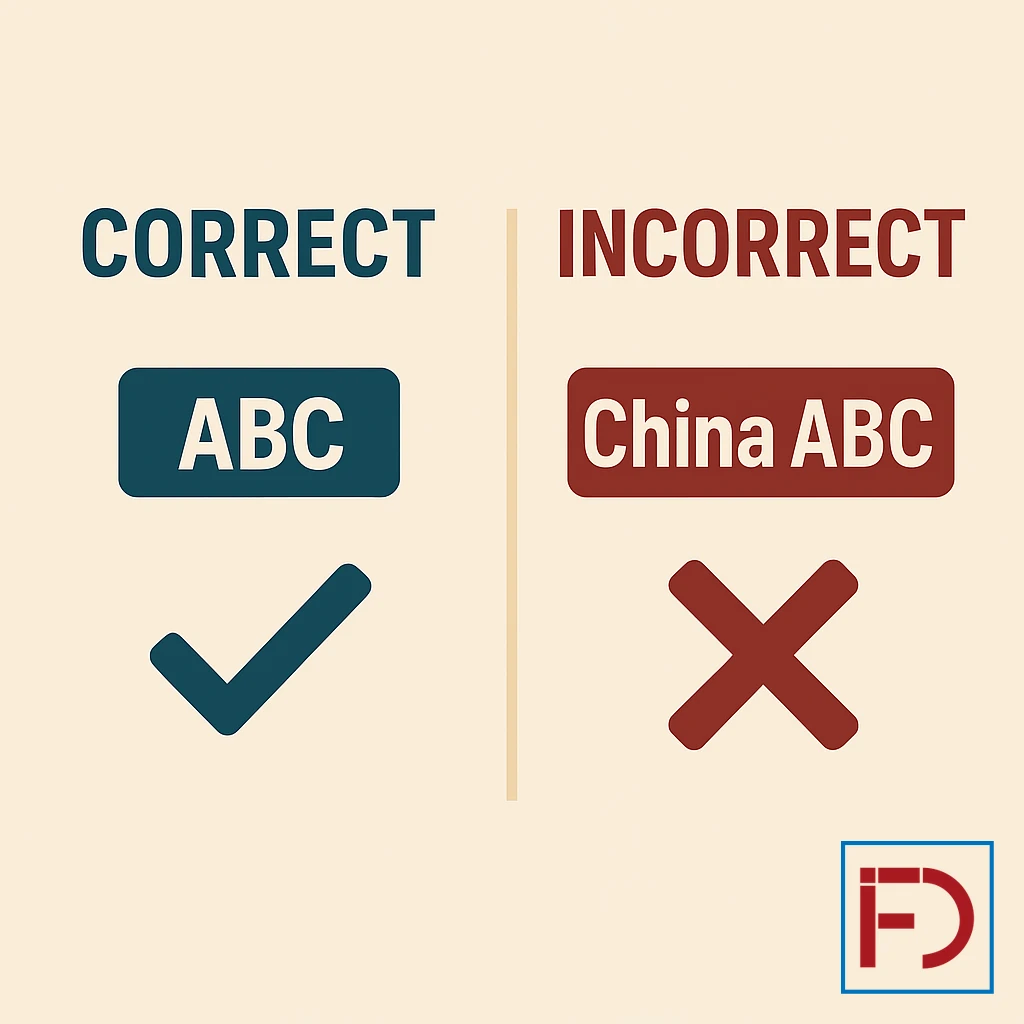
Correct vs. incorrect naming examples
| Correct Example | Incorrect Example | Issue |
|---|---|---|
| Beijing NovaTech Consulting Co., Ltd. | China NovaTech Consulting Co., Ltd. | “China” not allowed without approval |
| Shanghai Horizon Trading Co., Ltd. | Shanghai Best Global Trading Co., Ltd. | Contains “Best Global” exaggeration |
| Apple (China) Investment Co., Ltd. | Apple China Co., Ltd. | Missing approval for “China”; improper format |
| Siemens (Shanghai) Representative Office | Siemens China Limited | Representative offices cannot use “Limited” |
Bilingual and brand naming tips
- Align your Chinese trade name (字号) with the global brand sound or meaning.
- Avoid direct transliteration that sounds awkward or similar to local slang.
- Use short, easy-to-remember Chinese names with 2–4 characters.
- Register both Chinese and English names with trademark protection early.
- Keep tone culturally neutral and professional for regulators and partners.
Legal framework and governing bodies
| Law / Regulation | Issuing Authority | Key Points |
|---|---|---|
| Administrative Measures on Enterprise Names (2023 Revision) | State Administration for Market Regulation (SAMR) | Defines structure, restrictions, and registration procedures. |
| Regulations on the Registration of Foreign-Invested Enterprises | MOFCOM / SAMR | Sets naming, capital, and approval requirements. |
| Regulations on Foreign Enterprises’ Representative Offices | MOFCOM | Clarifies representative office naming. |
Practical recommendations for foreign investors
- Prepare multiple name options to improve approval success.
- Reserve names early during feasibility or WFOE planning.
- Avoid using restricted terms unless justified by actual operations.
- Keep the Chinese and English versions consistent for branding and documentation.
- For multi-city expansion, secure your trade name in key jurisdictions to prevent conflicts.
Conclusion
Choosing the right company name under China’s strict registration system is both a legal requirement and a strategic branding decision. Understanding the foreign company naming rules in China ensures smooth approval, protects your intellectual property, and builds local trust.
If you’re preparing to register your business, consult professionals familiar with WFOE registration and foreign-invested enterprise law to avoid costly name rejections or re-filings.