
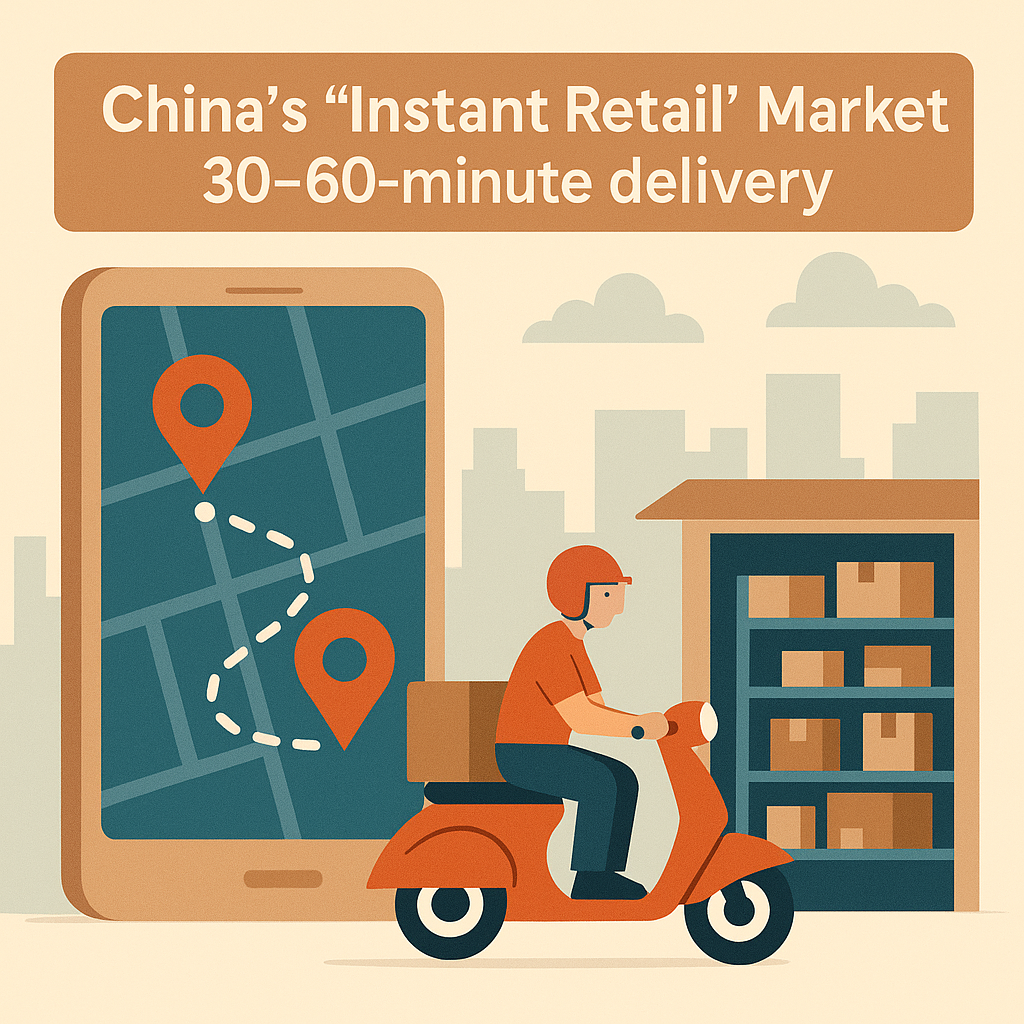
China’s “Instant Retail” Market refers to on‑demand commerce where local stores, micro‑fulfillment hubs, and rider fleets deliver online orders—often within 30 to 60 minutes—to urban consumers. For FDI teams, this model blends retailing, logistics, and data. It changes how brands launch, price, and service customers across Tier‑1 to Tier‑4 cities.
- Definition and scope of China’s “Instant Retail” Market
- Demand drivers and consumer behavior
- Core categories, margins, and basket economics
- City‑tier playbooks and store formats
- Last‑mile logistics & micro‑fulfillment
- Tech stack and data integration
- Entry models: WFOE, JV, and partner routes
- Channel partnerships with leading platforms
- Legal, tax, and data‑privacy checkpoints
- Costs & timelines table for decision‑makers
- Risks, mitigations, and 2025–2027 trends
Definition and scope of China’s “Instant Retail” Market
In simple terms, China’s “Instant Retail” Market delivers goods from nearby inventory—supermarkets, pharmacies, convenience stores, brand shops, and dark stores—to consumers on demand. Orders flow through super‑apps and specialized platforms; couriers fulfill close‑to‑home. The same network supports grocery, FMCG, beauty, pet care, OTC pharma, and even small electronics. For foreign brands, “instant” means online reach + offline inventory working as one profit engine.
Common service windows (illustrative)
- 30–60 minutes: groceries, snacks, beverages, daily necessities
- 60–120 minutes: beauty, OTC, small electronics, home goods
- Same‑day: bulky items or special handling
Demand drivers and consumer behavior
Why does China’s “Instant Retail” Market scale so quickly? Three forces stand out:
- Dense urban living: Short rider distances make 30‑minute SLAs realistic.
- Super‑app habits: Users already buy food delivery, ride‑hailing, and pay bills in one mobile workflow.
- Trust in time‑definite delivery: Consumers expect accurate ETAs, real‑time tracking, and easy refunds.
Shoppers often use instant retail for “need‑it‑now” moments (forgotten ingredients, urgent baby supplies) and for routine top‑ups between weekly grocery runs. Cross‑selling turns small baskets into profitable runs—think beverages + snacks, or mask + toner in beauty.
Core categories, margins, and basket economics
Not every category behaves alike. Use the mix to protect margins.
- Grocery & FMCG: High frequency, lower unit margin; win on speed and coverage.
- Pharmacy/OTC: Higher margin, strict compliance; strong loyalty potential.
- Beauty & personal care: Attractive margin with curated SKUs; leverage impulse buys.
- Pet care & specialty: Repeatable baskets (food + litter + treats).
- Small electronics & accessories: Lower frequency, strong add‑on potential (cables, cases).
Tip: Map contribution margin by category after delivery cost, promotions, and platform take‑rates. Prioritize SKUs with good GM% × velocity × add‑on probability.
City‑tier playbooks and store formats
China’s urban tiers change the economics of China’s “Instant Retail” Market.
- Tier‑1 (e.g., Shanghai, Beijing): High order density; premium SKUs; shorter zones; micro‑fulfillment or dark stores thrive.
- Tier‑2/3: Balanced density; use hybrid formats (store‑backroom + rider staging).
- Tier‑4 & county towns: Lower order density; partner with local chains; focus on pharmacy/FMCG and cost‑optimized service windows.
Store format choices
- Dark store / MFC: Best SLA and pick rates, requires capex and forecasting rigor.
- Ship‑from‑store: Fast to deploy, leverages retail footprint; needs strong inventory sync.
- Hub‑and‑spoke: A central stocking point feeding neighborhood pick‑points.
Last‑mile logistics & micro‑fulfillment
Last mile is the heartbeat of China’s “Instant Retail” Market. You’ll orchestrate:
- Rider networks: mix of platform riders and in‑house fleets; dynamic batching controls cost.
- Order zoning: smart heat‑maps keep SLAs realistic without ballooning fees.
- Picking productivity: handhelds, guided routes, and shelf zoning lift UPH (units per hour).
- Packaging & cold chain: for produce and pharma SKUs; reduce leakage and returns.
Operational golden rule: Keep pick + handoff under 10 minutes for 30‑minute delivery zones; push prep times to the backroom, not the aisle.
Tech stack and data integration
To succeed in China’s “Instant Retail” Market, tie physical inventory to digital demand.
- Core stack: OMS (order management), IMS (inventory), POS integration, rider dispatch, payment, and e‑invoice.
- Data fabric: real‑time stock visibility by location; ETA algorithms; demand sensing to set replenishment.
- Personalization: coupons and bundles auto‑triggered by weather, time of day, or basket history.
- Data governance: comply with local privacy rules; restrict data export; document processing logic.
Entry models: WFOE, JV, and partner routes
Foreign investors can approach China’s “Instant Retail” Market in several ways:
- WFOE (Wholly Foreign‑Owned Enterprise): Full control over brand and data; needs local hiring, tax, and licensing.
- Equity or contractual JV: Access to local footprint or licenses; agree on pricing, data use, and service levels up front.
- Partner/Distributor: Rapid scale via existing networks; trade control and marketing rights precisely in contracts.
- CBEC (Cross‑Border E‑Commerce) add‑on: For certain SKUs, test demand with bonded‑warehouse or direct‑mail models while you build local inventory.
Need a turnkey path? See FDI China for on‑the‑ground entity setup, HR/payroll, and ongoing compliance tailored to fast‑moving retail.
Channel partnerships with leading platforms
Most brands meet customers where they already shop:
- On‑demand delivery ecosystems: collaborate with instant retail channels inside leading super‑apps and delivery platforms.
- Retail media & ad tools: boost visibility with geo‑targeted ads, banners, and in‑app search.
- Omnichannel sync: share prices, promos, and inventory across your app, partner storefronts, and physical shops.
China’s “Instant Retail” Market rewards brands that treat each platform like a separate P&L with its own take‑rate, promo calendar, and SLA.
Legal, tax, and data‑privacy checkpoints
Compliance isn’t optional in China’s “Instant Retail” Market. Align early on:
- Business scope & licensing: food, medical devices, or cosmetics may require extra permits.
- Tax: VAT invoicing, deemed sales for promotions, and correct entity setup.
- Data & consumer protection: fair pricing, returns, and privacy notices; align with local personal‑information rules.
- Rider/contractor policies: ensure platform partners meet labor and safety standards.
Costs & timelines table for decision‑makers
| Workstream | Typical items | Indicative timeline | Notes |
|---|
| Entity & licensing | WFOE/JV, food/OTC permits | 6–12 weeks post‑docs | City and category dependent |
| Tech integration | OMS/IMS/POS, dispatch | 4–8 weeks | Phase by store/zone |
| Store setup | Dark store or backroom | 2–6 weeks | Racking, cold chain, scanners |
| Rider network | Contracting/onboarding | 2–4 weeks | Mix of platform + in‑house |
| Launch & ramp | Soft open → scale | 4–8 weeks | Iterate zones & promos |
Risks, mitigations, and 2025–2027 trends
Key Risks
- Cost shocks: surge pricing or rider shortages; hedge with blended fleets.
- Inventory drift: stockouts and mis‑picks; use real‑time accuracy checks.
- Promo addiction: discounts outstrip margin; favor bundle value over blanket cuts.
- Regulatory mis‑steps: solve with early licensing and strong labeling.
Trends to watch
- AI demand sensing & slot‑level ETAs improving promise reliability.
- Pharmacy growth (OTC & wellness) with higher margins and stricter controls.
- Retail media ROI as instant retail platforms expand ad tech.
- Sustainability—reusable totes, e‑bikes, greener packaging.
Turning tariff‑relief era into instant retail growth
Even if you sell nationally, local availability wins the cart. The rise of China’s “Instant Retail” Market dovetails with a more stable trade environment and better cross‑border logistics. Smart brands connect city‑level stock with platform reach, then scale to new districts with disciplined KPIs and compliance.