
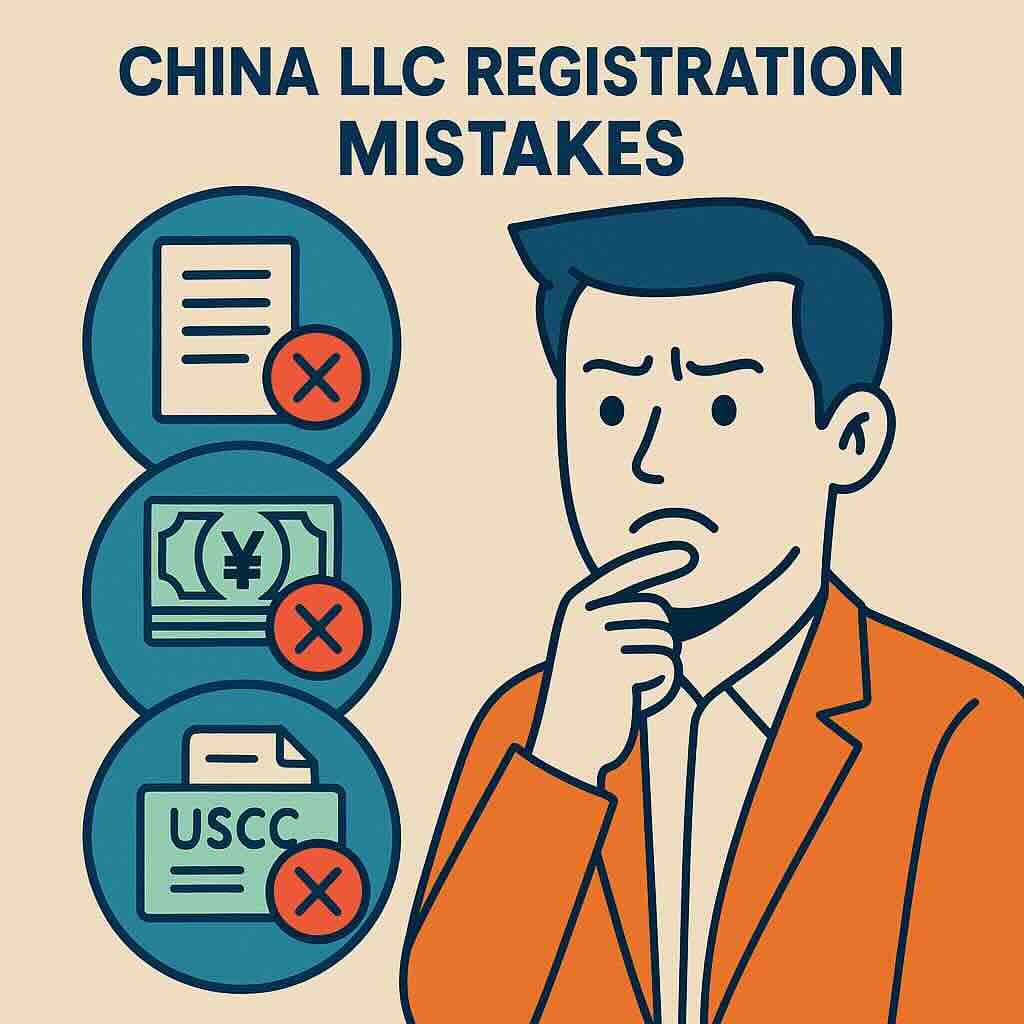
China LLC registration mistakes happen when founders rush filings, reuse old templates, or rely on decade‑old assumptions. The good news? Most pitfalls are easy to avoid with a current market‑access check, tight identity controls (name/USCC), a realistic capital plan under the new Company Law, and disciplined tax/banking onboarding. Pillsbury Law
China LLC registration mistakes: the quick answer
At a glance, the most expensive China LLC registration mistakes are: relying on outdated market‑access assumptions (the 2024 negative list removed all manufacturing restrictions), underestimating the five‑year capital‑contribution rule for new LLCs, letting GSXT data or the USCC drift from your license/invoices, and delaying bank KYC or fapiao setup. State Council of China
Misreading the negative list and market‑access rules
China manages foreign entry via pre‑establishment national treatment + a negative list. The 2024 list reduced restrictions from 31 to 29 and eliminated all manufacturing caps—a major shift for scope drafting. If you use old templates, you may over‑constrain yourself or, worse, assume a restriction that no longer exists. en.ndrc.gov.cn
Corrective action: verify your scope against the latest list
Before filing, map your planned activities to the latest negative list and note sector openings. Where your activity isn’t listed, full foreign ownership is usually allowed; where listed, check caps or approvals and consider JV or pilot policies. State Council of China

Over‑subscribing capital and ignoring the five‑year clock
Under the revised Company Law, new LLCs established on/after July 1, 2024 must fully contribute subscribed capital within five years. Over‑promising capital to impress a landlord or bank can backfire when installment deadlines hit. Pillsbury Law
Corrective action: align Articles of Association and funding plan
Right‑size registered capital, record a realistic contribution schedule in your Articles of Association, and make sure the bank KYC narrative matches your plan and scope. Pillsbury Law
Using the wrong legal name or USCC: GSXT mismatches
Another frequent China LLC registration mistake is letting your legal name or USCC (the 18‑character Unified Social Credit Code) drift across documents. The GSXT public registry (run by SAMR) is the system of record. Your license, GSXT entry, fapiao master data, and company seals must align—character for character. chinajusticeobserver.com
Corrective action: reconcile license, GSXT, fapiao, and seals
After licensing, pull your GSXT page and save a PDF. Confirm the USCC on the business license and on a sample e‑fapiao matches the registry entry exactly. Make this a pre‑payment control. chinajusticeobserver.com
Vague or non‑compliant business scope wording
A scope that’s too narrow blocks new SKUs and services; too broad can trigger avoidable questions. Drafting scope language that reflects what you’ll actually do, ties to the negative list, and anticipates near‑term additions saves painful re‑filings. (Use bilingual wording where needed.)
Treating the registered address as an afterthought
Using a short‑term or non‑compliant address creates headaches when banks, tax, or inspectors cross‑check records. Lock in a legitimate address—FTZ or non‑FTZ—suited to your permits, logistics, and hiring plan.

Banking & KYC: assuming account opening is automatic
Chinese banks conduct strict KYC and may require presence (or video KYC), a full file of licenses/seals, controller IDs, and clarity on business model and capital‑contribution timing. Plan the account‑opening workflow as part of registration, not after it.
Skipping tax profile setup and e‑fapiao enablement
Don’t forget to enroll tax profiles and enable e‑invoicing. For enterprises, the taxpayer identification number on fapiao is the USCC, which must match your license and GSXT. Any mismatch risks invoice rejection and delayed collections. chinajusticeobserver.com
Neglecting company chop (seal) governance
The official, financial, and legal‑representative chops carry legal weight. Missing issuance logs, uncontrolled storage, or lack of dual‑control sign‑offs invite fraud and disputes. Create written seal policies on day one.
Overlooking annual compliance and public disclosures
Annual audits/reconciliations and GSXT annual reports aren’t optional. Miss them and you risk penalties or credit downgrades in public systems. Build a calendar and assign owners early. China Briefing
Misusing FTZs—or ignoring them when they help
Free Trade Zones don’t magically waive taxes, but they can speed customs, finance, or data pilots that matter for your business model. Align your location choice with supply chain, approvals, and data flow needs—then draft scope and capital around that reality.
Forgetting special permits and pre‑licenses
Food, medical devices, hazardous goods, telecom/value‑added services, and education/media often require sector permits beyond the business license. Identify these early and stage your go‑live accordingly.
Data, privacy, and cross‑border flows: assuming old rules
Rules for outbound data and cross‑border transfers continue to evolve (including FTZ pilots). If you process personal data or export logs/telemetry, bake data compliance into scope and contract design from the start. ChinaLawAndPractice
Table: China LLC registration mistakes — risks and fixes
| Mistake (short) | Why it hurts | Quick fix | Source |
|---|---|---|---|
| Outdated market‑access assumptions | Over‑restrictive or non‑compliant scope | Map scope to latest negative list; document openings | (State Council of China) |
| Over‑promised capital | Five‑year contribution rule triggers cash strain | Right‑size capital; stage contributions in AoA | (Pillsbury Law) |
| Name/USCC mismatch | Payments, invoices, and filings fail | Reconcile license ↔ GSXT ↔ fapiao | (chinajusticeobserver.com) |
| Ignoring annual reports | Penalties/credit downgrades | Calendarize GSXT annual filing + audit/recon | (China Briefing) |
| Banking KYC as afterthought | Account‑opening delays | Pre‑book KYC; prep controller docs | — |
| Vague scope | Re‑filings to add SKUs | Draft bilingual scope; tie to list | (State Council of China) |
| Skipping e‑fapiao setup | Delayed AR | Enable e‑invoicing; test one invoice | — |
| Weak chop controls | Fraud/contract risk | Dual‑control; register usage logs | — |
| Wrong location choice | Permit/logistics friction | Compare FTZ vs city needs | — |
| Missing permits | Illegal operations | Map sector approvals pre‑launch | — |
21‑point checklist to launch clean and stay compliant
- Confirm market access with the latest negative list.
- Draft a bilingual scope aligned to your plan.
- Choose entity route (WFOE/JV).
- Right‑size registered capital with a five‑year schedule.
- Prepare Articles of Association accordingly.
- Secure a compliant registered address.
- File at AMR and obtain the business license.
- Pull and save your GSXT page.
- Carve official/financial/LR chops with usage policy.
- Open basic RMB and capital/FX accounts; complete KYC.
- Enroll VAT/CIT profiles.
- Enable e‑fapiao and issue a test invoice.
- Reconcile USCC across license/GSXT/fapiao/bank.
- Build an approvals/permits tracker.
- Draft a data‑compliance memo (if applicable).
- Register social insurance/housing fund.
- Publish the GSXT annual report on time.
- Schedule audit and tax reconciliation.
- Set up document retention and seal logs.
- Train finance/ops on invoice & chop controls.
- Review all records quarterly and before large payments. China Briefing
Sources & further reading
We keep these two top websites inside the article for authoritative verification:
- State Council / NDRC (official) — Negative List 2024: manufacturing restrictions removed; restrictions cut from 31 to 29 (effective Nov 1, 2024). State Council of China
- Norton Rose Fulbright — Company Law 2024 update: five‑year maximum capital‑contribution period for new LLCs from July 1, 2024. Norton Rose Fulbright
Additional helpful references cited above:
- Pillsbury — five‑year contribution requirement for LLCs (Article 47). Pillsbury Law
- China Justice Observer — GSXT operated by SAMR (official registry). chinajusticeobserver.com
- Wikipedia (GB 32100‑2015) — USCC is an 18‑character identifier; structure standard. Wikipedia
- China Briefing — annual compliance timeline and filing notes. China Briefing
Resource: Open the GSXT (National Enterprise Credit Information Publicity System) to view your public record and USCC. CNECIPS
For turnkey setup, payroll, and VAT/IIT compliance, see FDI China.