
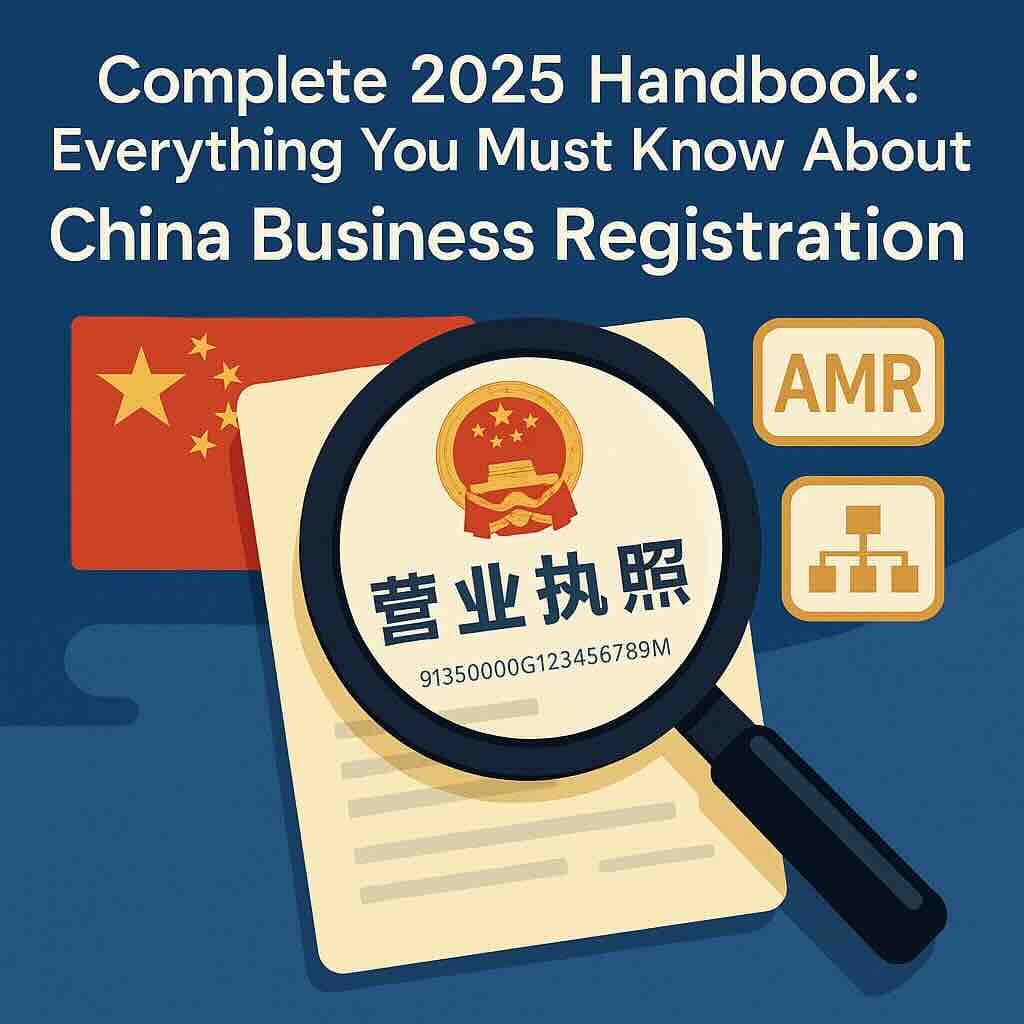
China business registration follows a straightforward sequence: pick the right legal route, confirm your market access under the foreign investment negative list, register with your local Administration for Market Regulation (AMR) to obtain a business license with an 18‑character Unified Social Credit Code (USCC), then finish chops, tax/fapiao, banking/FX, and social insurance. Since July 1, 2024, the revised Company Law also tightens capital contribution timing, which new companies must plan for from day one. State Council of China
China business registration: the quick answer
For most foreign investors, registration means forming a foreign‑invested limited liability company (commonly called a WFOE) if your business scope isn’t restricted. You file via the local AMR, receive a business license with your USCC, and your basic tax ID matches that USCC. You can then enable fapiao invoicing, open bank/FX accounts, and start hiring. Public records are searchable on the official National Enterprise Credit Information Publicity System (GSXT). gsxt.gov.cn

Choose your route: WFOE, JV, or EOR (plus who each is for)
- WFOE: 100% foreign ownership in most sectors; full control over hiring, invoicing, and IP. (Manufacturing is fully open per the 2024 negative list.) State Council of China
- JV: Use when a sector keeps caps/approvals or a local partner brings licenses, data, or distribution. State Council of China
- EOR (Employer of Record): Hire legally without forming an entity—great for pilots. You can migrate to a WFOE later.
Need hands‑on support? Explore FDI China for entity setup, payroll, and filings.
Pre‑check: negative list access & encouraged sectors
China applies pre‑establishment national treatment + a negative list. If your activity is not on the list, you can register with full foreign ownership. The 2024 edition cut restricted items from 31 to 29 and removed all manufacturing restrictions, a major opening for industrial projects. State Council of China
Company Law update: the five‑year capital contribution rule
The revised Company Law (effective July 1, 2024) requires newly formed LLCs to fully contribute subscribed capital within five years, unless otherwise provided. New registration measures released in early 2025 help implement these rules across AMR workflows. Plan your capitalization schedule in the Articles of Association. Norton Rose Fulbright
Name, address, and business scope (get the wording right)
- Chinese name: Usually includes the city + brand + industry + “有限公司”.
- Registered address: Lease in your target district or FTZ (if you need bonded or finance/data pilots).
- Business scope: Use precise wording that matches the negative list and your actual activities to avoid re‑filings later. State Council of China
File at AMR: how the business license (USCC) is issued
Submit your dossier to AMR (articles, shareholder IDs, lease, name approval). Once approved, you receive your business license showing “统一社会信用代码” at the top—the 18‑character USCC that identifies the company across government systems.

GSXT: where to verify your record and annual filings
After registration, check your public record on GSXT by Chinese legal name or USCC. GSXT, run by SAMR, is the official portal for basic company data, status, and annual reports. Pro tip: save a PDF of the GSXT page for your KYC file. gsxt.gov.cn
Chops, tax, and invoicing (fapiao) enablement
- Company chops (seals): Official, financial, and legal‑rep chops are standard in contracting.
- Tax & fapiao: Register your tax profiles; enable e‑fapiao issuance. For enterprises, the taxpayer identification number on invoices is the USCC—keep it consistent across license, GSXT, and ERP.
Banking & FX: basic RMB and capital accounts
Open your basic RMB account and the required capital/FX accounts after licensing. Banks will ask for the business license, chops, KYC pack, and controller details in line with the new registration measures and AML checks. China Briefing
VAT in a nutshell: 13%/9%/6% (and law effective 2026) + small‑scale VAT relief to 2027
China approved a comprehensive VAT Law that takes effect January 1, 2026. The current three‑tier rate structure continues, with exemptions detailed in law. Meanwhile, small‑scale VAT relief and micro‑business incentives are extended to Dec 31, 2027—useful for early‑stage entities choosing a simplified route. Reuters
Compliance calendar: what to file, where, and when
- GSXT annual report: File each year for the prior period (usually Jan 1–Jun 30 window) via GSXT; keep details consistent with tax filings. investtaiwan.nat.gov.tw
- Tax filings: VAT monthly (general taxpayers) or quarterly (small‑scale); CIT quarterly with annual settlement.
- Changes: Name, address, scope, or directors—file timely amendments with AMR and update GSXT.
Table: 15 registration milestones, who does what
| # | Milestone | Authority / platform | Output | Notes |
|---|---|---|---|---|
| 1 | Negative‑list check | NDRC/MOFCOM policy | Go/No‑go | 2024 list opens manufacturing. (State Council of China) |
| 2 | Entity route | — | WFOE/JV/EOR | Control vs speed trade‑off. |
| 3 | Name pre‑approval | AMR | Name notice | Chinese naming rules apply. |
| 4 | Lease secured | — | Registered address | Needed for AMR filing. |
| 5 | Articles & dossiers | AMR | Filing package | Align with 5‑year capital plan. (Norton Rose Fulbright) |
| 6 | AMR approval | AMR | Business license (USCC) | Your official ID. |
| 7 | Chops | Public‑security authorized maker | Seals (official/financial/LR) | Needed for banking & contracts. |
| 8 | Bank accounts | Bank/SAFE | Basic RMB + capital/FX | Bank KYC will cite your USCC. (China Briefing) |
| 9 | Tax registration | Tax bureau | VAT/CIT profiles | USCC used as enterprise TIN. |
| 10 | Fapiao enablement | Tax e‑invoicing | e‑fapiao access | Keep invoice master data clean. |
| 11 | Social insurance | Local bureaus | SI/HF accounts | City‑specific rates/bases. |
| 12 | GSXT check | GSXT (SAMR) | Public record online | Save a PDF screenshot. (gsxt.gov.cn) |
| 13 | First return cycle | Tax + GSXT | Returns submitted | Calendar varies by status. |
| 14 | Licenses/permits | Sectoral agencies | Approvals | E.g., food/medical devices. |
| 15 | Ongoing changes | AMR + GSXT | Alteration filings | Name/scope/rep changes. |
Common pitfalls (and how to dodge them)
- Scope too narrow: Blocks future products or services. Draft flexible but accurate wording.
- Capital plan mismatch: The five‑year rule is real—don’t over‑subscribe capital you can’t contribute on time. Norton Rose Fulbright
- Skipping GSXT checks: Always reconcile name + USCC across license, GSXT, and e‑fapiao. gsxt.gov.cn
- Banking last: Early coordination with your bank shortens go‑live timelines. China Briefing
- Out‑of‑date access assumptions: Remember the 2024 negative list changes. Manufacturing is open; some services still carry conditions. State Council of China
Don’t worry. We are here to help.
If you’re aiming for a fast, compliant china business registration, consider a two‑phase plan: EOR for immediate hiring, then convert to a WFOE once customer demand is clear. For one‑stop support on entity setup, payroll, VAT/IIT filings, and GSXT/AMR procedures, see FDI China’s services.
Sources & further reading
We keep the top two official source websites inside this article:
- GSXT — National Enterprise Credit Information Publicity System (SAMR): official portal to view your public record and USCC. gsxt.gov.cn
- State Council / NDRC (Negative List 2024): confirms manufacturing restrictions removed and a shorter list. State Council of China
Additional authoritative sources referenced:
- Norton Rose Fulbright — revised Company Law (effective July 1, 2024) and capital contribution rules. Norton Rose Fulbright
- China Briefing — registration measures (Jan 2025) and Company Law highlights. China Briefing+1
- Reuters — VAT Law takes effect Jan 1, 2026. Reuters
- EY — extensions of small‑business tax incentives, including small‑scale VAT relief to 2027. EY
- EU IP Helpdesk — how to search companies on GSXT. IP Helpdesk
Resource: Start your search on the GSXT portal: https://www.gsxt.gov.cn.
Need help entering China? Whether you’re a global investor exploring new opportunities or a business expanding operations, our experts can help you navigate every step. Visit FDIChina to start your China expansion journey today.