
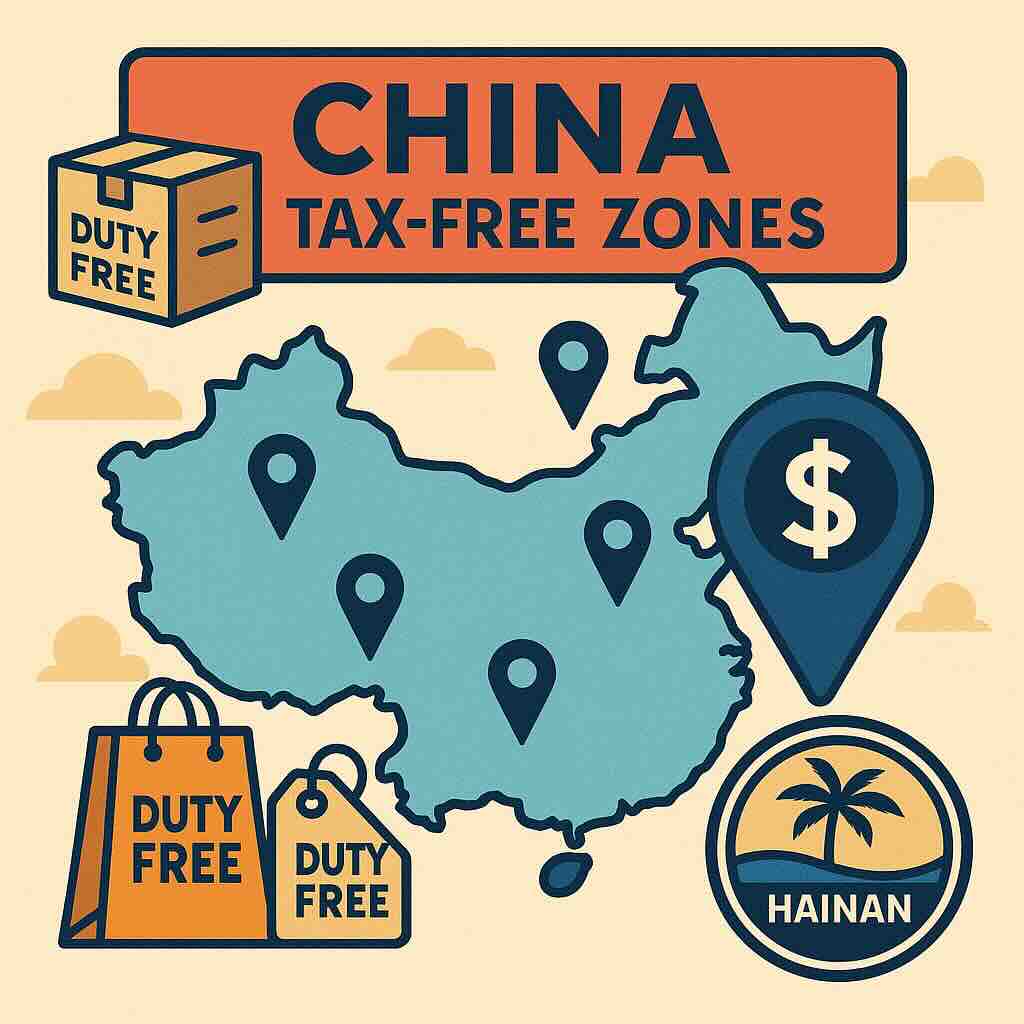
If you’re wondering whether China has “tax‑free,” the honest answer is that China tax‑free zones aren’t blanket tax holidays; they’re special customs and policy zones—notably pilot Free Trade Zones (FTZs) and the Hainan Free Trade Port—that exempt or defer import duties and import‑stage VAT/consumption tax under defined conditions while normal income taxes and VAT on domestic sales still apply. Czech Foreign Affairs
China tax‑free zones: the short answer
China tax‑free zones are not nationwide tax amnesties. Inside FTZs and bonded areas, goods can be stored or processed without paying import duty and import‑stage VAT; tax is levied when goods enter the domestic market. Services and profits inside these zones still follow China’s VAT/CIT rules unless a specific incentive applies. Czech Foreign Affairs
What counts as “tax‑free” in practice (and what doesn’t)
“Tax‑free” in China usually refers to:
- Customs duty & import‑VAT relief in bonded/FTZ environments (deferral or exemption until goods enter the mainland market). China Tax
- Zero‑tariff treatment in Hainan Free Trade Port for goods on approved lists or under “first‑line/second‑line” rules. State Council of China
- Offshore duty‑free retail quotas for travelers in Hainan. State Council of China
It doesn’t mean you avoid CIT or VAT on domestic sales or income; those remain in scope unless an explicit policy says otherwise. Czech Foreign Affairs

Bonded zones & FTZs: customs treatment, not blanket tax holidays
Goods within FTZs are treated as outside the customs territory for certain flows. Import duty and VAT are exempt/ deferred while goods remain bonded; tax applies when goods are sold into mainland China. This is the core mechanic behind China tax‑free zones. Czech Foreign Affairs
The big picture: 22 pilot FTZs + Hainan Free Trade Port
China currently has 22 pilot FTZs spread nationwide, plus the Hainan Free Trade Port (FTP). In 2024, the FTZs drew US$28.25 billion in actual FDI—24.3% of the national total—showing how “tax‑free” logistics and streamlined rules anchor investment. State Council of China
Hainan Free Trade Port: zero‑tariffs and independent customs (Dec 18, 2025)
Hainan will launch island‑wide independent customs operations on December 18, 2025, shifting to a “customs closure” model with much wider zero‑tariff coverage. This turns Hainan into a special customs‑supervised territory with an “open first line, controlled second line” between Hainan and the mainland. State Council of China
The three zero‑tariff lists (equipment, raw materials, vehicles & yachts)
Hainan’s zero‑tariff policy is organized around three product lists—self‑use production equipment, raw and auxiliary materials, and transport vehicles & yachts—with exemptions of import duty, import‑stage VAT and consumption tax for eligible entities. The scope is expanding ahead of customs closure. en.hainan.gov.cn
Hainan duty‑free shopping: 100,000‑yuan annual quota
Separate from business import rules, offshore duty‑free retail in Hainan allows consumers an annual 100,000‑yuan quota and broader eligibility—measures reiterated by official releases in 2025. This is retail tax‑free, not corporate. State Council of China
VAT basics vs “tax‑free” myths (13%/9%/6% and 1% small‑scale to 2027)
China’s VAT remains 13% / 9% / 6% for general taxpayers. Small‑scale taxpayers benefit from a temporary 1% levy through Dec 31, 2027—useful relief, but not a tax‑free regime. A new VAT Law takes effect Jan 1, 2026, consolidating earlier rules while keeping the core framework. These are fundamentals every operator in China tax‑free zones still follows. PwC Tax Summaries
Export VAT zero‑rating and exemptions: when 0% really means 0%
Exports often qualify for zero‑rating (0% VAT with input credit/refund) or exemption (no output VAT, but no input credit). Many FTZ and Hainan playbooks use process‑and‑export models to combine bonded inputs with zero‑rated outbound sales. The nuance matters when pricing and cash‑flowing China tax‑free zones. PwC Tax Summaries
Corporate income tax: standard 25% vs selected 15% incentives
The standard CIT is 25% nationwide. Certain encouraged industries in designated zones/ports—Hainan FTP and some FTZ/regions—can achieve preferential 15% CIT if they meet substantive operation and industry tests. That’s a reduction, not “tax‑free.” China Briefing
Table: What’s “tax‑free” in China—and what it means for your model
| Mechanism | What’s (potentially) tax‑free | Who benefits | Caveats / When it’s taxable |
|---|---|---|---|
| FTZ / bonded zone | Import duty + import‑stage VAT/CT deferred or exempt while bonded | Manufacturers, e‑commerce, logistics | Tax applies if goods enter mainland; domestic sales incur VAT/CIT. (Czech Foreign Affairs) |
| Hainan FTP zero‑tariff | Zero tariffs (and exempt import VAT/CT) on listed goods; wider coverage with customs closure (Dec 18, 2025) | Qualifying enterprises in Hainan | Eligibility & list control; second‑line to mainland triggers duty/VAT. (State Council of China) |
| Hainan duty‑free retail | Retail tax‑free within annual 100,000‑yuan quota | Travelers/shoppers | Consumer policy—does not reduce a company’s CIT/VAT. (State Council of China) |
| Export zero‑rating | 0% VAT on exports, input VAT credits/refunds | Exporters | Documentation required; some services are exempt (no credit). (PwC Tax Summaries) |
| Small‑scale VAT | 1% rate through 2027 | Small sellers | Not tax‑free; no input‑VAT credit; check thresholds. (PwC Tax Summaries) |
| CIT incentives | 15% CIT in select zones/industries | Qualified enterprises | Substantive‑operation & industry tests apply. (China Briefing) |
Choosing a zone: a quick site‑selection playbook
- Export‑heavy or cross‑border e‑commerce? Shortlist FTZs with strong bonded warehousing and port/air links; you’ll optimize import duty/VAT timing inside China tax‑free zones. PTL Group
- Advanced manufacturing or aerospace? Evaluate Hainan FTP for zero‑tariff equipment/raw materials lists and post‑closure expansion. State Council of China
- After‑sales or domestic distribution? Remember: second‑line sales to the mainland trigger duty/VAT; plan your supply chain accordingly. State Council of China
- Corporate taxes & talent? Incentives can reduce CIT to 15% in certain zones/industries; verify criteria up front. China Briefing
Need a feasibility check and setup plan? See FDI China’s services for entity registration, bonded/FTZ workflows, and VAT filings.

Compliance reality: invoices, proofs, and audits still apply
Even in China tax‑free zones, you’ll still need fapiao (VAT invoices), customs proofs, and eligibility filings. The VAT Law (2026) formalizes many rules, while Hainan’s customs closure widens zero‑tariff coverage but tightens eligibility and supervision—so keep documentation airtight. Reuters+1
30‑day action plan to leverage China tax‑free zones
- Map your flow: Identify SKUs and where value is added; pick two FTZs or Hainan FTP as candidates. State Council of China
- Quantify customs relief: Model duty + import‑VAT savings from bonded storage/processing and zero‑tariff lists. en.hainan.gov.cn
- Decide VAT posture: General taxpayer vs 1% small‑scale (through 2027) based on margins and input credits. PwC Tax Summaries
- Confirm export treatment: Determine zero‑rating vs exemption and refund cadence; align fapiao and logistics docs. PwC Tax Summaries
- Check CIT incentives: If your industry/zone qualifies, validate 15% CIT requirements (substantive ops, income sourcing). China Briefing
- Prepare for Hainan closure: If Hainan fits, align to Dec 18, 2025 customs rules and expanding tariff‑line coverage. State Council of China
Sources & further reading
Top two official websites (included as requested):
- State Council (english.www.gov.cn) — FTZ upgrades; 22 pilot FTZs and FDI share; Hainan’s independent customs timeline (Dec 18, 2025). State Council of China+2State Council of China+2
- MOFCOM (english.mofcom.gov.cn) — Hainan FTP independent customs announcement and policy context. Ministry of Commerce
Additional authoritative references cited above:
- Reuters — VAT Law effective Jan 1, 2026 (policy consolidation and exemptions). Reuters
- PwC Tax Summaries — 1% small‑scale VAT through Dec 31, 2027; export zero‑rating/exemptions. PwC Tax Summaries
- Official Hainan portals / releases — zero‑tariff lists and expansion; policy scope and retail duty‑free quota. en.hainan.gov.cn+2State Council of China
- China Briefing — FTZ/FTP policy digests and CIT incentive snapshots. China Briefing
Read Reuters’ summary of the VAT Law (effective 2026) to understand how VAT interacts with FTZ/FTP operations. Reuters
Need help entering China? Whether you’re a global investor exploring new opportunities or a business expanding operations, our experts can help you navigate every step. Visit FDIChina to start your China expansion journey today.