
HK Offshore Setup
Hong Kong Company Registration
Register a legal entity in Hong Kong with FDI China. We consult you on structure, guarantee compliance and help you obtain the sacred HK bank account.

Open a Company in Hong Kong
With its strategic location, robust legal framework, and favorable tax regime, Hong Kong is an ideal destination for establishing a business or HQ office. Our expert team offers a range of company registration services tailored to meet your specific needs. We can assist you in establishing various types of business entities in Hong Kong.
What Business Structure is Right for you?
There are multiple different company structures available in Hong Kong including limited and unlimited companies. Our experts can recommend the best and most suitable company type for your business if you don’t have your mind set on a particular structure.
To get started we ask you the following questions:
- What is the business purpose of the entity and what business operations will you conduct?
- Are the shareholders individuals or a holding company?

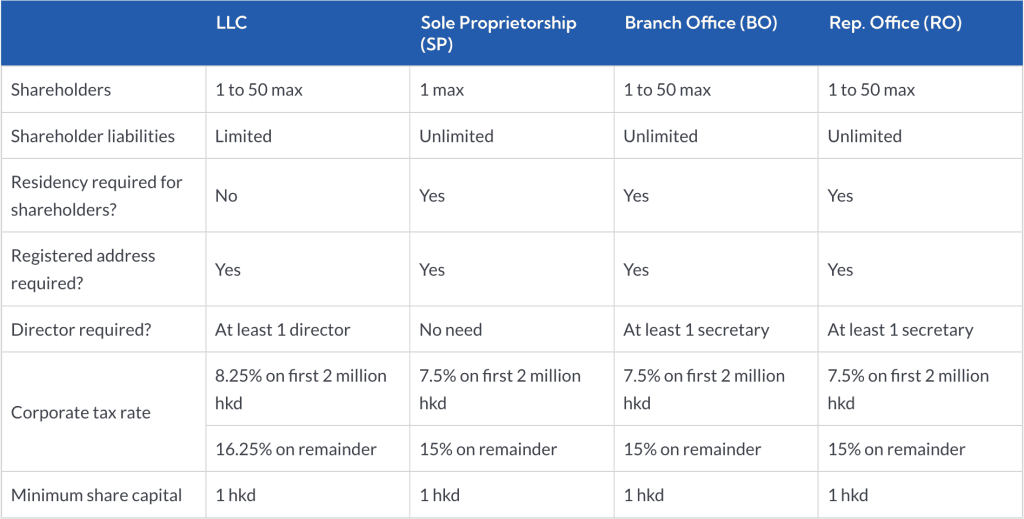
Key characteristics of different company structures in Hong Kong
Company Type
LLC
Sole Proprietorship (SP)
Branch Office (BO)
Rep. Office (RO)
| Shareholders | 1 to 50 max | 1 max | 1 to 50 max | 1 to 50 max |
| Shareholder liabilities | Limited | Unlimited | Unlimited | Unlimited |
| Residency required for shareholders? | No | Yes | Yes | Yes |
| Registered address required? | Yes | Yes | Yes | Yes |
| Director required? | At least 1 director | No need | At least 1 secretary | At least 1 secretary |
| Corporate tax rate | 8.25% on first 2 million hkd | 7.5% on first 2 million hkd | 7.5% on first 2 million hkd | 7.5% on first 2 million hkd |
| 16.25% on remainder | 15% on remainder | 15% on remainder | 15% on remainder | |
| Minimum share capital | 1 hkd | 1 hkd | 1 hkd | 1 hkd |
Key characteristics of partnership structures in Hong Kong
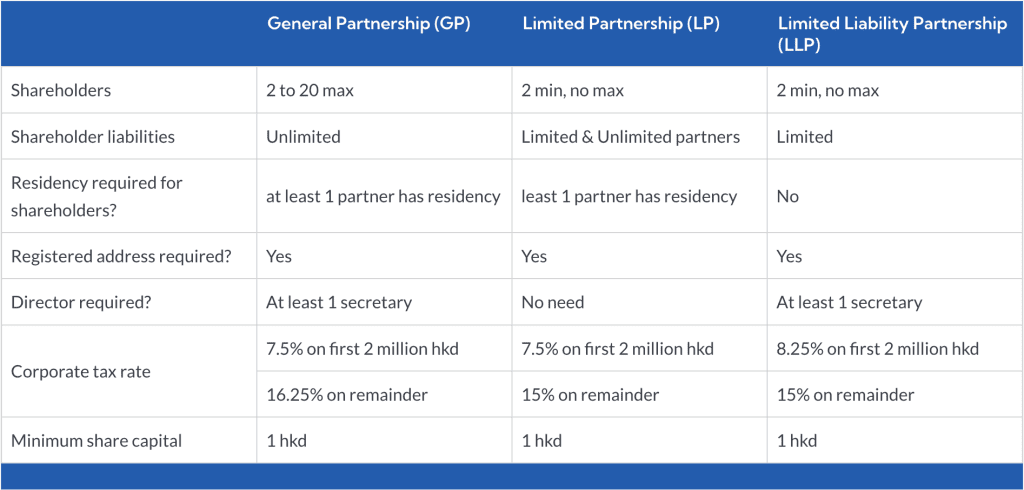
Partnership Type
General Partnership (GP)
Limited Partnership (LP)
Limited Liability Partnership (LLP)
| Shareholders | 2 to 20 max | 2 min, no max | 2 min, no max |
| Shareholder liabilities | All Unlimited | Limited & Unlimited partners | All Limited |
| Residency required for shareholders? | at least 1 partner has residency | least 1 partner has residency | No |
| Registered address required? | Yes | Yes | Yes |
| Director required? | At least 1 secretary | No need | At least 1 secretary |
| Corporate tax rate | 7.5% on first 2 million hkd | 7.5% on first 2 million hkd | 8.25% on first 2 million hkd |
| 16.25% on remainder | 15% on remainder | 15% on remainder | |
| Minimum share capital | 1 hkd | 1 hkd | 1 hkd |
Our Services in Hong Kong
From Hong Kong company registration to supporting your new business with our accounting and payroll & employment services.
Company registration
Registration of your company, registered address, secretary and bank account opening assistance.
Tax & accounting
Monthly & quarterly bookkeeping and compliance reporting of your company's financials.
Payroll, PEO & EOR
Employee onboarding and salary delivery including mandatory benefits and insurance.
Types of foreign-invested Companies in Hong Kong:
- Private Company Limited by Shares (LLC): The most common and flexible type of business entity, offering limited liability protection to shareholders and favorable tax treatment.
- Sole Proprietorship: Ideal for individuals who want to own and manage their business independently, with full control and responsibility.
- Branch Office: A perfect solution for foreign companies looking to expand their operations in Hong Kong while maintaining the same legal entity as their parent company.
- Representative Office: Suitable for foreign companies wanting to explore business opportunities in Hong Kong without engaging in direct profit-making activities.
- General Partnership (GP): An arrangement where two or more individuals share ownership and management responsibilities, with unlimited liability.
- Limited Partnership (LP): Combines the features of a general partnership with limited liability for certain partners, making it attractive for investment purposes.
- Limited Liability Partnership (LLP): Provides the benefits of a partnership with limited liability protection, ideal for professional services firms.
A Limited Liability Company (LLC) in Hong Kong is a business structure that offers its owners protection from personal liability, as the company is considered a separate legal entity from its shareholders. The liability of each shareholder is limited to the amount they invest in the company’s capital. This is different from sole proprietorships or partnerships, where the owners may be held personally liable for business debts. LLCs offer significant advantages, such as the ease of raising capital by issuing shares, as well as providing flexibility in ownership transfers and limited liability protections, which can enhance business credibility.
Setting up an LLC in Hong Kong is a relatively straightforward process, involving steps like reserving a unique business name, determining the share structure, preparing the Articles of Association, and registering the business with the Companies Registry. While it is simple to establish and operate an LLC, ongoing compliance with local regulations is required. Despite the legal separation, owners may still face personal liability in cases of director misconduct or if personal guarantees are provided for loans. Nonetheless, LLCs remain a popular choice for entrepreneurs due to their favorable tax treatment and flexible ownership structure.


A sole proprietorship in Hong Kong is a simple and quick business structure to set up, with no minimum capital investment required. It is a non-incorporated entity, meaning the owner has full control over the business but also assumes unlimited liability for any debts or legal issues, which could extend to personal assets like a home or savings. The business profits are taxed at a flat rate of 15% and included in the owner’s personal tax return, without the need to file separate business taxes. This structure is ideal for those who want ease of setup and full control over their business operations.
To establish a sole proprietorship, the owner must register with the Business Registration Office at the Inland Revenue Department within one month of starting operations. The process involves choosing a unique business name and providing identification documents, with registration usually completed within 24 hours. While it’s straightforward to set up, a sole proprietorship has disadvantages such as difficulty in securing loans or attracting investors due to the personal liability involved. Additionally, ongoing compliance is necessary, including filing annual tax returns and renewing the business registration certificate.
A branch office in Hong Kong is an extension of a foreign parent company, not a separate legal entity. This structure allows foreign companies to expand into Hong Kong while maintaining control over operations from the parent company. The parent company is fully liable for the branch office’s debts and obligations. To set up a branch office, the foreign company must register with the Inland Revenue Department, submit corporate documents, appoint a local representative, and establish a business address in Hong Kong. Despite having similar tax obligations to local companies, the branch remains closely tied to its parent entity for major decisions.
In contrast, a representative office is a cost-effective way for foreign companies to explore the Hong Kong market without significant financial commitment. This structure is not a legal entity and cannot engage in profit-generating activities like signing contracts or making deals. Instead, its role is limited to administrative tasks such as market research, networking, and coordinating sales efforts. Setting up a representative office is relatively simple, requiring registration with the Inland Revenue Department and obtaining a Business Registration Certificate, with no need for tax filings or audited accounts due to its non-revenue-generating nature.


A general partnership in Hong Kong is a traditional business model where two or more partners share the profits, managerial responsibilities, and liabilities equally. In this structure, each partner is personally liable for the business’s debts, which means personal assets could be at risk if the business incurs losses. Setting up a general partnership is straightforward, requiring partners to agree on the terms of the partnership and register the business with the Inland Revenue Department. However, this type of partnership can expose all partners to unlimited liability.
A limited partnership (LP) combines general and limited partners, with the former managing the business and assuming unlimited liability while the latter contributes capital with liability restricted to their investment. Limited partners are not involved in daily operations, making this structure ideal for those who want to invest without managing the business. LPs benefit from pass-through taxation, where profits are only taxed at the individual partners’ level, avoiding double taxation. Setting up an LP in Hong Kong involves registering the business, drafting a partnership agreement, and complying with local legal requirements.
A limited liability partnership (LLP) offers partners limited liability protection, shielding personal assets from the business’s debts, while allowing them to participate in managing the partnership. Unlike a general partnership, LLP partners are not personally liable for the actions or debts of other partners, making this structure appealing for professionals who want to retain control without risking personal assets. Establishing an LLP requires registration with the local authorities and adherence to legal obligations, offering more protection compared to a general partnership.

Hong Kong Company Types
LLC
A popular business structure for entrepreneurs and businesses seeking flexibility, limited liability, and ease of international operations.
This structure is ideal for companies involved in trade, consulting, or international operations looking to limit personal liability while gaining access to a strategic business hub in Asia.
Sole Proprietorship
The simplest business structure, where the owner has full control and bears all liabilities.
Ideal for small businesses offering professional services, as it requires minimal setup and maintenance. Entrepreneurs looking for a straightforward structure with fewer compliance requirements may find a sole proprietorship the best fit.
Branch Office
For companies established overseas that want to conduct operations without forming a separate legal entity.
Suited for businesses that want to explore the Hong Kong market without full incorporation, especially those focused on sales, marketing, or supporting existing clients.
Representative Office
For companies conducting nonprofit activities.
Businesses focused on gathering market insights, building relationships, or overseeing local suppliers may find a Rep Office the most suitable option.
Partnership
A business structure where two or more individuals or entities share ownership, responsibilities, and profits.
A Partnership in Hong Kong can take several forms, including General Partnerships (GPs), Limited Partnerships (LPs), and Limited Liability Partnerships (LLPs). Each one characterized by a different liability status of partners.
Our Working Process
1. Consultation & Proposal
We (can) advise you on the best solution for your business model and send you our comprehensive proposal.
2. Signing & Payment
After reviewing the proposal, we sign the service contract and receive your payment.
3. Preparing Documents
We send you an application form as well as the list of documents we need from your side.
FAQs
Can I register a company in Hong Kong online?
Absolutely! We manage the entire company registration process online, requiring minimal effort on your part. From arranging a local Company Secretary to securing a registered address and opening a business account, we’ve got you covered—no need for you to leave your desk!
What types of companies can I open in Hong Kong?
The most common type is a private limited company (Ltd) AKA a Limited Liability Company (LLC), which offers limited liability to its shareholders. Other options include sole proprietorships, partnerships, and public companies, but private limited companies are typically the best choice for startups and foreign investors.
Do I need to be a resident of Hong Kong to open a company?
No, you do not need to be a Hong Kong resident to open a company. Foreign individuals and businesses can fully own and manage companies in Hong Kong.
What are the steps to register a company in Hong Kong?
The main steps are:
- Choose a company name and ensure it is available.
- Decide on the business structure.
- Prepare the required documents, including Articles of Association and company details.
- Register with the Companies Registry.
- Obtain a Business Registration Certificate from the Inland Revenue Department.
Do I need a physical office address in Hong Kong?
Yes, all companies must have a registered address in Hong Kong, which cannot be a P.O. Box. If you don’t need a physical space, you can use a virtual office service.
Do I need a company secretary?
Yes, a company secretary is mandatory for all Hong Kong companies. The secretary must be a Hong Kong resident or a Hong Kong-registered corporate entity such as FDI China. They handle statutory compliance and administrative duties.
Can I open a bank account for my Hong Kong company?
Yes, most Hong Kong companies open a corporate bank account. However, banks may require proof of business operations, identification of directors and shareholders, and a physical interview. Some startups use fintech solutions as an alternative.
Do I need a visa to run a Hong Kong company?
If you wish to relocate to Hong Kong to manage your business, you will need an Investment Visa. However, you can operate your company remotely without residing in Hong Kong.
Is there a minimum share capital required to register a company in Hong Kong?
In Hong Kong, there is no mandatory minimum share capital for company registration. However, it is common to start with an initial share capital of at least HKD 1, or the equivalent in any other currency.
How long does it take to register a company in Hong Kong?
Once all the required documents are prepared, the company registration process typically takes 2-4 business days to complete, including obtaining the business registration certificate from Hong Kong’s Inland Revenue Department. The timeline largely depends on when the documents are submitted and the operating hours of the relevant authorities.
What are the minimum statutory requirements for registering a company in Hong Kong?
Most business owners in Hong Kong choose to register their companies as private limited companies. To do this, you need to meet the following key requirements:
- At least one shareholder, aged 18 or above, who can be either local or foreign
- At least one director, also aged 18 or above, who can be either local or foreign
- A single individual can serve as both shareholder and director
- A registered address in Hong Kong is mandatory
- While no minimum share capital is required, it is common practice to have around HK$10,000 in share capital, typically represented by 10,000 ordinary shares of HK$1.00 each
- The company must appoint a Designated Representative (DR) to maintain the Significant Controllers Register (SCR)
- You need a local company secretary. If the secretary is an incorporated entity, it must have a local office in Hong Kong
Once these conditions are met, you can apply for a business registration certificate through the Hong Kong Companies Registry to officially establish your business.