

Bringing in foreign professionals can offer a competitive edge by introducing global perspectives, specialized skills, and cross-cultural insights. However, hiring a foreign employee in China is not as straightforward as hiring a local worker. It involves a multi-step legal process governed by strict immigration and labor regulations.
From securing government approvals to navigating visa applications and permit renewals, both employers and prospective foreign hires must follow a well-defined process to ensure compliance. In this guide, we’ll walk you through the essential steps, requirements, and key considerations for successfully hiring foreign employees in China.
- Familiarize Yourself with Labor Laws: Gain a thorough understanding of China’s labor laws and the specific regulations set by the PRC government for hiring foreign workers.
- Engage with Local Labor Unions: Take the time to understand the expectations of local labor unions regarding the recruitment of overseas employees.
- Conduct a Compliance Assessment: Perform a gap analysis to identify any potential conflicts between local labor regulations in your business’s location and national laws set by the PRC government.
- Complete Legal and Administrative Requirements: Ensure all necessary paperwork, including licenses, documentation, and visa applications, is processed correctly before hiring a foreign employee.
- Stay on Top of Renewals: Keep track of required renewals for licenses, visas, and other essential documentation to maintain the legal employment status of foreign employees.
- Keep Up with Evolving Labor Laws: Stay informed about changes in China’s labor laws. Train your HR team and adopt a proactive approach to regulatory updates to avoid compliance issues.
By following these steps, employers can ensure a legally compliant and efficient hiring process for foreign employees in China.
Prerequisites for Foreigners to Work in China
Foreign nationals must meet specific eligibility criteria to legally work in China. While some requirements may vary slightly by region, the core conditions are consistent across the country.
To be eligible for employment in China, a foreign candidate must:
- Be at least 18 years old and in good physical and mental health
- Have no criminal record
- Hold a valid passport or equivalent travel document
- Possess the necessary qualifications, skills, and work experience for the position
- Secure a job offer from a legally registered employer in China (strongly recommended)
Fulfilling these criteria is essential for obtaining a Chinese work permit and the corresponding residence visa.
Conditions for Hiring a Foreign Employee in China
Meeting the basic eligibility requirements is just the first step. Both employers and prospective foreign employees must also adhere to specific legal and administrative processes to successfully complete the hiring procedure.
These requirements apply to both local Chinese companies and foreign-invested enterprises operating in China. However, it’s important to note that the hiring process for foreign staff is entirely different from that for local employees and is subject to stricter regulations.
Here are four key areas that employers and candidates need to understand:
1. Work Permit and Foreign Expert Certificate Applications
Although they may seem similar, the Foreign Work Permit and the Foreign Expert Certificate are distinct documents, each issued by different authorities. Employers are responsible for submitting applications for both.
- The Foreign Expert Certificate is typically issued by the Foreign Experts Affairs Bureau.
- The Work Permit is granted by the Labor Bureau.
Each authority has different documentation standards. For instance, a stamped certificate from a previous employer may be acceptable to the Foreign Experts Affairs Bureau, but not to the Labor Bureau, which may require additional verification steps.
2. Restrictions on Hiring Interns from Overseas
China does not officially recognize foreign interns hired directly from abroad. Therefore, companies are not allowed to hire foreign nationals for internships unless specific legal conditions are met.
However, exceptions exist:
- Foreign students enrolled in a Chinese university under a valid X1 student visa may engage in internships—with prior approval from both the university and the Public Security Bureau (PSB).
- Foreign nationals entering China on an M visa (business or trade purpose) may participate in short-term internships (up to 90 days), provided all legal procedures are followed.
Hiring foreigners on tourist visas (L-visa) or student visas (X-visa) without the required legal clearances is strictly prohibited and can lead to serious penalties for both the employer and the individual.
3. Understanding Legal Procedures for Hiring Foreign Staff
A knowledgeable HR team is vital when hiring foreign nationals. Your HR personnel must be well-versed in Chinese labor laws, immigration policies, and the documentation process to ensure compliance.
Visa and work permit processing times can range from 4 weeks to several months, depending on the completeness and accuracy of the submitted documentation. A well-prepared application greatly improves approval chances and reduces delays.
Hiring foreign talent may be complex, but it brings long-term benefits, including enhanced diversity, cross-cultural collaboration, and access to global expertise. The Chinese government continues to support international recruitment that contributes to the country’s development.
4. Work Permit Application Process for Foreign Candidates
Foreign nationals must obtain a Z-Visa (Work Visa) to legally work in China. The application must include specific details, such as the job location and duration of employment.
Important points to note:
- The Z-Visa is valid for 30 days upon arrival in China. Within this window, the employer and employee must apply for a Temporary Residence Permit, which defines the legal working period.
- The Temporary Residence Permit typically aligns with the employment contract and can range from 90 days to a maximum of 5 years.
- Working beyond the approved time period or outside the authorized work location without updating the permit is considered a violation of immigration laws.
Step-by-Step Process for Hiring a Foreign Employee in China
Hiring a foreign employee in China involves a structured, documentation-intensive process. Careful attention to detail is essential to avoid delays and ensure compliance with immigration and labor regulations.
Below is a lock-step guide to obtaining both the Work Permit and Residence Permit required for legal employment in China:
- Apply for an Employment License
The employer must first apply for an employment license from the local Human Resources and Social Security Bureau. This serves as official approval for the company to hire a foreign national for a specific role. - Obtain the Work Permit Notification Letter
Once the employment license is approved, the employer must apply to the relevant Foreign Affairs Office in China for a Work Permit Notification Letter (sometimes referred to as the “Confirmation Letter for Work Permit”).
This document is necessary for the foreign candidate to apply for a work visa. - Apply for the Z-Visa (Work Visa) in the Home Country
Using the Work Permit Notification Letter, the foreign applicant must apply for a Z-Visa at the Chinese embassy or consulate in their home country. - Enter China and Apply for the Work Permit
After arriving in China with the Z-Visa, the candidate must apply for an official Work Permit Card (formerly known as the Alien Employment Permit) through the local labor authorities. - Apply for the Residence Permit
With the Work Permit in hand, the applicant must then apply for a Residence Permit from the Public Security Bureau (PSB) within 30 days of arrival. This permit replaces the initial Z-Visa and grants legal residency for the duration of employment.
Permit Renewal
Both the Work Permit and Residence Permit are valid for a limited period, typically matching the duration of the employment contract (ranging from 90 days to 5 years). They must be renewed before expiration to ensure continuous legal employment and residency.Permit Renewal
Both the Work Permit and Residence Permit are valid for a limited period, typically matching the duration of the employment contract (ranging from 90 days to 5 years). They must be renewed before expiration to ensure continuous legal employment and residency.
How local labor laws impact hiring decisions
Generally, the local labor laws varies from one locality to another and hence, there is no fixed answer to this question. The best strategy, however, is to arrange a meeting with a consulting firm that has its roots in China and discuss the nitty-gritty of the labor laws in your destined location. It is an important preparatory step that paves your path to meeting with local authorities and work your way without any problem.
The below charts points out some fact-based differences in different localities. These tables also highlight the differences that you may experience while hiring a China’s local candidates VS hiring overseas employees.


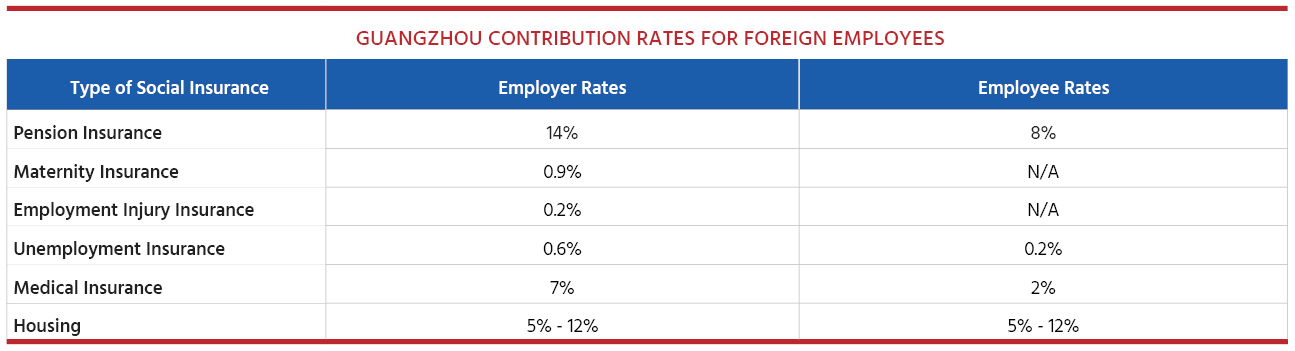
*Note that housing fund, pension insurance, and medical insurance contributions are not required for foreign employees. As for employers, contribution exemptions is only applied for the housing fund insurance.
Latest amendment in China’s labor laws:
The latest amendment in China’s work visa policy for foreign workers has come into effect on 1st April 2017. This latest regulation focuses on simplifying the process and paperwork and is applicable to all the foreigners employed in Mainland, China. Furthermore, this regulation aims to increase the quality control imposed on foreigners already working or planning to work in China by changing the nature of work permits and application procedures.
In lieu of the new regulations, the work permit will include a foreigner ID in replacement of the former Chinese ID card. This Foreigner ID will be used for purchasing and signing up for the things that were once allowed only to the Chinese ID card. In addition, the annual renewal requirement work visa has also changed. Once you have applied for the annual permit two times, you are entitled to request a five-year permit on your next application. The need for the re-issuance of the Expat ID card with the work visa has also come to an end.
How FDI China can assist in hiring a foreign employee in China?
FDI is a prominent consulting firm in China that has been operating for over a decade and has successfully assisted more than 200 companies in the Mainland. We offer employer of record solutions related to the staff management and help our foreign clients develop and expand their businesses in China.