
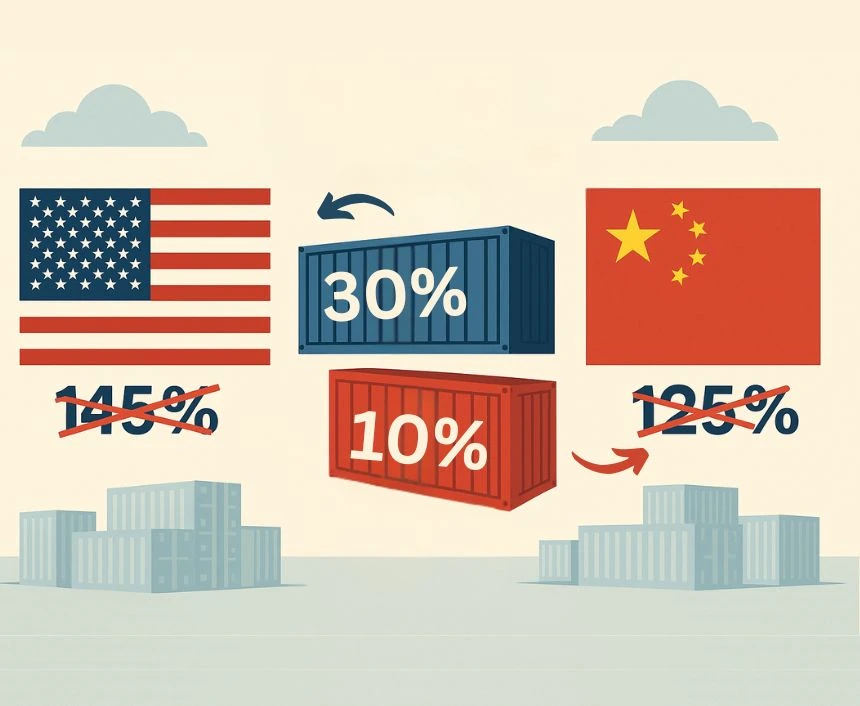
China–US Tariff Suspension 2025 marks a major truce in bilateral trade, and firms around the world should assess the strategic implications now that China has suspended retaliatory tariffs on U.S. goods and the U.S. has paused certain Section 301 actions.
What the suspension covers and why it matters
Under the agreement announced on November 1, 2025, China committed to suspend all retaliatory tariffs it put in place since March 4, 2025, across a broad range of U.S. imports including agricultural products, and the U.S. agreed to suspend certain actions under Section 301 for one year starting November 10, 2025. Produce Report
For example, Reuters reported that China “will suspend retaliatory tariffs on U.S. imports, including duties on farm goods”. Reuters
From an FDI and global business perspective, the China–US Tariff Suspension 2025 is meaningful because it reduces policy risk, supports trade normalization, and signals a more stable bilateral engagement.
Supply chains and sourcing strategies may evolve under the tariff truce
With tariffs relaxed, companies sourcing from China or selling into China have improved flexibility:
- Reduced duty burdens mean lower landed costs for U.S. imports of Chinese outputs and for Chinese importers buying U.S.-origin goods.
- The tariff suspension gives firms breathing room to reassess dual-sourcing strategies and near-shoring vs China-focusing decisions.
- For global manufacturers and their suppliers, the lowered trade friction may lead to reshoring pauses and renewed China-based production/investment.
- Operators should update their risk models: the China–US Tariff Suspension 2025 lowers the chance of sudden tariff hikes, but does not eliminate them—so contingency sourcing remains wise.
Foreign direct investment (FDI) opportunities unlocked
Trade liberalization tends to correlate with FDI acceleration. Key implications:
- Chinese investors may feel more confident investing in U.S. operations, joint ventures or supply-chain hubs with reduced trade retaliation risk.
- U.S. and global companies may revive planned expansions of wholly foreign-owned enterprises (WFOEs) or Chinese joint ventures, leveraging the improved trade climate.
- The tariff truce may encourage cross-border mergers & acquisitions in sectors impacted by tariffs (agro-food, logistics, manufacturing).
- The internal link: for companies exploring how to structure their China entity post-tariff relief, see the firm’s China market-entry services at FDI China.
Impact on U.S. agricultural and Chinese import markets
One of the most immediate and visible benefits of the China–US Tariff Suspension 2025 concerns agriculture:
According to White House documentation, China agreed to suspend all retaliatory tariffs on U.S. farm goods such as chicken, wheat, corn, cotton, sorghum, soybeans, pork, beef, aquatic products, fruits, vegetables and dairy. The White House
For U.S. farmers and exporters, this means large Chinese demand may resume, improving export volumes and farm income.
For Chinese importers, the tariff relief means lower input costs for food and agricultural imports, supporting consumer prices and supply diversity.
Global supply-chain players (shipping, logistics, ports) supporting agro-trade stand to benefit from increased flows.
Benefits for exporters, importers and third-country firms
The China–US Tariff Suspension 2025 also creates opportunities beyond the bilateral players:
- U.S. exporters to China benefit from better market access and fewer retaliatory barriers.
- Chinese firms importing from the U.S. or sourcing U.S.-origin goods gain cost relief and margin improvement.
- Third-country firms can use the improved U.S.–China trade climate as a platform for triangular trade—for example supplying Chinese partners who previously faced import tariffs.
Next steps for business strategy in light of the tariff relief
Businesses seeking to capitalise on the China–US Tariff Suspension 2025 should take proactive steps:
- Re-run cost models: recompute landed cost under new duty regime for each China-U.S. trade lane.
- Re-evaluate market entry timing: companies whose China investment was delayed by tariff risk may now accelerate.
- Reconnect buyer-seller networks: leverage the improved trade environment to revive paused sourcing or export arrangements.
- Update content around FDI & trade: include keywords like “China US tariff suspension 2025 effects on supply chains” in your blog posts and white papers.
- Monitor policy updates: though tariffs are suspended, monitor any re-imposition triggers or extension negotiations.
Turning Tariff Relief into Market Opportunity with FDI China
The China–US Tariff Suspension 2025 has not only paused years of escalating trade tensions but also reignited investor confidence in the world’s two largest economies. As tariff barriers ease, foreign companies now face a renewed window to expand their presence in China—through direct investment, strategic partnerships, or optimized supply-chain setups.
That’s where FDI China comes in. Our on-the-ground experts help international businesses translate policy shifts like the tariff suspension into concrete action plans—covering company registration, tax compliance, employment outsourcing, and market-entry strategy. Whether your goal is to establish a Wholly Foreign-Owned Enterprise (WFOE), manage cross-border payroll, or navigate post-tariff regulatory updates, FDI China provides an end-to-end solution.
By aligning your business structure with the trade reforms emerging from the China–US Tariff Suspension 2025, you can reduce entry risks, unlock tariff-free trade routes, and position your organization at the heart of China’s recovering import and manufacturing ecosystem.
👉 Explore tailored expansion strategies at FDI China and turn today’s policy breakthrough into tomorrow’s growth opportunity.
Conclusion
The China–US Tariff Suspension 2025 is more than a temporary headline—it’s a strategic pivot that offers global companies, investors and supply-chain managers an opening to reset China-U.S. trade and investment strategies. While the suspension brings opportunity, success depends on careful follow-through, updated modelling and proactive risk management.